Episode Transcript
[00:00:00] Speaker A: So in my conversation with Tom, he spoke about the customer experience, which you just talked about at Budzuto. He was very animated about the customer base and what the preferences are. He spoke about sanctuary for your residents. Were you involved in developing this philosophy?
[00:00:17] Speaker B: Yeah, and I think, you know, I think we always felt that way. Tom always believed that customer was right. He always came at it from a customer perspective. And he and I were very in sync on that because I had.
I had been on the front line, so I had just worked with a lot of people who were.
Who were in need of housing. And so I felt like I had a firsthand perspective of where renters are when they're coming in. I mean, you sort of think about it.
You know, a housing move is always precipitated by some life change. You know, either someone's, you know, someone's divorced, or you've had a relationship that has ended, or you have a job that's starting or coming in from out of town. Yeah, you're coming in from out of town, or, you know, there's something going on. And, you know, there's always a lot of stress associated with change. And so I always felt like if you could diffuse that, you know, and try and make and turn this negative experience into something really positive and to try and find, like, some way to sort of create some, you know, some connection with a customer, that it could be a really fun experience.
And I loved leasing for that reason, because it was challenging and just really enjoyable. You meet so many people and you learn a lot about them. And so Tom and I really believed that our job was to make this, you know, to make people customers for life or friends for life, and to try and treat them, you know, to give them the best possible experience that we could.
[00:01:55] Speaker A: So let's talk about origins of all this thought process.
[00:01:58] Speaker C: Sure.
[00:01:58] Speaker A: My sense is, and of course, interviewed both your dad and Julie.
[00:02:04] Speaker C: Julie Smith.
[00:02:05] Speaker A: Yeah, Julie Smith and I met Julie. Father brought her into our office when I was a mortgage banker. And this was right in the early 1990s, right after the crash.
[00:02:17] Speaker C: Yes, yes.
[00:02:19] Speaker A: And that was the growth of your company's property management business. And so you basically took institutional investors that owned a lot of property that they took back, not by their choice.
[00:02:29] Speaker C: Right.
[00:02:29] Speaker A: Unintended to manage.
[00:02:31] Speaker C: Right.
[00:02:34] Speaker A: You had done a good job on a few of them. The rumor got out, oh, Bozzuto's great at managing properties, and suddenly it just exploded.
[00:02:43] Speaker C: It did.
[00:02:44] Speaker A: But Julie brought not just quality service, but she has a sense about interacting with people. I think that I don't know. Many other people have.
[00:02:57] Speaker C: Yes, I think you're right.
[00:02:58] Speaker A: An extraordinary person in that regard.
[00:03:00] Speaker C: Absolutely.
And continues to be that person. She is now our. She no longer runs our management company. Stephanie Williams, she's our CAO and runs the cultural components, for lack of a better word or job. Far more sophisticated than I'm giving it credit. But technology, marketing, communications, all these things that. All these essentially support groups that make up our culture.
She introduced our employee resource groups, which were now very prolific in our employee resource groups. And we'll talk a little bit about our culture. But getting back to your point, she recognized, and my father also, this idea of being humble, a humble sort of servant. I like the servant leadership idea. I read the other day they said leadership is not a stagnant position, it's a service journey. Constant service journey. Wow. What a cool way to describe it. Although I know some leaders that wouldn't describe it that way.
And I think if I've always thought of our management company, and I wasn't here when they started the management business, but what I learned from watching them was by treating people better than maybe they had expected, we were giving them this value, giving them this dignity.
And my father coined this expression. So we. We create sanctuary.
So instead of just saying we build apartments, which would be a terrible tagline, it was this notion that, sure, shelter is the vehicle by which this is accomplished, but in reality, it's how are people treated?
Sanctuary has this resident quality of safety, home kindness, respect, dignity, inclusion.
[00:04:45] Speaker A: It's almost a religious.
[00:04:47] Speaker C: It has. It does have that quality to it, doesn't it? And there's sort of a sanctity, right. There's this.
So I love this idea. If we can create a place where people feel at home.
[00:05:01] Speaker A: Welcome to another episode of icons at B.C. area real estate.
I'm your host, John Koh.
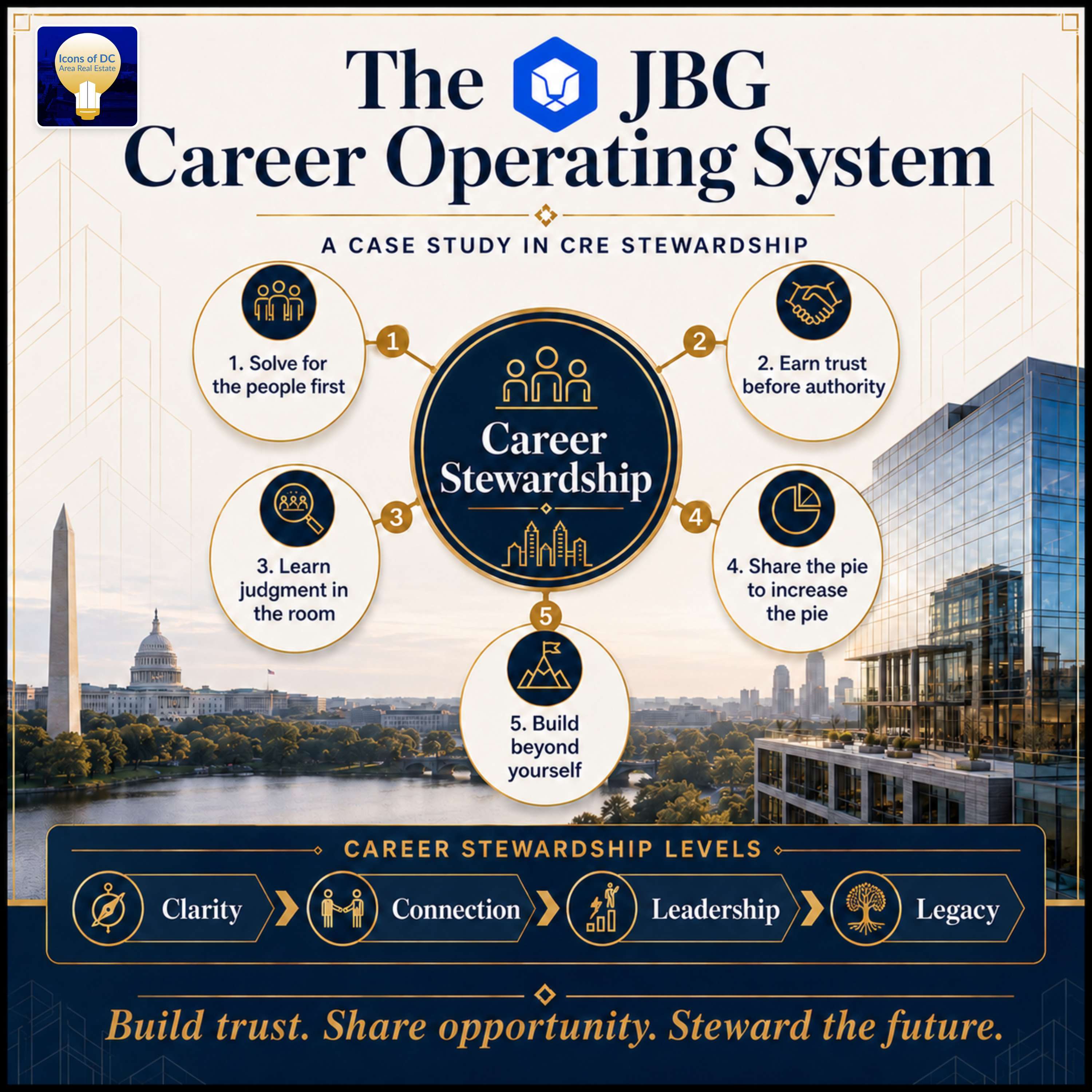
In the previous episode, we examined what I called the JBG Career Operating System.
Through the voices of several generations of JBG leaders, we explored how a strong professional culture develops judgment by giving people responsibility, exposing them to consequential decisions, and allowing them to disagree, and teaching them that trust must be earned before authority is granted.
That episode asked a fundamental career question.
What kind of professional is your environment forming you to become?
Today, we will move one step further because culture does not remain inside conference rooms, investment committees, or corporate value statements.
Eventually, culture becomes something other people experience.
It becomes the way a resident is treated when a pipe breaks.
It becomes the way an employee is supported during a crisis.
It becomes the standard A company protects when an attractive business opportunity conflicts with its values.
It becomes the degree of care someone feels when entering a building.
And ultimately, it becomes what the next generation inherits.
Today, we are opening the archives of three earlier conversations with Tom Buszutto, Toby Buzzuto, and Julie Smith to examine a broader question.
Can a real estate company create sanctuary not only through the homes it builds, but through the culture it sustains?
Most of us in commercial real estate have been trained to think in terms of land, capital, design, execution, leasing, and returns.
Those disciplines matter.
Without them, nothing gets built. But an apartment is not merely a unit in a financial model.
It is where someone awakens in the morning. It is where a family gathers. It is where a person returns after a difficult day. It may be the first place someone lives after leaving home, beginning a marriage, accepting a new job, losing a spouse, or rebuilding a life.
Real estate has a human consequence, and stewardship begins when we recognize that consequence.
The Basuto story offers a particularly useful case study because three people represent three different dimensions of its evolution.
Tom Buzzuto established the values.
Julie Smith translated those values into the daily discipline of property management and customer care.
Toby Buzzuto inherited the responsibility of protecting the culture while adapting it for another generation.
Their stories reveal four dimensions of the crew clarity, connection, leadership, and legacy.
But rather than impose those four pillars upon the company from the beginning, I want us to listen for how they emerge.
Sanctuary begins as an intention.
It becomes credible through behavior.
It is tested by sacrifice.
And it endures only when others are prepared to carry it forward.
Act one Sanctuary begins with clarity.
Every durable culture begins by answering a small number of difficult questions.
What do we believe?
What kind of work are we trying to do?
How will we treat people?
What will we refuse to compromise, even when compromise is profitable or convenient?
These questions come from the first pillar of career stewardship, Clarity.
Clarity is sometimes mistaken for certainty.
It is not certainty. Real estate is too cyclical, too local, and too dependent on human behavior for certainty.
Clarity means knowing the principles from which you will make decisions when the outcome is uncertain.
When Tom Buzzuto and his partners formed the Basuto group in 1988, they were not beginning with unlimited capital or a nationally established platform.
They were establishing a company during a period of major disruption in the real estate industry.
They had projects, relationships, experience, and a willingness to accept risk.
But they also made an early decision that the company would be organized around a specific culture.
The values were not complicated.
Concern, creativity, passion, perfection.
Concern for colleagues, clients, residents and partners.
Creativity as an invitation to bring forward and share ideas.
Passion as the desire to participate fully in the work and perfection, not as an assertion that human beings can produce flawless results, but as a refusal to treat quality as incidental.
Let's return to Tom's explanation.
[00:10:56] Speaker D: We don't think of it as shelter. We don't think of it as housing. In our company, we talk about building sanctuary because we try to integrate our development and management activities in such a way as to make the living experience of the resident as sanctuary like. Like as possible.
[00:11:16] Speaker A: So let's shift away from the market and talk a little bit about your company with regard to interface with employees
[00:11:23] Speaker D: and your culture a little bit.
[00:11:27] Speaker A: So when you interview people for the company, what characteristics do you look for
[00:11:32] Speaker D: from young professionals that you're interviewing?
I once answered this years and years ago.
We've used this answer as I was asked this question conference once, and I answered it. And the answer has since become our guiding mantra.
It's a lot easier to hire a nice person and teach them skills than it is to hire a skilled person and try and teach them to be nice.
So the first characteristic we look for is culture. And we've had some real rock stars in the company whose culture was not compatible with ours, who we have escorted out of the company.
And you need to be prepared to do that if you're running a business years ago.
I'm talking about when we first started the company.
We spent a lot of time. I spent a lot of time thinking about how we were going to differentiate our company from other people. There are a lot of good competitors in this market. And we decided that the best way to do it was with culture and to build a company that had a truly unique culture.
And just the fact that we were focusing only primarily on culture, I think, made us a little different.
We took the whole company at that time, many of us, 30 people, 35 people away, spent a couple of days talking about what are our values? What are our values? And ultimately had reached no conclusion at all.
So John Slidell and I came back to my office and sat down that afternoon, and we came up with the values that we thought describe the company. We have built an entire culture around those values. We have hired people who demonstrate those values. We have trained people based around those values. And they're really simple and they're one word. Values is concerned creativity, passion and perfection. People are always feeling the need to elaborate on what they mean, starting with me. But the values we have are four values. Concern, creativity, passion, perfection. We say concern, we mean concern for each other.
First, concern for the communities we were building concern for the people we're working with. Concern ultimately, most importantly for our clients and customers.
Creativity. I always say to people, we're not, you know, you may be good looking, but we're not hiring you for your body, we're hiring you for your mind. So bring your ideas. Even if you're stealing them from your last employer, bring your ideas. Tell us to tell them to us.
Passion. We always say, if you're not feeling like you're really looking forward to coming to work here, go do something else, please, for your own sake and for ours. And perfection.
You know, we all recognize that it may not be achievable, but we also recognize that Leonardo da Vinci, Michelangelo, you know, I can go through the list, were human beings who came pretty close to achieving perfection. And there's no reason we can't strive for the same thing. So those are our values and that's what we've built the company around.
[00:14:44] Speaker A: That's inspiring, Tom.
[00:14:46] Speaker D: Very inspiring.
[00:14:47] Speaker A: There is an important distinction in Tom's comment about hiring.
He is not suggesting that competence is unimportant.
A company entrusted with people's homes, investors, capital and the physical safety of buildings must be technically capable.
The point is that skills can often be developed.
Character is harder to retrofit.
A technically accomplished person who consistently undermines trust can impose an enormous cost on an organization.
The cost may not initially appear in a development budget or operating statement.
It appears as a with as withheld information, avoided conversations Employees who stop contributing ideas, partners who become guarded residents who feel that no one is listening.
Eventually those cultural costs become business costs.
That is why clarity is invisible infrastructure.
Before an organization can create sanctuary for a resident, it must establish a degree of psychological sanctuary within its own walls. A place where people understand what behavior is expected and what conduct will not be rewarded.
Tom once made the broader observation that culture matters more than strategy, tactics or even capital.
That can sound overstated in a capital intensive business.
But consider the deeper point.
Capital does not deploy itself.
Strategies do not execute themselves.
Plans are carried out by people and the quality of the relationships determines how honestly problems are surfaced not or how effectively expertise is combined and whether the organization can respond when the original plan stops working.
Clarity does not eliminate difficult decisions. It gives people a consistent place from which to make them.
For an individual professional, the corresponding questions what values are actually governing my career?
Not the values I would list in a biography.
The values revealed by my calendar, my decisions and my treatment of other people.
What will I protect when I'm under pressure?
What kind of conduct? Am I unwilling to normalize merely because someone is productive, powerful, or profitable?
And when the path becomes uncertain, what principles will keep me oriented?
That is the beginning of stewardship, not achievement orientation.
Act 2 connection when culture reaches the resident, values become meaningful only when another person can experience them.
This brings us to the second pillar. Connection.
Connection is not simply networking.
It is not the number of contacts stored in a telephone or the number of people who recognize us at an industry event.
Connection is the capability or the capacity to understand another person's circumstances and respond in a way that builds trust.
Few positions in real estate expose this more clearly than property management.
Development operates over years.
Investing often operates over market cycles.
Property management operates every day.
A resident does not experience a company through its strategic plan.
The resident experiences a company through the person who answers the telephone, maintains the building, explains a charge, handles a complaint, or responds when something fails.
Julie smith spent approximately 25 years leading Busuto's property management business before becoming chief administrative officer.
She describes herself during the company's early years as a kind of table setter, helping establish the operating systems and service expectations that made the broader enterprise possible.
Her explanation of sanctuary begins not with design or amenities, but with vulnerability.
[00:19:37] Speaker B: The company sort of, it's been so long now that it just feels like it's bread and the bone, to be honest with you. But this relentless focus on the customer.
And Tom always said, I'll never forget this. And I remind the younger people coming into the company of this all the time that the best customer you'll ever have is the one you already have.
And so you've got to retain people because they will be advocates for life. And I can't tell you how often I run into people who say, oh, I love the suit. I lived in one of your buildings for three years, years, and I hated to leave. Or I'm such a. I'm, you know, I'm a flag waiver, Basuto. And it's because of the experience that they've had with our people. And so, you know, our core values care and concern. Like really caring about people being creative in trying to create, you know, solve. Solve problems, but also to create fun in buildings. Passion, like really caring about what you do. Like when people are passionate about their work, it really shows.
And perfection. You have to be a perfectionist in this business. This is the Martha Stewart piece of it.
But presentation is everything. And we always believe that we're inviting people into our home and we want that to look as good as it possibly can look. So really very basic Core driving values that I think have now.
The teams just take it to whole new heights.
[00:21:09] Speaker A: Tom actually said that he and Rick and John spent a long weekend, apparently in a retreat, to come up with those core values, which was. He said, they carry them to today. And this was back in the early 90s when you came up with them.
[00:21:23] Speaker B: It was.
[00:21:23] Speaker D: And
[00:21:26] Speaker B: they're still so good.
[00:21:28] Speaker A: Housing transitions expose people.
Even a positive move can be disruptive.
There are deposits, applications, deliveries, schedules, family needs, employment demands, uncertainty, and the basic disorientation of placing one's life in a new environment.
The property manager sees parts of a resident's life that an investor or a developer may never see.
Julie's insight is that service begins by acknowledging that vulnerability.
This is where the word sanctuary becomes more than a marketing expression.
Sanctuary is not necessarily quiet music, attractive furniture, or an impressive lobby.
Those things may contribute to an experience.
But sanctuary is fundamentally the sense that someone has anticipated your humanity, that you will be treated with dignity, that the person across a desk understands that the issue disrupting your afternoon may be affecting your family, your work, or your basic sense of security.
That does not mean every request can be granted. It does not eliminate leases, policies, costs, or accountability.
Stewardship is not the abandonment of standards.
It is the application of standards without forgetting the person affected by them.
Julie also makes a commercially important point.
The best customer is often the customer you already have.
That principle joins humanity and economics. Trust is not separate from a business performance.
Trust affects retention, referrals, reputation, employee satisfaction, and the willingness of partners to assign additional work.
Julie describes the company's geographic growth as a consequence of following existing clients into new markets.
Good work created more work.
Connection compounded.
But connection is most visible when ordinary systems are under extraordinary pressure.
The COVID 19 pandemic converted apartment communities into homes, offices, schools, gyms, care environments and places of isolation. Almost overnight on site, employees were placed in unusually difficult position.
They were expected to continue maintaining buildings while protecting themselves, supporting their families, responding to anxious residents, and navigating rapidly changing health and operating procedures.
Julie describes how Busuto's teams responded. How do you teach your managers how to manage these highs and lows during the day and keep that right attitude to do it?
[00:24:37] Speaker B: Yeah, I mean, I think it's just. It's all in a day's work, to be honest with you. I mean, like. Like I said, fortunately, people don't call and scream at us unless something has really gone wrong. And so there are ways for people. If people have an issue with their apartment, you can just go ahead and Submit a work order online, and that goes directly to the service manager, and you can rate your service manager today. And so we try and develop really strong relationships with our residents. And so when something goes wrong, which inevitably will, and we tell them that at some point, you're going to need us to come fix something for you, and we'll do it within 24 hours, and we'll get it done as quickly as we can. So it's having a really strong maintenance team, but that typically doesn't happen concurrently. So, you know, if someone is taking a potential customer to live in the building, they get 110% of that person's attention. And then there's always someone in the office who can deal with other things. But it's a juggling act, for sure.
And people that love the business love it because it's a juggling act.
And people who don't like the business don't like it because it's a juggling act.
[00:25:47] Speaker A: Every day is different.
[00:25:48] Speaker B: Every day is different. The day flies by. You spend a lot of time talking to people. It's a job for extroverts. Absolutely. And, yeah, and there are times when things go really wrong, and that's no fun. And. Or, you know, we have floods and we have fires and we have weather events, and we have, you know, all kinds of things.
Power outages. Yeah. But that's where our team tends to really shine, because they will.
They'll move mountains to try and create a good experience out of a bad, you know, a bad situation. And Covid was no different. You know, we had to put a lot of restrictions in place in our buildings to keep our residents safe. And it was hard fighting with residents to get them to wear masks initially and to, you know, and to try and sort of adapt to a new normal. But they, you know, they made the best of it. We've had residents say to us, you were the best thing that happened to me during COVID because, you know, they were isolated. They couldn't go see their families. They were stuck in their apartments working, you know, and the teams were, you know, doing backflips to try and come up with fun new things that they can keep.
Yeah. How to keep the residents engaged, Just checking in on them, see how they're doing. And that went a long way.
[00:27:06] Speaker A: Resident said, wow, that is a demanding standard.
Not because every resident will be pleased, not because every operating problem will have an ideal resolution, but.
But because the organization's character becomes visible when the established process is no longer sufficient.
Connection asks, can we Remain present when another person is distressed?
Can we listen without immediately becoming defensive?
Can we distinguish between a contractual issue and a human situation surrounding it?
Can we preserve dignity while still exercising judgment?
These questions apply well upon property management.
They apply to lenders dealing with borrowers during a troubled project. They apply to partners disagreeing over a capital call. They apply to managers delivering difficult feedback. They apply to senior professionals deciding whether to take time to develop someone who is still learning. They apply to someone whose decisions affect other person's livelihood, reputation, home, or future.
Connection is not sentimentality.
It is disciplined attention to human consequence.
And it is one of the places where stewardship becomes visible.
Act 3 making sanctuary tangible Sanctuary is partly relational, but real estate also gives us the unusual opportunity to make values physical.
A building can communicate welcome or indifference.
It can encourage people to gather or isolate them.
It can reduce friction or create, can acknowledge the patterns of ordinary life or force residents to work around poor decisions. For years, Toby Basuto brought an artistic sensibility to his part of the business.
Before entering real estate, he studied music and briefly considered a career in the music industry.
When he later became a developer, he began thinking about apartment environments through analogies drawn from hospitality, restaurants, theater, art and performance.
His question was not only what should this building contain, it was how should it feel to enter it?
I walk into a Puzzuto building, the smell hits me right up front. And you have a unique scent.
[00:29:53] Speaker C: Yes, a positive one.
[00:29:56] Speaker D: I hope I.
[00:29:57] Speaker C: Unique? You meant a good one.
[00:29:59] Speaker A: Unique.
Yeah.
[00:30:00] Speaker C: So we, we have paid for a proprietary scent and it is infused, for lack of a better word, in all of our buildings. And it's really interesting because my 17 year old daughter is with me today and doing a little quick internship with us and I took her into a building. We built a project called the Aster in College park, and the first thing she said when we opened the door was, wow, this reminds me. The smell of. This reminds me of your other buildings. And she's 17, so I can assure you she's not paying a heck of a lot of attention to what we do or don't do. Yet she knew immediately and that was the first second the door opened and I didn't say anything. What she may not have recognized, but I think she did subconsciously, was that I had the right kind of music playing. And then we walked around and the building was perfectly clean. Then she said, I like all the art in here.
[00:31:01] Speaker D: Okay?
[00:31:02] Speaker C: Remember, she's 17, so this is. The things she's perceiving are real big deals because to get through the filter of a teenage brain. Must be something pretty interesting.
And what I said was, what did you know? That we handpicked every piece of art in this building. We worked with an art consultant and we worked. These all have meaning and these all have purpose.
[00:31:22] Speaker B: And.
[00:31:23] Speaker C: And it's these little things that add up. By the way, when you walk in the aster, there's a bridge that connects the two buildings, a skywalk, let's call it that. And then underneath of the skywalk would have just been concrete. And I drove by a mural one day on a building in Baltimore, and I called the artist and I said, could you paint the underside of the walkway?
So now, what could have been a very pedestrian, no pun intended experience, a very utilitarian experience, is now this piece of art. And that's what you see before you walk in the front door. Then you smell the building, then you hear the music, and you see the art. And you can see how excited I'm getting.
It's the totality of the experience.
Therefore, service, the way you treat your customers, or in our case, our residents, becomes the real game.
And I think those institutions and private developers that make management decisions based purely on cheapest provider are making a massive error.
[00:32:33] Speaker A: Those details can easily be dismissed as decoration.
They can also be reduced to a commercial strategy.
Spend more on amenities and design in order to charge higher rents.
That economic relationship exists, and Toby discusses it candidly.
But the stewardship question is deeper.
What experience are we intentionally creating for the person who will live here?
The difference between ornament and stewardship is whether the design begins with the customer's life.
Does the environment help someone feel oriented?
Does it encourage healthy social interaction?
Does it provide places to retreat and places to connect?
Does it communicate that someone paid attention?
The best design often becomes nearly invisible.
A convenient place to set down groceries, lighting that allows someone to feel secure. A lobby that is gracious without being intimidating.
A staff area that treats employees with the same respect shown to residents.
A common space that people actually use, rather than one designed mainly for a marketing photograph.
Toby describes the environment in theatrical terms.
But a successful stage is not merely visually impressive.
It supports the people occupying it.
The physical and relational dimensions of sanctuary must reinforce one another. A beautifully designed building with indifferent service is not sanctuary.
Warm service in an environment that repeatedly frustrates residents is incomplete.
The design makes a promise.
The operating culture either fulfills or violates it.
Immediately after discussing the physical experience, Toby turns toward leadership and culture.
[00:34:47] Speaker C: Leadership is not a stagnant position. It's a staggering service. Journey, constant service journey. Wow, what a cool way to describe it. Although I know some leaders that wouldn't describe it that way.
And I think if I've always thought of our management company, and I wasn't here when they started the management business, but what I learned from watching them was by treating people better than maybe they had expected, you were giving them this value. You're giving them this dignity, this. And my father coined this expression. He said, we create sanctuary.
So instead of just saying we build apartments, which would be a terrible tagline, it was this notion that, sure, shelter is the vehicle by which this is accomplished, but in reality it's how are people treated? And sanctuary has this resident quality of safety, home, kindness, respect, dignity, inclusion. It's almost a religious feeling it has. It does have that quality to it, doesn't it? And there's sort of a sanctity right there's this.
So I love this idea if we can create a place where people feel at home and it doesn't sound like that brilliant of a concept, but so many of my competitors who are excellent in some ways, if not many, many ways, but some of them would focus more on the transactional quality of real estate. And they could be making widgets or auto parts just as well.
It happens to be apartment buildings or units. If you want to break it down even more granularly, we believe in something a little greater than that.
Again, their business model may be as good or better. I don't mean to say suggest anything negative about that. It's just a different way of viewing things
[00:36:40] Speaker A: that sequence matters.
Toby moves from art, scent, music, and physical experience to service.
The building may be the stage, but people create the experience.
Leadership, then, is not simply the authority to direct these people.
It is responsibility to create the conditions in which they can serve well.
Do employees have the information they need?
Are they trusted to solve problems? Are they treated with dignity by clients and managers?
Are expectations clear?
Does leadership remain close enough to the daily work to understand the pressures placed on frontline employees?
A company cannot sustainably offer sanctuary to customers while denying it to its own people.
Eventually, the contradiction becomes visible.
The fourth wall breaks. The resident feels the strain.
The employee leaves the service promise weakens.
Connection, therefore, has two outward toward the customer and inward toward the people responsible for serving that customer.
This is where connection begins to become leadership.
Act 4 leadership what are you willing to protect?
Leadership is often discussed as vision, charisma, decisiveness, or performance.
Those traits can matter, but stewardship offers a more demanding what are you willing to protect when Protecting it as a cost.
This is the third pillar. Leadership.
Values become real when they influence decisions involving revenue, growth, power or prestige.
It is easy to support a value when the value and the immediate financial incentive point in the same direction.
The test occurs when they diverge.
Toby describes the distinction between wanting to be the best and wanting to be the biggest.
He also discusses assignments the company declined because integrity concerns or because Mizuto employees were not being treated appropriately.
[00:39:13] Speaker C: So every time we grow, you can not only screw up whatever you're doing that's new, but you could screw up the corpus of what got you there, what got you this new thing.
So we have to ensure that everything we do. We saw this with Starbucks, they went crazy in growth and then had to retract essentially right size the business because they became too frayed at the edges. They weren't running the very thing that allowed them to grow. They compromised and I would argue, I'm not quite sure they got it back.
They shrunk, sort of did better. Certainly in the stock price they did better. But I'm not sure the experience today in the store is the same as it used to be.
Anyway, we want to avoid that. So learning, leadership training, all of these things are critical to ensure that someone is operating at the level we of
[00:40:07] Speaker A: our in property management. Do you ever get called to manage a project or compete for something that all of a sudden wait a minute, you don't want to manage this? Do you ever turn down invitations to manage property?
[00:40:20] Speaker C: Yes, and I don't mean that in an arrogant way because we all have to eat, we all have to survive and so you take you. But I would rather when you take a property management assignment for an owner that well, certainly I will tell you a non starter is someone whose ethics aren't aligned with ours.
[00:40:39] Speaker A: Of course.
[00:40:40] Speaker C: So we're at it if there's even a sniff of it.
But then it gets into a gray area.
If an owner treats my on site staff poorly, maybe they're a successful owner. I don't really care if they're treating our staff poorly or God forbid with some sort of discriminatory or gender issue or anything that was just anathema to my way, our way of thinking and hopefully everyone's way of thinking, we're out.
Flat out, I'm out. I will quit on the spot and candidly we've done that's happened before without naming names. The beauty of not wanting to be the biggest is that I don't in theory have to take an opportunity with someone who would compromise any of our values.
[00:41:30] Speaker A: This is where leadership becomes more than language.
Declining revenue does not automatically make a company virtuous.
Every decision has facts, trade offs and consequences.
But a willingness to walk away demonstrates that the stated culture has boundaries.
Without boundaries, values become preferences.
They are followed by when convenient and suspended when sufficiently important person or sufficiently large opportunity appears.
Employees notice those exceptions.
One compromise decision can teach more about the real culture than a year of presentations.
If a client mistreats employees and leadership repeatedly accepts it because the assignment is profitable, the message is clear.
Revenue outranks respect.
If a high performer is permitted to undermine colleagues because the person produces results, the message is equally clear. Performance outranks character.
Leadership is a discipline of understanding that what we tolerate instructs the organization.
Stewardship does not require perfection.
It does require honesty.
There will be compromises. There will be situations in which two legitimate values conflict.
There will be decisions that appear correct at the time and prove wrong later.
The standard is not moral infallibility.
It is the willingness to examine the true cost of the decision, including costs that do not immediately appear on the financial statement.
The Basuto discussion also raises a necessarily complication.
The word sanctuary can easily become associated only with high end housing, with hotel like amenities, curated art, and residents who can pay for premium service.
But sanctuary cannot be credible as a stewardship principle if dignity is reserved only for people who can afford luxury.
Toby discusses Busuto's affordable housing partnerships and the expectation that residents across different types of communities should receive the same fundamental level of respect.
[00:44:08] Speaker C: Where we're partnered as the developer, we'll put some skin in the game of our own equity, our expertise, our time, our reputation.
But we'll work with a nonprofit whose mission is fabulous and dedicated to whether it's 80% of AMI, 60%, 50%, 40, whatever the heck it is, and provide those people with the very highest level level of housing at their income level that they could conceivably get.
The idea being that we have created something special for a different income class with great pride and we just finished oh EYA was our partner.
We just built a project called the Laureate at Shady Grove Metro. HOC is the majority owner. UIA and Busuto are the co let's call it code GP for lack of a better word.
And I'm forgetting the exact percentage John, but call it 30% or 30 some odd percent is affordable housing in an absolutely stunning normal quote unquote luxury building.
And I had the opportunity to attend the grand opening the other night and was able to speak to some of the residents who are there under the. In the affordable units. And they described their experience as game changing, life changing. One of them was a mom with a baby.
And I called my dad that night on the way home and I said, how lucky are we that we could provide that type of housing in this case with our partners for these fabulous people who are otherwise, they just don't have the same income as we do.
[00:45:52] Speaker A: So another example, I toured with Justin Canal.
[00:45:57] Speaker C: Yes.
[00:45:58] Speaker A: Recently. That he's working on in Chevy Chase, Maryland.
[00:46:01] Speaker C: Yes.
[00:46:02] Speaker A: And so you delivered. I mean, the first delivery there was an HOC project, if I'm not mistaken.
[00:46:08] Speaker C: Yes. We manage. We're a fee manager for HOC in a building on the periphery of our Chevy Chase.
[00:46:14] Speaker D: Lee.
[00:46:15] Speaker A: And at the other extreme, you have delivered a Ritz Carlton condominium project which is probably the highest level project you've ever developed.
[00:46:24] Speaker C: It is, if I'm not mistaken. Yeah, I think that's a fair.
[00:46:26] Speaker A: So you have, you know, what's the common thread?
[00:46:31] Speaker C: The common thread is walk in the building that we manage for HOC and see how you're treated and walk in the Ritz Carlton and see how you're treated. And I'm going to guess it's pretty damn close. If not, it should be the same. There should be no difference.
I genuinely hope there is Zero, zero difference.
[00:46:52] Speaker A: This is a critical distinction.
Equal dignity does not mean that every building has the same finishes, services, capital structure or amenities.
It means that residents worth is not determined by the rent.
Hospitality is not flattery directed toward the affluent.
It is the practice of recognizing the person in front of us.
In the context of career stewardship. Leadership therefore asks what happens to people around me when pressure increases? Do I pass the pressure downward?
Do I protect only those who are useful to me?
Do I preserve standards when no one senior is watching?
Am I willing to advocate for a colleague when doing so may be inconvenient?
I can make a difficult economic decision without becoming indifferent to human consequence.
And have I defined what I will walk away from?
A career does not become a stewardship career because it reaches a senior title.
It becomes one when responsibility expands beyond personal success.
Leadership begins when we recognize that our decisions are forming the environment in which other people must work and live.
Act4legacy preparing someone else to carry the standard.
An organization can have clear values. It can form strong relationships, it can be led with integrity. And it can still lose its culture in a single generation.
That brings us to the fourth pillar, legacy.
Legacy is often discussed as something a leader leaves behind.
Buildings, transactions, wealth, awards.
A company bearing the founder's name.
But the more useful stewardship question is, what do other people become capable of because you were there?
A culture is not truly inherited through slogans.
It is inherited through apprenticeship, example, responsibility, correction, trust, and eventually the willingness of a leader to step aside.
Julie Smith's career offers a powerful example.
After leading the property management business for decades, she identified and developed Stephanie Williams as a potential successor.
This was not a quick transfer. Julie describes years of working together, traveling together, pursuing business, and preparing Stephanie for the complexity of leading a large organization.
[00:49:53] Speaker B: We were going to be looking at ruins for a while and doing a whole lot of development. And I really like Stephanie. I'd worked with her on a couple of deals that she had been developing for Busuto. And so we just got together one day and I said, you know, Steph, you're not going to have a lot to do over the next couple of years. And I think it would be a great opportunity for you to broaden your base and learn some new skills. And I really could use somebody to help me and the management company and our advisory services role, which really required some development expertise because we had a big pipeline of assets that were in development, in construction or in construction that were going to happen, that were already financed before the gfc. So she, she joined that group and ran that group and then was running business, business development. So all of the new business development was going through her. And you know, she's very skilled developer and so she was actually able to shepherd a lot of these projects that we were helping developers get off the ground. And, and it was a sizable portfolio. So it was several years worth of work.
And so that was her sort of her foray into the management business.
And she got really good at it really fast and learned a lot. And Stephanie had spent of time, a lot, lot of time on airplanes and trains together, which gave us hour to just talk about the business and to talk about strategy and for me to teach her more about what I knew about the business. And you know, and then one day, you know, I asked her if she would be interested in taking over at some point, because I said, I'm starting to think that I, you know, I can't do this forever because it's not fair. It's not fair to the company. So I'm really sort of thinking about who, who was going to come in behind me. And she was very, very interested. So that was really the start.
[00:51:41] Speaker A: It's interesting that somebody that came up in development would want to go into the property management side of the business.
But obviously you inspired her well and
[00:51:51] Speaker B: I think the way she came in was really enjoyable.
So she came in on the sort of business development side and she was doing something that she knew and we had. We had just an incredible portfolio of assets that we're going to be opening up. So it is really fun working on these buildings. They're big and they're beautiful and it's fun working with all the consultants and it's really fun coming up with sort of the master plan and working on all the branding issues. So I know she was very good at that and enjoyed it.
[00:52:21] Speaker A: There is humility in that decision.
A leader who has built an operation can begin to believe that the operation is itself separable from the leader.
Experience reinforces that belief. The leader remembers the crises, relationships, sacrifices and decisions that shape the business.
Others may also reinforce it by continuing to bring every important question to the same person.
But stewardship eventually requires a change in posture.
From demonstrating one's own capability to developing capability in others, from being the answer to improving the quality of other people's questions, from retaining control to transferring judgment, from remaining essential to making oneself less essential.
That is not withdrawal. It is a different kind of contribution.
The JBG episode emphasized the importance of placing emerging professionals in rooms where consequential decisions are made.
Julie's story illustrates the same principle from another direction.
The successor was not prepared simply through instruction. She was prepared through proximity, repeated exposure, shared work and gradually expanded responsibility.
Legacy is built before the retirement announcement. It is built while the organization is still operating and the teacher is still available.
Toby faced a different succession challenge.
He was not only becoming a leader, he was succeeding his father in a successful company carrying the family name.
That creates opportunity but also create scrutiny.
Toby describes the need to earn credibility, treat people consistently and avoid assuming that his position alone entitled him to trust.
[00:54:30] Speaker C: So the meeting that the course from our perspective was not about if he becomes CEO. What is the nature of this? It's how does a father and a son or any father and son, any family member work together without screwing it up or screwing up the livelihood of those employees who are non family members.
And now at this point, John is retired. Duncan has a great career at Lincoln and my dad and I are the sole owners of the company.
So if we had not been mindful of but I have fabulous partners like Julie Smith and Mike Schlegel and Dan Murphy who if we had not been mindful not only via that course, but other planning methods to have succession that would it was to your like the learners it was a long term.
We have not come up with a 200 year plan. I have enough problem making it to Friday. But we do have five year plans that we do and we do a three year plan all the time and we've become a big believer in this. So.
[00:55:34] Speaker A: Interesting. So did that help? You know, I mean when I think about somebody in your shoes, when you, and when you start with a company at whatever you're 25, 26, 28 years old, everyone looks at you, oh, okay, we know where he's going.
And then, but so it creates this kind of, it makes it tough. I would think, you know, they'll look at you, okay, you know, I gotta be, I gotta treat him differently than, you know, other colleagues. So how, how did you manage that? And did you get counseled at this program about how to deflect this? And I assume you used the word humility. You probably humbled yourself more than you may would ought to had if your father hadn't been running the company to some extent.
[00:56:22] Speaker C: Yeah, I think your last point. Point, I agree with, well, I agree with everything you just said. But when you are, when you, when nepotism sounds like a dirty word and maybe it could be, but what are you going to do with it? And if so a. I tried to come to the company with the same or better skill set that anyone would have at that age at that time. And that. And I started in the bottom position.
[00:56:51] Speaker A: That was your dad's idea.
[00:56:52] Speaker C: It's my dad's idea straight up and his partners.
And so when I arrived I felt confident enough to be a development associate, which is a junior position.
So but I lived in that position without any feeling that I could be better than that because I don't think I could have been. I had to learn. So you do it for a year, you do it for two and learn from great developers, then you become a developer, then you learn that for a couple years and you become a senior developer and so on.
And then to your point, if you know, people are looking at you and I would argue they're still looking every day and it does force you, I think if you're a good person, and hopefully I am, to have humility, to be kinder, to be more aware of the fact that people are going to make certain assumptions about you that I'm guessing aren't positive stereotypically so you have to disprove it immediately and constantly and never forget it.
So I would argue that I probably treat our make up a position, our service managers, which would have been called maintenance people as well as the, the highest priced CEO that I know when I'm with them. And it's not because that I'm trying to prove something. It's because I feel so fortunate to be in the role that I'm in and I don't think I'm better than those guys. Candidly, the work ethic and values of some of our hard working people are superior to that of many, many of us.
So it's having that humility and then it gives you a little fire in the belly, or at least it did for me.
And I don't that fire is like only on simmer at the moment, meaning it will keep going and going and going because I think you always want to show that you weren't given something.
[00:58:56] Speaker A: Succession is not accomplished simply because the next leader receives the title.
The formal authority may transfer in a day.
Legitimacy develops over time.
A successor must respect what came before without becoming trapped by it.
The founder must remain available without quietly reclaiming every difficult decision.
Long standing employees must learn to trust a new leadership style.
The successor must determine which principles are permanent and which practices belong to an earlier period.
This is particularly difficult in family businesses because professional roles and family relationships overlap.
Tom and Toby took the unusual step of attending an executive education program focused on families in business that that reflects an important stewardship principle.
Even experienced leaders may need help navigating a transition they have never experienced before.
Seeking guidance is not a sign that succession is failing. It may be evidence that the participants understand its importance.
Tom's own description of the transition is strikingly generous.
So, Tom, you transitioned to chairman a couple of years of the Buzzuto Group. How do you see your role today? And how does it feel to have your son succeeding you running the day to day business?
[01:00:32] Speaker D: John, thank you very much. It's wonderful of you to do this and I'm honored to have the opportunity to be talking with these young folks.
How does it feel? It feels wonderful. I have said numerous times that the only thing that can be more gratifying than having your successor be one of your family, one of your children, is to have that successor doing a better job than you ever hoped to do yourself. Toby's doing a great job and I'm very, very pleased and very proud of what the company has been able to accomplish in the past three to four years.
As to what I do, one thing I did was to get out of the of this office.
I felt if I kept coming in here every day, no one would believe that Toby was running the business. So I got another office. It's actually on the water in Baltimore.
[01:01:35] Speaker A: That is one of the clean, clearest statements of stewardship in these interviews.
The objective is not replication.
The objective is continuation and improvement.
A successor should not be required to become an imitation of the predecessor.
The deeper hope is that the values survive while the capabilities expand and that next generation sees possibilities the founder could not see and that it avoids some of the earlier mistakes.
That it responds to a changing world without losing the principles that gave the organization coherence.
Legacy is therefore not control from a distance.
It is confidence that the work can develop beyond you.
Tom also identifies the the formation of the company and the careers it created as one of his greatest successes.
So in looking back, you know, when you formed the company to now, what would you say is the biggest success
[01:02:46] Speaker D: in your experience forming this company? I mean, you know, it's interesting, as I said, very beginning of this, I'm a houser, you know, and my partners and I have built over 50,000 homes for people.
You know, as you sit there and look back, you say, my God, that's a lot to be grateful for.
We've been really blessed to be able to do that. But I think we've been equally blessed to have created a multi generational company, an evergreen company with thousands that has created jobs from careers for thousands of people.
So, you know, and we've financially done okay in the process.
[01:03:33] Speaker A: If your 25 year old self were sitting here, what would you tell him?
[01:03:36] Speaker D: Go for it, go for it, go for it.
[01:03:40] Speaker A: There is an important evolution in that story.
A young professional begins by trying to perform a job well. A leader eventually creates the conditions in which thousands of other people can perform meaningful work.
The scale changes, but the underlying responsibility remains recognizable.
Show up, learn, perform with care, build trust, accept greater responsibility, and then use that responsibility to expand the capacity of others.
That is the movement from career success to career stewardship.
Synthesis. The four pillars of Sanctuary Let us return to the four pillars of cre. Career Stewardship Advisory.
Not as labels based on the Basuto story, but as patterns revealed by it.
[01:04:37] Speaker C: Clarity.
[01:04:38] Speaker A: Tom and his partners identified the values that would orient the organization.
Consultants concern Creativity, Passion, Perfection.
Clarity gave people a shared reference point. It answered the question, what matters here for an individual, clarity means knowing your values, strengths, direction, and the standards by which you intend to make decisions.
Connection.
Julie transformed those values into daily behavior.
She understood that housing transitions make people vulnerable and that the resident experiences the company through thousands of small interactions.
Connection answers the question, how should people experience us for an individual, connection means developing relationships grounded in trust, attention, reciprocity, and service, not merely access.
Toby described leadership as humble service and offered examples of protecting employees and declining work that conflicted with the desired culture.
Leadership and answered the question, what are we prepared to protect?
For an individual, leadership means accepting responsibility for the environment one creates and acting consistently when values and incentives diverge.
Legacy Julie prepared a successor. Toby worked to earn his role rather than rely on inheritance. Tom Extract expressed the hope that his son would improve upon what he had built. Legacy answered the question, who will be more capable because we were here?
For an individual, legacy means transferring judgment, creating opportunity, developing others, and building something that continue without requiring permanent personal control.
Clarity establishes the intention.
Connection makes it human.
Leadership protects it.
Legacy allows it to endure.
Together, they form an architecture of stewardship.
The JBG and Vezuto stories are different.
JBG's culture was shaped around rigorous dialogue. Exposure to senior disposition, Decision making earned trust, investment, judgment, and the sharing of opportunity.
It showed us how an organization can form capable professionals. The Buzzuto story shows us what those formed professionals can create for other people.
At jbg, culture developed judgment and Busuto culture became an experience.
It became a sense of home.
A resident supported during a crisis, an employee protected from a damaging relationship. A successor prepared over years, A son encouraged to improve upon his father's work.
Together, the episodes suggest a larger progression.
First an environment forensics.
Then our decisions form the environment experienced by others.
Eventually, we become responsible for what the next generation will inherit.
That is the path from professional development to stewardship.
So I leave you with several questions.
What kind of sanctuary are you creating?
Not only through the buildings you finance, develop, construct, own, lease, or manage.
What kind of sanctuary are you creating for the people who work beside you?
Do people understand what you stand for? Do they feel heard when circumstances become difficult?
Do you protect them when doing so carries a cost?
Are you developing their ability to make decisions or merely keeping them from dependent upon yours? Do people do people simply perform around you? Or do they become more capable, more confident, and more grounded because of you?
And finally, what will they inherit from the culture you are helping to shape?
A set of transactions?
A list of procedures?
An organization dependent on a small number of personalities?
Or a living standard of judgment, service, dignity, and responsibility that others are prepared to carry forward?
These are the questions that led me to develop the CRE Career Stewardship Advisory.
In the next episode, I will bring together the lessons from the JBG and Hazuto stories and explain the advisory more fully. Why I believe it is needed.
Oh my.
It is designed to serve how clarity, connection, leadership and legacy relate to different stages of a commercial real estate career and how the professional can begin shifting from simply pursuing the next opportunity to intentionally designing a career of enduring contribution.
The objective is not to provide a formula for success.
Careers did not follow formulas.
The objective is to establish a disciplined process for asking better questions, strengthening relationships, improving judgment, and becoming more conscious of the impact our work has on other people.
The Basuto story reminds us that real estate stewardship is not abstract.
It is visible in how we build, how we serve, how we decide, how we lead, and how we prepare someone else to continue the work.
I'm John Ko.
Thank you for joining me for this special edition of Icons of Easier Real Estate.
Until next time, consider this what kind of sanctuary will exist because you were there?
[01:11:06] Speaker C: Sam.