Episode Transcript
[00:00:00] Speaker A: Foreign.
[00:00:09] Speaker B: Hi, I'm John Ko and welcome to Icons of DC Area Real Estate, a one on one interview show featuring the backgrounds, career trajectories and insights of the top luminaries in the Washington D.C. area Real estate market. The purpose of the show was to explore their journeys, how they got started, the pivotal moments that shaped their careers, and the lessons they've learned along the way. We also dive into their current work, industry trends, and some fascinating behind the scenes stories that bring unique perspective to our industry. Commercial Real Estate welcome to a special episode of icons of D.C. area real estate.
This is John Coe.
Today's episode is a little different.
Rather than focusing on one guest, I want to use several past conversations to examine one of the most influential real estate cultures in the Washington D.C. area.
The JBG companies.
Now JBG Smith but this is not simply a company history.
It is a lesson in stewardship.
In a world where professional success is often measured by what we extract from our careers, the JBG story suggests something else that the ultimate metric of a career is what we leave behind in people, in place, and in the strength of the system we pass on.
In my CRE Career Stewardship Advisory Work, I often ask young professionals a simple but uncomfortable question.
Are you intentionally designing your career or are you simply reacting to opportunities?
That question sits at the center of this episode.
Because when I look back across my interviews with leaders connected to JBG and JBG Smith, Matt Kelly, Moyna Banerjee, Todd Rich, Grant Ehat, AJ Jackson, and Evan Reagan Levine, I see something deeper than a successful real estate platform.
I see a pattern.
I see a culture that formed people.
I see a way of thinking about capital, people, judgment, opportunity and place.
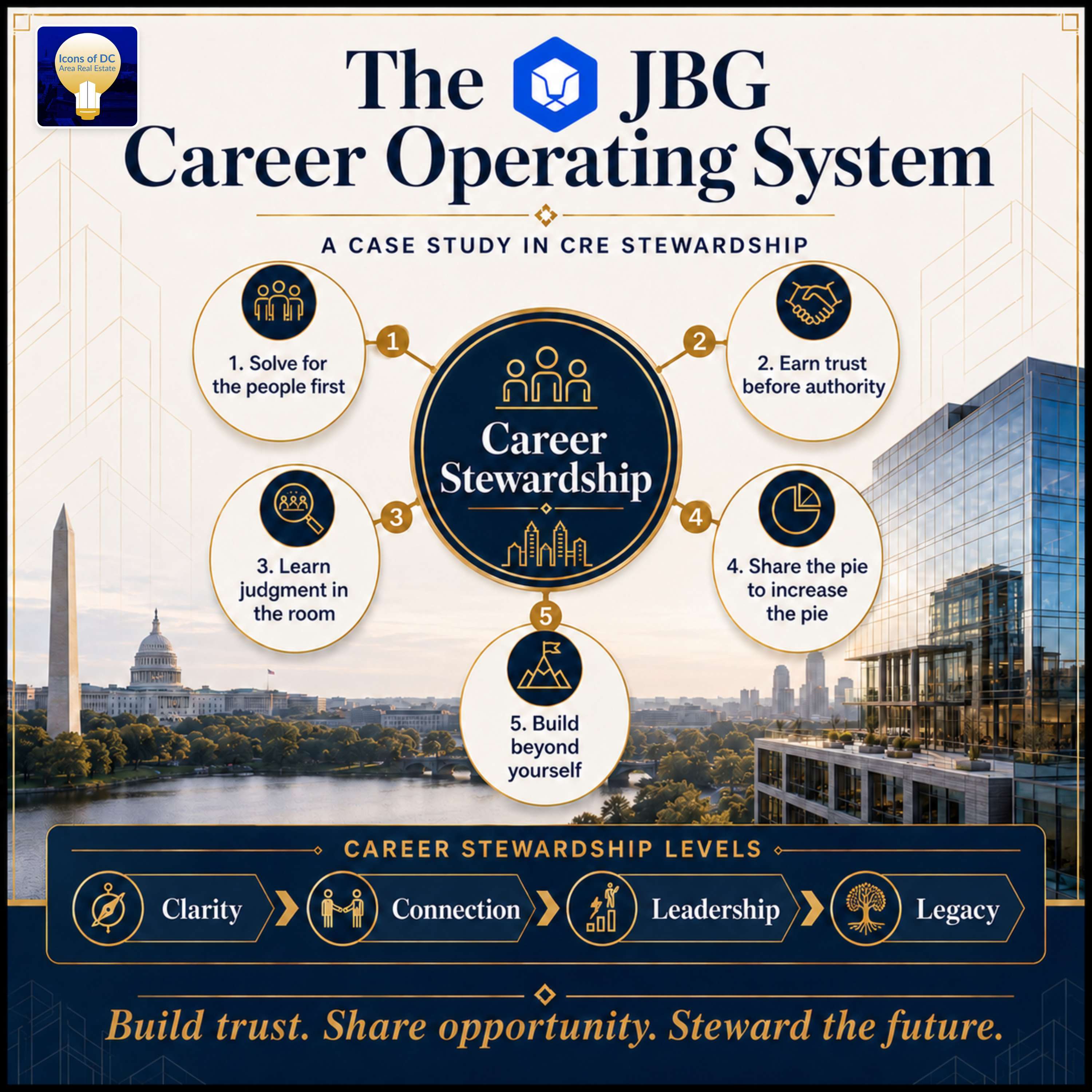
I see what I would call the JBG Career Operating System.
It was not written as a manual.
It was not a formal curriculum. It was not reduced to a slogan.
But across these interviews, five operating principles keep appearing.
1.
Solve for the people first.
2. Earn trust before authority.
[00:03:05] Speaker A: 3.
[00:03:06] Speaker B: Earn judgment in the room.
[00:03:08] Speaker C: 4.
[00:03:10] Speaker B: Share the pie to increase the pie.
5.
Build beyond yourself.
Those five principles align closely with the four levels of career stewardship that I use in my advisory work.
Clarity, connection, Leadership and legacy.
So today I want to examine JBG not simply as a legendary firm, but as a living case study in how real estate careers mature.
Because the lesson of JBG is not that every young professional should try to build the next jbg. The lesson is more immediate.
The lesson is that a meaningful career is not built by chasing every opportunity.
It is built by developing judgment, earning trust, choosing the right people, helping others grow, and eventually doing work that outlasts your own ambition.
That is stewardship principle number one, Solve for the people first.
Career stewardship level one, clarity.
The first operating principle is this. Solve for the people first.
That phrase comes directly from my interview with Matt Kelly, CEO of JBG Smith.
Matt recalled advice from his father. Solve for the people first.
That is deceptively simple phrase.
It could sound like ordinary parental advice, but in Matt's career, it became a serious filter.
Early in his professional life, Matt had a formative experience at Goldman Sachs. What's the Goldman culture like? What was it that you knew after two weeks you weren't going to fit there long term?
[00:05:11] Speaker D: It wasn't really about the culture of Goldman.
It was, you know, and maybe this is just a function of having grown up in a Midwestern household where my parents were around a lot. But I remember sitting in a cubicle, I was looking into an office, and there was a vice president who was occupying that office. And the guy I remember distinctly, he was losing his hair because he was going through chemotherapy for cancer treatment.
He had three young kids at home. And I was there all night, right, all the time, because I was drowning in information and I had to learn, I had to figure out how to do this stuff. And so everything was taking me a very long time. This was my second week on the training program.
And this guy was also there until all hours of the night. And I just thought to myself, gosh, at the time I thought, vice president. That's a really sad. Sounds like a really senior role. I didn't quite realize that there were a lot of levels above that still, although I figured it out soon enough. But I just remember thinking, this guy has cancer. And this is 1996, when getting cancer then is a little different than it is today.
And I just thought, wow, this guy could be dead soon. And he may be spending the majority of his final hours here at the office looking at me. That's not the. That's not a. That's not the kind of world I want to live in. It really gave me a pretty strong sense that, you know, this wasn't the lifestyle I wanted. And, you know, it's. Look it. It's not as though I haven't been through and experienced and still experience times of very hard work and late hours and all that. But the other thing that it made me realize was that, you know, in any job where you're inclined to work hard or where you have to work hard or where you want to work hard, really better? Well, very much like, if not love, the people next to you that you're doing it with.
[00:07:17] Speaker B: That is not an argument against ambition.
It is an argument for conscious ambition.
Young professionals often assume that the first test of a career is prestige.
Can I get into the best firm? Can I work on the biggest deals? Can I build the most impressive resume? Can I be around the most sophisticated capital?
Those questions are not irrelevant, but they are incomplete.
The deeper question is, what kind of person will this environment cause me to become?
That is the career stewardship level of clarity.
Clarity is not merely knowing what job you want.
It is knowing what kind of people, work incentives and culture will shape your judgment.
Matt said that JBG was the place where the promises made to him actually came true.
That line matters. A lot of young professionals are sold a story when they join a firm.
They are told they will be mentored.
They are told they will be given responsibility.
They are told they will grow.
But the real question is whether the culture actually behaves that way. When opportunity arrives at jbg, Matt saw senior leaders who gave young people room to run.
They did not simply use young talent as production capacity.
They gave them exposure. They trusted them. They let them grow into responsibility.
And the insight behind that was powerful. Sharing the pie would increase the pie.
That is one of the most important career lessons in this entire episode.
Scarcity based cultures protect opportunity.
Stewardship cultures multiply opportunity.
A scarcity culture says, protect your turf. Do not let young, younger people get too close to the client. Do not give away too much authority. Make sure you remain indispensable.
A stewardship culture says, if we develop people well, the enterprise become much larger than any one person.
That was the first major JBG lesson.
Solve for the people first.
For a young professional, that means you should not merely ask, where can I get the best job?
You should ask, where can I become the kind of professional I respect?
Who will model judgment for me?
Who will tell me the truth?
Who will give me responsibility before I am fully comfortable?
Who will allow me to grow without needing me to remain small?
Those are career architecture questions. They are not soft questions. They are strategic questions.
Because your first serious professional environment does more than pay you, it forms you.
So Principle 1 of the JBG Career Operating System is choose the people, incentives and culture that will shape your judgment.
That is clarity.
Principle 2 Earn trust before authority Career stewardship Level 2 connection the second operating principle is Earn trust before authority.
Real estate is a capital business, but capital is ultimately a Trust business money does not simply move towards spreadsheets. It moves towards judgment.
It moves towards credibility. It moves toward people who have proven they can be trusted when conditions change.
Todd Rich captured this in my interview with him when he spoke about the tremendous responsibility of managing other people's capital.
That phrase deserves to be slowed down.
Other people's capital.
That may mean institutional investors, it may mean families, it may mean pensioners, it may mean shareholders, it may even mean partners who have trusted you with a meaningful portion of their future.
Capital is never just capital.
It carries obligation.
And the more responsibility you receive in a real estate career, the more you understand that the job is not simply to win, but the job is to be worthy of trust.
Todd's post JBG career at Declaration Partners also reflects this principle.
A family office investment context allows for patience, selectivity, and flexibility.
It does not require forcing a deep deal simply to destroy deploy capital.
That is a very mature investing insight. If a deal comes around that just
[00:12:28] Speaker A: screaming, you're going to take a hard look at it. But if the people that bring it
[00:12:33] Speaker B: to you, you're wondering about, you might
[00:12:35] Speaker A: say, well, we'll buy it, but we're not going to be with you guys.
[00:12:40] Speaker E: David Swensen, who's the legendary head of the Yale Investment office and one of the anchor investors of jbg, at least back when we were a private firm, has a wonderful sentiment he expresses in his book, but I always liked it better when he said it in person, which is that the best legal documents cannot protect you from a bad partner, but the best partner can protect you from the worst legal documents.
And what I think he really meant was that people matter is that having a trusted partner, someone who you believe has your best interest at heart and who will think things through ethically and honorably, is far more important than any one deal or any one legal structure. And so I think the point that you made is entirely valid. And you know, this is a people business still, you know, and we care about those relationships. We care about our reputation and the
[00:13:27] Speaker A: reputation of those we invest in.
[00:13:28] Speaker B: The immature professional wants to be seen doing deals.
The mature professional wants to be right about risk.
That distinction matters especially in commercial real estate, where markets can reward aggressiveness for a while and then punish undisciplined ambition very quickly.
JBDG's historic culture had a similar discipline.
The founders, Don Brown, Joel Gildenhorn and Ben Jacobs, understood the responsibility of using other people's money.
The firm developed a culture where if one partner could not get comfortable with a deal, the firm would walk away.
Think about that.
In many firms, the dominant voice wins.
The rainmaker wins. The most forceful personality wins. The person with the strongest conviction pushes the deal through.
But a minority rule culture says something different.
It says if one trusted partner sees a risk we cannot resolve, we stop.
That is not bureaucracy. That is capital stewardship.
As for a young professional, this is a major career stewardship lesson level two is connection.
But connection does not mean networking in the shallow sense.
It does not mean collecting business cards or LinkedIn connections. Connection means becoming trustworthy.
It means becoming known for reliability, judgment, discretion, preparation, and follow through.
It means people begin to say, I want her in the room.
I trust his numbers.
She tells the truth.
He does not overstate his case.
She knows what she knows, and she knows what she does not know.
He can be trusted with a client.
She can be trusted with capital.
That is how authority begins.
Authority is not seized first, it is granted later.
Molina Banerjee's career illustrates this beautifully.
Her path at JBG Smith moved through multiple disciplines. Acquisitions, asset management, capital markets, investor relations, and ultimately the CFO role.
That kind of career does not develop by accident.
It develops because a professional keeps becoming useful in more consequential ways.
In my interview with Moyna, she discussed capital allocation, nav per share, share repurchases, asset sales, funding, caution, and the discipline of making decisions in the public markets.
But she also spoke about qualities that are less visible on a spreadsheet.
Authenticity, intellectual curiosity, willingness to dig in, and collaboration.
These traits matter because public company stewardship requires more than intelligence. It requires temperament. It requires resilience. It requires the ability to operate under scrutiny. If you could post a statement on a billboard on the Capital Beltway from
[00:16:58] Speaker C: Millions to Sea, what would it say?
[00:17:00] Speaker F: Okay, so I actually, I thought long and hard about this, and I wanted to. I was going to. I wanted to bring this down. And obviously your podcast listeners can't see this, but this is a quote that I actually have in my office. It's by a gentleman named Charles Swindle called Attitude. It's really long, so I won't read the whole thing. I'll read, like the last bits of it. But the way I got inspired by this, it was piece of paper that literally looked like this that hung on John Gray's office at 345 Park Avenue. And there would be times when we'd be meeting with John, it would be late at night because we were getting ready to go to investment committee, leaning in his office. And I would look at the wall and the piece of paper was there and I would read it and it would just inspire me. It's like, okay, keep going. You can do it. And it's all about attitude. And I'll just read it. It says, the longer I live, the more I realize the impact of attitude on life. Attitude to me is more important than the facts. It's more important than the past, the education, than money, than circumstances, than failures, than successes, than what other people think or say or do.
It is more important than appearance, giftedness or skill. It will make or break a company, a church, a home. The remarkable thing is we have a choice every day regarding the attitude we will embrace for that day. We cannot change our past. We cannot change the inevitable. The only thing we can do is play on the one string we have, and that is our attitude. I am convinced that life is 10% what happens to the me and 90% how I react to it. And so it is with you. We are in charge of our attitudes. And I will tell you, I look at this almost every day and I try to, you know, I try to keep this in perspective. And I think if we all did, it would probably serve us all well.
[00:18:51] Speaker B: That is not motivational fluff.
In a capital markets role. Attitude affects judgment.
Temperament affects decision making.
Resilience affects how you behave when conditions are not favorable.
That is part of Trust.
So Principle 2 of the JBG Career Operating System is authority follows trust.
Trust follows disciplined behavior.
For the young professional listening, the question is, are you building relationships through usefulness, reliability and judgment, or are you merely trying to become visible?
Visibility means get attention.
Trust gets responsibility.
That is connection.
Principle 3 Learn judgment in the room.
The third operating principle is learn judgment in the room.
This may be the most important principle for young professionals who want to become leaders.
Technical skill matters, analytical ability matters, Work ethic matters. But judgment is formed differently.
Judgment is formed by exposure.
It is formed by watching serious people make consequential decisions. It is formed by seeing assumptions tested. It is formed by hearing disagreements that are sharp but not personal.
It is formed by watching experienced professionals live with ambiguity.
Evan Reagan Levine's story is especially useful here.
When Evan joined JBG in 2013, he came in as a research associate working for Matt Kelly.
But from the beginning, he had exposure to investment committee discussions with senior leaders.
[00:20:56] Speaker C: My fondest memory that I grew the most from in those investment committee meetings was watching and I work with all the folks you just named. And they're all extraordinarily intelligent, capable people. But watching them sit across and have tremendous respect for each other, but vehemently disagree. And watching Mike and Rob battle it out, I learned more sitting and watching them argue than I think I did in any other aspect of my career. Because you see these people who can present arguments, they can do everything we talked about, bring all these facts to the table. And by the way, at the end, they're friends and partners and experts, but they weren't afraid to push. And I think that's something that we lose frequently in our sort of business climate today. And even a generational thing that people don't want to make waves and they don't want to fight with each other. And as long as you keep respect for the people at the table, you should fight a little. There's not a right answer. A lot of times you're going to find that answer in between, that's going to get pushed and pulled by really intelligent people who care.
That is important to do. And it's okay to have people watch you do it because they're going to learn from seeing both viewpoints that, by the way, they might hear both viewpoints. There are many times I heard, I'll just pick on Mike and Rob because they were there and it's so important. But I hear Mike take a viewpoint, be like, yeah, that sounds really good. Then I'd hear Rob poke a bunch of holes in it and say, I don't know. And I would say, well, that sounds really good too. How do I discern and judge? It's amazing to hear people like that who had that ability to both deliver such compelling arguments that we ended up getting to a better place. And I think that's an important article.
[00:22:20] Speaker A: Well, if you took all those people and you put them in a time machine to go back, say 30 years, 25 years, to the early part of their career, and if they knew today, if they knew then what they know today about what's happened in the last 30 years, they'd all at that point
[00:22:38] Speaker B: would have been shocked.
[00:22:39] Speaker A: Absolutely.
Because, you know, time and events change your decision process.
[00:22:45] Speaker C: Absolutely.
[00:22:47] Speaker A: And it's just, you know, so you can argue all you want in the moment, but five years hence, it doesn't matter anymore because it's a completely different place, a different environment, a different decision. Everything's different.
[00:23:00] Speaker B: That is a career classroom, not a formal classroom, not a training seminar, not a textbook.
A room where real capital, real risk, real reputation, and real decisions are on the table.
Evan described learning by watching people like Mike Plaserman and Rob Stewart debate risk, assumptions and strategy.
He saw experienced professionals test each other's thinking. He saw ideas challenged before capital was committed.
That is how judgment gets built.
A spreadsheet can tell you what the assumptions are.
A committee room teaches you which assumptions deserve to be attacked.
A model can show you the projected return.
A disciplined debate asks whether the return is real, whether the basis is defensible, whether the downside is survivable, whether the exit is plausible, whether the market story is wishful thinking and whether the people involved can execute.
That is the difference between analysis and judgment.
Analysis says, what does the model say?
Judgment asks, what are we missing?
Analysis asks, what is the return?
Judgment asks, what has to be true for this return to happen?
Analysis asks, can we do this? Judgment asks, should we do this?
That is the leadership transition many young professionals want. Responsibility, that is good. Ambition is necessary.
But before you can carry responsibility, you need exposure to how responsibility is handled. You need to see how senior people disagree.
You need to see how they change their minds.
You need to see how they protect capital.
You need to see how they treat uncertainty.
You need to see how they respond when a deal they wanted does not work.
This is why apprenticeship matters in real estate, not apprenticeship in the narrow sense of doing what you are told.
Apprenticeship in the deeper sense of being close enough to judgment to absorb it.
AJ Jackson offered another version of this lesson from a very different setting.
Before his work in impact investing in workforce housing, AJ had a significant public sector experience, including time connected to gsa.
In reflecting on crisis and decision making, he described the confidence that comes from having to make decisions when there is no playbook and no one else to ask.
[00:26:02] Speaker G: You know, the biggest surprise in my career and one of the biggest learning opportunities came when I was at the gsa. I was there, as I mentioned, I went in at the beginning of the Bush administration. So I was there during 911 and you know, obviously that was a surprise. We did not. We did not. It's not in the playbook at all. And I spent the better part of the second half of my time there working on essentially the reconstruction, reestablishment of the federal presence in Lower Manhattan. Folks, a lot of folks don't know, but you know, World Trade Center 6 was a GSA building, actually a custom house. But that building collapsed as well. Well, later in the day, since it burned out, the federal presence is all concentrated down there at 290 Broadway and 26 Federal Plaza, basically in sort of the no go zone.
The phone service that Verizon switched down there was damaged. Phone service was knocked out. So Anyway, we spent a lot of time working on there.
[00:27:05] Speaker A: Federal people that were killed.
[00:27:09] Speaker G: There were some. Yeah, they're not out of. Not out. Out of gsa. Yeah, not out of gsa. But that was. I mean, we were. I was on the ground there. I don't know, the 13th or. Probably the 13th or 14th or something
[00:27:23] Speaker E: or something like that.
[00:27:23] Speaker G: I mean, it was fresh. It was very fresh.
[00:27:25] Speaker C: It was very fresh.
[00:27:26] Speaker G: And so that, you know, that was the biggest surprise, obviously, but also a real learning opportunity in just mindset shift for, you know, for me, because obviously we were not. Not prepared for that and not something that we had, you know, trained up on or thought about. All of a sudden there were all these needs coming in from these different federal agencies, all these decisions to be made, all sorts of actors to either take or not take.
[00:27:58] Speaker A: Were you in your office at this time?
[00:28:00] Speaker G: No, actually, the administrator and I were in Philadelphia for a meeting and got a call from the deputy administrator after the first plane went in and then got a call back after the second one and so started to make our way back to D.C. we got as far as.
So we were going to go jump on an airplane, a commercial airplane, and obviously all the flights started being canceled. We jumped on the train, made it as far as Wilmington, Delaware, at which point a national emergency was declared and train service was stopped. So we got in touch with the administrator and sent the Federal Protective Service, or I'm sorry, the deputy administrator sent the Federal Protective Service up to Wilmington to get us. But you can imagine, we get off the train in Wilmington, there's nobody on the platform. There's no one downtown. The Federal Protective Service is coming directly from D.C. up to Wilmington. We walk.
[00:28:53] Speaker C: I don't know how many blocks we
[00:28:54] Speaker G: walk from the transistor.
Pre iPhone, pre GPS, walking around downtown London. No one was there. Started knocking on the door of the police station. So the administrator and I show up and talk about your racial equity question. Two black men show up banging on the door of the police station and the cops in the midst of a terrorist attack. And these cops are kind of like, what the hell? Finally convinced them that we were actually with the federal government, that the federal police were coming to take us back to Washington and could we shelter in the police station until they got there? But anyway, got back to Washington, turned
[00:29:26] Speaker B: around, went back to New York a couple days later.
[00:29:28] Speaker G: But it just.
[00:29:35] Speaker H: The
[00:29:39] Speaker G: confidence in decision making that I developed out of that experience because you had to keep making decisions and because there was no one else to ask and no one had a playbook. You know, that's been really. That's really stuck with me. Be nice if there's another way to learn that lesson. Yeah, it's really stuck with me.
[00:30:02] Speaker A: Wow.
[00:30:03] Speaker B: That's another form of judgment formation.
Sometimes judgment is learned by observing the wrong.
Sometimes it's learned when you discover that you are the wrong.
Either way, leadership begins when you stop waiting for perfect clarity and begin making responsible decisions under imperfect conditions.
This is Career Stewardship Level three Leadership Leadership is not merely a title.
It is not merely having people report to you. It is not merely being asked to speak first in a meeting.
Leadership is the capacity to hold complexity without panic.
It is the capacity to separate ego from analysis. It is the capacity to challenge others without humiliating them.
It is the capacity to be challenged without becoming defensive.
It is the capacity to make decisions when the facts are incomplete and the consequences are real.
That is why the investment committee image matters so much.
A young professional sitting in that room is learning much more than deal mechanics.
He or she is learning how serious people think.
The JBG lesson is do not only ask for responsibility.
Put yourself close to rooms where judgment is being formed. Then pay attention.
For the listener, the question is, what rooms are forming your judgment now?
And if you are not in those rooms yet, ask, what would make senior people trust me enough to let me closer?
That is leadership Principle 4 Share the pie to Increase the Pie Career Stewardship Level three Leadership Continued the fourth operating principle is Share the pie to increase the pie.
This principle may be the most distinctive cultural lesson from jbg.
Many real estate organizations are full of talented people.
Many are entrepreneurial.
Many are financially sophisticated. Many have smart capital and strong deal flow.
But fewer have cultures that intentionally multiply opportunity.
In too many professional environments, senior people protect the very opportunities young people need in order to grow.
They may say they mentor, but they do not transfer responsibility.
They may praise young talent, but they do not let younger professionals get close to the client.
They may talk about teamwork, but the real incentives reward individual control.
JBG seems to have operated differently.
Matt Kelly described a culture where senior leaders gave young people room to run. They did not hoard business. They they believed that sharing the pie would increase the pie.
That is an extraordinary cultural premise because it requires confidence.
Only secure leaders can truly develop other leaders.
If a senior person is insecure, talent feels threatening.
If a senior person is secure, talent feels like leverage.
If a senior person is a steward, talent feels like responsibility.
That is the difference.
In a scarcity culture, you hoard with opportunity to secure your own position.
But a steward understands the hoarding is actually a form of decay.
When you stop developing the next generation, you aren't protecting your seat. You are ensuring the institution fails once you leave.
Sharing the pie isn't just an act of generosity. It is the primary duty of an institutional steward.
Grant Yeehat's reflections reinforce this from another angle.
Grant spoke plainly about the importance of character, loyalty, and trusting your instincts on people.
[00:34:27] Speaker H: Trust your instincts on people.
[00:34:29] Speaker C: Usually.
[00:34:29] Speaker H: Not always, but usually.
And when we had at jbgr, we had, you know, the hiring decisions for most of the most positions were done by the three of us, by Jim,
[00:34:45] Speaker C: Rob and I, all of us.
[00:34:47] Speaker H: I mean, you know, and almost every major decision was really made by the three of us once we became partners.
And we usually, almost always agreed.
And the people that we wanted to keep, we kept. I mean, we would rarely lose someone to a competitor. I mean, sometimes there were extenuating circumstances where somebody's spouse would move or got to get a job somewhere else and they'd have to go. But usually the people that we wanted to keep were loyal to us, and
[00:35:19] Speaker C: we were loyal to them.
[00:35:20] Speaker H: And we tried to compensate them at the highest level we could to make them satisfied and to treat them as
[00:35:27] Speaker C: well as we could.
[00:35:28] Speaker B: Those words can sound simple, but they are not simple in practice.
Character matters means you do not separate performance from integrity.
Loyalty matters means relationships are not disposable.
Trust your instincts on people means you pay attention to the signals people send before money, ego and pressure make everything more complicated.
This is a central advisory lesson.
Careers do not stall only because people lack technical ability.
They stall because people misread themselves, misread others, change the wrong rooms, or fail to understand how trust compounds.
A professional may be smart and still not be trusted. A professional may be productive and still not be respected.
A professional may be ambitious and still not be someone others want to build with.
That is why the share of the pie principle matters.
It is not simply generosity. It is institutional strategy.
A firm that develops people well can renew itself. A leader who develops people well becomes more influential, not less.
A young professional who helps others succeed becomes part of a trusted network, not merely a resume.
This is where career stewardship level three deepens.
Leadership is first about judgment, but then it becomes about multiplication.
At some point, the question changes. Early in your career, the question is, who is helping me grow? Later, the question becomes, who grows because I am here.
That is the major transition, and it applies earlier than people think.
You do not need to be a CEO to begin practicing this. You can practice it as an analyst, associate vice president, broker, lender, asset manager, developer, or advisor.
You can share credit.
You can make introductions.
You can explain what you know.
You can help a peer avoid a mistake. You can make a younger colleague feel included. You can support the person who is not yet visible.
You can be generous without being naive.
That is Stewardship at the human level.
Moina Banerjee's comments about authenticity, intellectual curiosity, digging in, and collaboration belong here as well.
These are the qualities that allow talented people to work together without collapsing into ego, politics, or fear.
A JBG lesson is A great culture does not merely retain talent, it compounds talent and the listener question is, are you becoming the kind of person others want to help and eventually the kind of person who helps others grow.
That is Leadership as multiplication.
Principle 5 Build upon yourself Career stewardship level for legacy the fifth operating principle is build upon yourself. Build beyond yourself.
Build beyond yourself.
This is where the JBG story moves beyond career development advancement and becomes a stewardship story.
At some point, a real estate career becomes larger than the number next transaction.
It becomes about place.
It becomes about community.
It becomes about what your work enables and what it displaces.
It becomes whether the value created by your work is merely captured or whether it is also shared, translated, and carried forward.
JBG Smith's work in National Landing gives us one version of this story.
Evan Reagan Levine described real estate success as requiring the intersection of communication, analytics, and design.
That is a powerful triad Communication because real estate involves people, institutions, public agencies, investors, tenants, residents, and communities.
Analytics because capital must be allocated carefully, risk must be understood, and decisions must be supported by evidence.
Design because buildings and places are not abstractions. They shape how people live, move, gather, work, and belong.
When those three come together, real estate becomes more than a financial instrument, it becomes a human environment.
National Landing is not simply a cluster of buildings.
It is an attempt to shape an ecosystem office, residential, retail, transportation, public space, institutions, technology, and civic identity.
Evan's billboard message captured that ambition. The future is built here.
That is a striking line because it can be read in two levels.
At one level describes a place National Landing, the region, the future of the Washington economy.
At another level, it describes professional responsibility.
The future is built here in the decisions we make, the capital we allocate, the people we mentor, the communities we shape, the risks we take, and the values we preserve.
AJ Jackson's work adds another dimension to this legacy question.
Through the Washington Housing Initiative and LEO Impact Capital, AJ has focused on using private capital at scale to preserve affordable workforce housing in high opportunity neighborhoods. That phrase private capital at scale matters because the affordable housing challenge cannot be solved only through good intentions. It requires structure. It requires capital. It requires operating ability. It requires partnerships. It requires people who can translate between public purpose and private execution.
AJ's work asks a hard question.
As places improve, who gets to remain?
That's a stewardship question.
It is not anti development. It is more demanding than that.
It says, development has consequence.
Capital has consequence.
Place making has consequence. Success has consequence.
If a neighborhood becomes more valuable but essential, workers are pushed farther away.
What exactly have we built?
If a project creates financial return but weakens the social fabric around it, what has really been gained?
If a community becomes more attractive but less accessible, who benefits from the future being built?
These are not easy questions, but mature commercial real estate professionals should not avoid them.
AJ's billboard question stronger Together points toward the answer. He also invoked the stoic idea that what is bad for the hive cannot be good for the bees.
That is a profound stewardship principle.
The individual and the community are not as separate as we pretend. The the investor and the resident are not as separate as we pretend.
The building and the neighborhood are not as separate as we pretend. The career and the community are not as separate as we pretend.
That is level four legacy.
Legacy is not simply reputation after retirement.
Legacy is what your work makes possible for others.
Legacy asks, what am I building that will matter when I am no longer the central actor?
That is where career stewardship ultimately leads.
Not everyone will run a public company. Not everyone will transform a district.
Not everyone will lead a major housing initiative. Not everyone will build an institution.
But everyone in commercial real estate can ask, does my work merely extract value, or does it help create value that others may live inside, build upon, and pass forward?
That is the legacy question.
Principle 5 of JBG career Operating System is Build beyond yourself Synthesis.
The JBG Career Operating System so what is the JBG Career Operating System? It is not a formula. It is not a claim that JBG or JBG Smith is perfect. No firm is.
Every organization faces market cycles, internal pressures, strategic trade offs and moments of difficulty. But across these conversations, a pattern emerges.
A serious real estate career matures through five stages of behavior.
First, solve for the people. First, that is clarity. Choose the culture that will shape your judgment.
Second, earn trust before authority. That is connection.
Become reliable with capital, relationships, information and responsibility.
Third, learn judgment in the room. That is leadership. Get close to consequential decisions. Watch how serious people disagree.
Learn to separate analysis from judgment. Fourth, share the pie to increase the pie. That is leadership at a higher level.
Stop seeing other people's growth as a threat.
Start seeing it as a very durable Institutions are built the way.
Fifth, build beyond yourself. That is legacy.
Let your work mature into place. Community, continuity and consequence. That is the arc, clarity, connection, leadership, legacy.
It is also the arc of a career movement from self interest to stewardship.
At the beginning of a career, most of us ask what can I become?
That is a fair question.
Later the question becomes who can I become useful to? Then what judgment can others trust me to exercise?
Then who can I help grow? And finally, what am I building?
What am I helping build that outlasts me?
That is the journey from career advancement to career stewardship at the end of Many icons of D.C. area Real estate episodes, I ask guests some version of the billboard question.
If you could put a message on a billboard on the the Capitol Beltway, what would it say?
I love that question because it forces clarity.
It asks a leader to compress a lifetime of experience into a few words.
Matt Kelly's answer was be kind to one another.
Brand ehat emphasized kindness and listening.
Todd Rich said, rule number one, have fun.
Moyna Banerjee offered four Fortune favors the brave, AJ Jackson said stronger together and Evan Reagan Levine said the future is built here.
Those answers may sound different, but through a stewardship lens they belong together.
Be kind to one another.
Listen, have fun. Be brave.
Recognize that we are stronger together. Build the future here. That is not a random way list.
It is almost a code.
It says treat people well.
Stay open.
Bring energy to the work.
Take responsible risks. Remember that no one builds alone. And understand that the future is not something we wait for, it's something we build.
So if I were to synthesize the JBG Career operating system into one stewardship billboard might say this Build trust, share opportunity. Steward the future.
Or perhaps build what others can believe in and build it with people you trust. Or even more simply, become the kind of person others want to build with.
That may be the heart of this entire episode.
Because the lesson of JBG is not that every professional should try to build a legendary company. The lesson is more personal and more immediate.
Build the kind of judgment, trust, generosity and civic imagination that makes others want to build with you.
That is how a career stops being a consequence of transactions and becomes a body of work. Ultimately, stewardship is the recognition that the industry you work in, the the capital you manage, the buildings you design, the communities you shape did not begin with you and it must not end with you.
When you view your career through this lens, you stop asking, what can I get? And start asking, what is my responsibility to the future.
That is the shift from a successful career to a significant one.
Thank you for listening to another episode of Icons of Easier Real Estate. I'm John Coe. We'll see you next time.