Episode Transcript
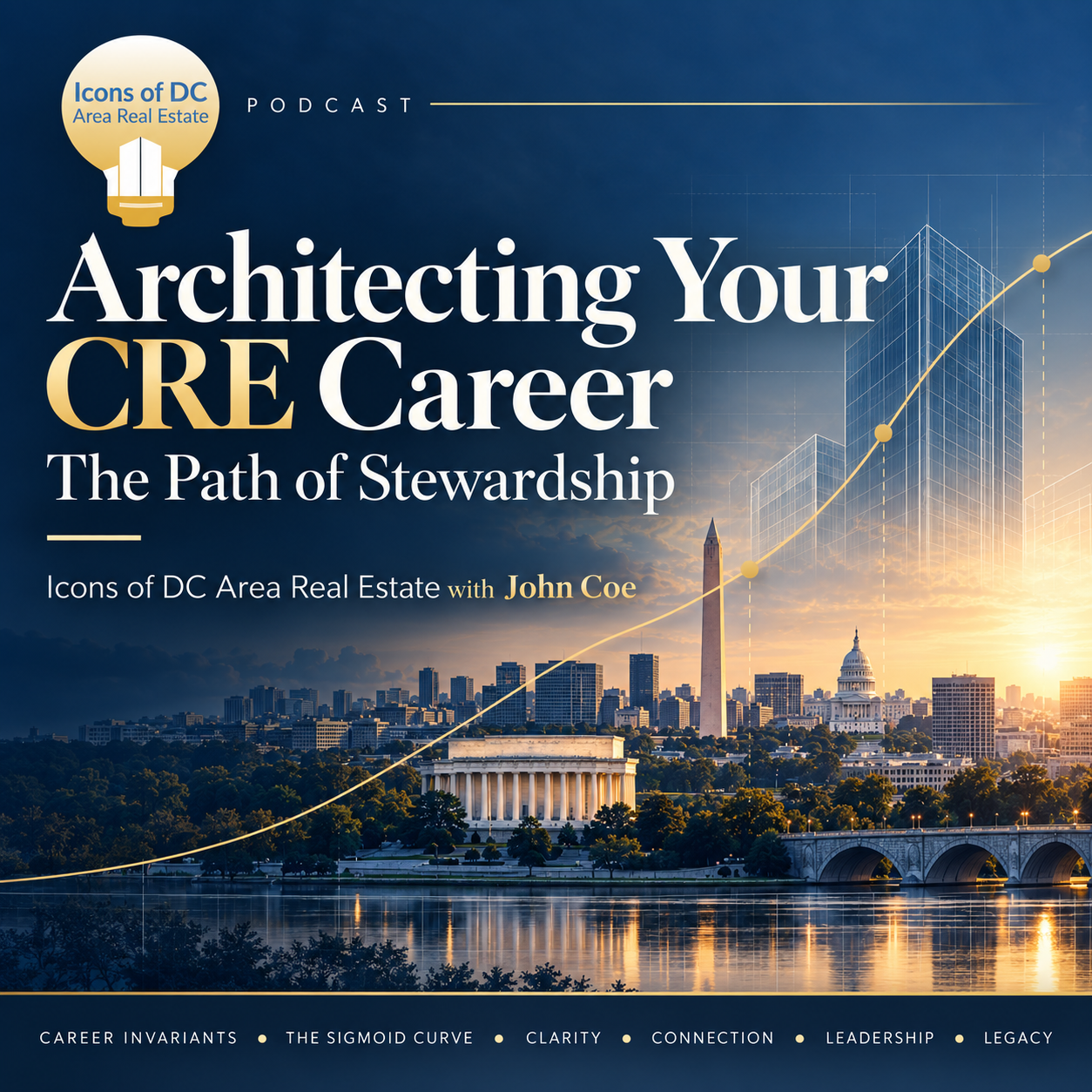
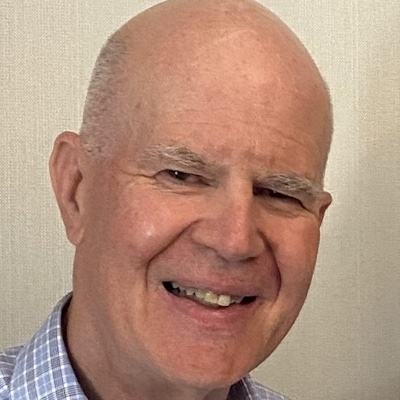
[00:00:00] Hi, I'm John Koh, and welcome to icons of D.C. area real estate.
[00:00:05] For more than 150 conversations, this podcast has explored the backgrounds, career trajectories, decisions, relationships, and lessons of people who have helped shape commercial real estate in the Washington region and beyond. Most episodes begin with one person's story.
[00:00:23] Today's episode is a little different.
[00:00:26] It is about a pattern I have begun to recognize across many of those stories and looking back across my own.
[00:00:34] In a recent episode, I used the history and culture of JBG as a case study in what I called a career operating system.
[00:00:44] Across several conversations with people connected to JBG and JBG Smith, five principals kept appearing.
[00:00:53] Solve for the people first, Earn trust before authority.
[00:01:00] Learn judgment in the room, share the pie to increase the pie, and build upon yourself.
[00:01:10] Those principles were never published as a JBG employee manual.
[00:01:15] They emerged through behavior, through the way people chose colleagues, treated capital, made decisions, developed talent, and thought about the places that they were helping to create.
[00:01:29] Then, in the Busuto episode last time, we explored another idea. Sanctuary.
[00:01:40] Tom and Toby Buzzuto have described housing as more than a physical product.
[00:01:47] A home can become a place of dignity, belonging, renewal, and security.
[00:01:55] That idea lifts real estate beyond the transaction.
[00:01:59] It asks us to consider what the built environment makes possible in another person's life.
[00:02:06] But as I reflect on those two prints episodes, I began to see a bridge between them.
[00:02:14] If stewardship shapes what we build externally, it must also shape how we build ourselves internally.
[00:02:23] If a building can provide sanctuary, can a career provide an inner architecture strong enough to sustain us through change?
[00:02:34] If a company can have an operating system, shouldn't a person have one, too?
[00:02:40] And if our work affects capital, colleagues, families, neighborhoods, and communities, shouldn't we become more intentional about the kind of professional, the kind of human being that our careers are forming?
[00:02:58] That is the subject of this episode.
[00:03:00] I want to introduce a practice I have been developing called the CRE Career Stewardship Advisory.
[00:03:10] But more importantly, I want to offer you a way to examine your own career.
[00:03:16] Whether you are just establishing yourself, questioning your direction, stepping into greater leadership, or deciding what your accumulated experience is now asking of you.
[00:03:29] This is not an argument for following one prescribed path.
[00:03:35] Commercial real estate careers rarely work that way.
[00:03:39] Markets change, companies merge, partnerships dissolve, Deals disappear.
[00:03:47] Family obligations become more important.
[00:03:50] Unexpected opportunities appear.
[00:03:53] Sometimes we choose the transition, sometimes the transition chooses us.
[00:03:59] The question is not whether your circumstances will change.
[00:04:03] They will.
[00:04:05] The question is what should remain true about you when they do?
[00:04:12] One of the most common misconceptions about a Career, successful career is that it develops through a clear sequence of increasingly important jobs.
[00:04:24] You perform well, someone notices, you receive more responsibility.
[00:04:30] Your compensation increases, your title improves, your network expands.
[00:04:37] Eventually, all of this is supposed to add up to fulfillment, influence, and perhaps even significance.
[00:04:45] Sometimes it does.
[00:04:47] But after listening to more than 150 accomplished people describe their journeys, I can tell you that a career is rarely that orderly.
[00:04:58] The resume shows the sequence after the fact.
[00:05:02] It does not show the uncertainty experienced while living it.
[00:05:07] The resume does not show the job that looked impressive but felt wrong.
[00:05:12] It does not show the commission that was expected and never arrived.
[00:05:17] It does not show the trusted partner who left the market that shut down, the promotion that created an identity crisis, or the moment when someone realized that the ladder they had been climbing was leaning against the wrong wall.
[00:05:34] Many talented professionals do not lack ambition or ability.
[00:05:39] They lack an operating system for interpreting change.
[00:05:44] They react to the opportunity immediately in front of them. They optimize for title, compensation, platform or visibility without asking what that choice will develop or diminish in them.
[00:06:00] They may accumulate experience without translating it into judgment.
[00:06:05] They may accumulate contacts without building genuine relationships.
[00:06:11] They may acquire authority without becoming leaders.
[00:06:15] And they may approach the later chapters of a career with impressive credentials but no clear idea of what they are now responsible for stewarding.
[00:06:27] That is career drift.
[00:06:30] Career drift does not always look like failure.
[00:06:33] Sometimes it looks like motion.
[00:06:36] Sometimes it even looks like success.
[00:06:39] You are busy, respected and well compensated.
[00:06:43] But you are responding to the logic of the market more than acting from a considered understanding of who you are and what you are trying to contribute.
[00:06:55] The alternative is career architecture.
[00:06:59] Architecture does not mean controlling every outcome.
[00:07:03] An architect cannot control the economy, the weather, the contractor, the cost of materials, or how future occupants will use the building.
[00:07:13] But the architect can establish principles.
[00:07:17] The architect can identify load bearing elements.
[00:07:22] The architect can understand the site, anticipate stresses, create options, and make choices that allow the structure to remain useful as conditions change.
[00:07:38] A career needs the same kind of thinking.
[00:07:42] What are your load bearing elements?
[00:07:45] What conditions allow you to do your best work?
[00:07:49] What kind of responsibility causes you to grow?
[00:07:53] Which relationships make you more honest, capable and useful?
[00:07:58] What are you unwilling to sacrifice merely to advance?
[00:08:03] And what must remain true about you even as your company, title, market, compensation and status change?
[00:08:13] I call those things career invariants.
[00:08:19] An invariant is something that remains constant while other variables change.
[00:08:25] Career invariants are not job titles. They are not five year goals.
[00:08:30] They are not a personal brand statement or a list of desirable benefits. They are the qualities, obligations and ways of contributing that should remain recognizably yours across different chapters of work.
[00:08:46] For one person, an environment variant might be rigorous intellectual honesty.
[00:08:54] I will not shape my analysis merely to support the answer someone else wants.
[00:09:00] For another, it may be building and developing teams.
[00:09:05] Wherever I work, I need to help other people become more capable.
[00:09:11] Another professional may recognize that translating complexity is central to who she is.
[00:09:18] She may move from development to investment or from principal work to advisory work, but she remains the person who helps others understand what matters and makes a better decision.
[00:09:32] Someone else may be a bridge between capital and community, senior leaders and emerging professionals, technical specialists and decision makers, or vision and execution.
[00:09:46] The external role may change.
[00:09:48] The internal contribution persists.
[00:09:52] Looking back at my own career, I can now see several invariants that I did not have the language for at the time.
[00:10:01] I was drawn to commercial real estate because it combined capital, tangible outcomes, problem solving, and relationships.
[00:10:10] I wanted to understand complicated situations and help people find a path forward.
[00:10:17] I valued trust and fair dealing. I wanted to be useful to clients and colleagues.
[00:10:23] And increasingly, I found meaning in connecting people and helping younger professionals see possibilities that were not yet visible to them.
[00:10:33] Those characteristics appeared differently at different stages.
[00:10:38] Early in my career, they appeared through analysis and transactions.
[00:10:43] Later, they appeared through client counsel, leadership, and industry involvement.
[00:10:49] More recently, they have appeared through interviewing, curation, mentoring, and community building.
[00:10:57] The vehicle changed. The underlying contribution became clearer.
[00:11:03] That distinction is important because an invariant is not a rule that always produces the same choice.
[00:11:10] If security were the invariant, we might always choose the safest job.
[00:11:16] If risk taking were the invariant, we might always choose the most uncertain opportunity.
[00:11:22] Neither is sufficiently thoughtful.
[00:11:24] The deeper invariant might be responsible usefulness, choosing the environment in which our abilities, relationships, obligations, and appetite for growth can be brought to the best alignment available at that moment.
[00:11:41] At one stage, stewardship may require joining a stable institution.
[00:11:46] At another, it may require leaving one.
[00:11:50] At one stage, the responsible decision may be to protect your family from unnecessary financial volatility.
[00:11:57] At another, the responsible decision may be to risk your established identity in order to create something that serves others.
[00:12:06] The operating system is constant. The application changes with context.
[00:12:13] This is also why career advice is so often unsatisfying.
[00:12:18] Take the risk, follow your passion. Build your network.
[00:12:23] Never leave money on the table. Each statement may be useful in one situation and destructive in another.
[00:12:31] A stewardship approach asks more demanding questions.
[00:12:36] What is the strongest argument for each path?
[00:12:40] What obligations must be honored?
[00:12:43] What am I optimizing for, and what might that cause me to neglect?
[00:12:49] Which decision better expresses the person I intend to become?
[00:12:54] And if the outcome disappoints me. Will I still respect the reasoning and values that produce the choice?
[00:13:04] The developmental architecture I use has four clarity, connection, leadership, and legacy.
[00:13:17] These are not compartments that we finish and leave behind.
[00:13:21] We do not graduate from clarity and never need it again.
[00:13:25] A senior executive entering a new chapter may need more clarity than a 25 year old analyst.
[00:13:35] Relationships remain essential during leadership.
[00:13:39] Leadership continues during legacy.
[00:13:42] The levels describe changing centers of gravity.
[00:13:48] They can also be understood as the work required to move from one curve of contribution to the next.
[00:13:55] Clarity helps us see that a curve is flattening.
[00:14:00] Connection exposes us to possibilities beyond our current frame.
[00:14:05] Leadership allows us to create renewal with and through other people.
[00:14:11] Legacy asks whether the next curve will serve only our continued relevance or enlarge the capacity of those who come after us.
[00:14:22] Clarity asks, where am I going and what kind of professional am I becoming?
[00:14:28] Connection asks, who and what must I align with and how do I become worthy of trust?
[00:14:36] Leadership asks, how do I exercise judgment, influence outcomes, and help others become more capable?
[00:14:45] Legacy asks, what am I here to steward, translate, and pass forward?
[00:14:51] I can now see these centers of gravity across my own career.
[00:14:58] My clarity period began at Prudential 1979.
[00:15:03] I was learning the business, learning how capital and real estate came together, and learning what kinds of people, what kinds of work. I should say engaged my strengths.
[00:15:17] In 1981 I moved from Wichita, Kansas to Chicago to Joan Hallmark Development Company.
[00:15:26] I had left Prudential in 1980 and gone to Wichita working for ABCO Properties.
[00:15:35] After one year, I moved from Wichita to Chicago to join Home Art Development Company.
[00:15:41] That position lasted only about one year.
[00:15:45] At the time, a short tenure could feel like a disappointment or a wrong turn.
[00:15:52] Looking back, it was part of the clarification process.
[00:15:56] Sometimes clarity comes not from discovering exactly what you want, but from entering an environment and learning from what does not fit.
[00:16:07] In early 1983, I joined CB Commercial in Chicago, which is now known as CBRE, and moved more fully into the connection phase.
[00:16:19] I had greater clarity about my strengths and about the business.
[00:16:23] Now I needed to develop clients credibility and a base of relationships.
[00:16:29] Investment, sales, brokerage rewards technical ability, persistence, market knowledge and timing.
[00:16:38] But it also teaches a more enduring lesson. No important transaction happens without trust.
[00:16:45] My leadership phase became more visible as I assumed greater authority at Legg Mason and through industry leadership in the Urban Land Institute at ULI Washington, I led the Trends Conference Committee for two consecutive years.
[00:17:03] That meant much more than appearing on a stage. It meant building a full one day program, identifying themes, recruiting speakers, assembling panels and selecting a venue, coordinating logistics and creating an experience worthy of the participants time.
[00:17:21] I also led committees focused on regionalism and urban plan at uli.
[00:17:28] Those roles taught me that leadership is often an act of architecture. You do not need to deliver every insight yourself. You need to create create the conditions in which good people, good questions, and different forms of expertise can come together productively.
[00:17:45] My legacy phase emerged more gradually.
[00:17:48] The foundations were present when I formed CO Enterprises in 2015 and continued through mentoring through ULI.
[00:17:58] The podcast, which began in 2019, gave me a way to capture and curate the wisdom of people I respected.
[00:18:07] The pandemic in 2020 revealed that the podcast had become more consequential than I had understood, and in 2021, the iconic Journey and CRE community turned that accumulated knowledge and those relationships into a more intentional mentoring platform.
[00:18:28] But to understand how these phases actually feel while we are living them, it helps to examine two crossroads, one in 1985 and another 30 years later in 2015.
[00:18:42] Case 1 Chicago or Washington From 1983 to 1984, I experienced meaningful success in investment sales brokerage at CB Commercial in Chicago. I earned several significant fees, enough in that period for Jana, my wife, and I to buy a single family home in Hinsdale, Illinois.
[00:19:05] From the outside, the career path appeared to be working. I had moved beyond the uncertainty of my short homart experience.
[00:19:14] I was learning how to originate and execute business. I was developing relationships in a major market.
[00:19:21] The compensation upside of brokerage was becoming real.
[00:19:25] But there was another part of the story.
[00:19:28] I was on straight commission.
[00:19:31] Success arrived unevenly. Jana had never been fully comfortable with that lifestyle.
[00:19:39] When two large transactions closed, we had some breathing room and the concern receded. But we had not accumulated enough reserves to make the volatility inconsequential.
[00:19:50] In early 1985, a large commission appeared imminent.
[00:19:54] We expected it to close. It did not.
[00:19:57] Suddenly, a career that had recently generated enough income to buy a home was not generating enough cash to cover our living expenses.
[00:20:07] Jana's income was not sufficient to carry the household. I would have needed to refinance our home or borrow money simply to continue living while waiting for the next transaction.
[00:20:19] That is not that is, the part of the resume does not show.
[00:20:24] The resume might say that I left CB Commercial in 1985 and joined the BF Sol company in Washington, D.C. it would make the move look sequential and perhaps even strategic.
[00:20:38] Living through it felt very different.
[00:20:42] Jana's patience with straight commission had dissolved. Understandably, I needed to make a move. Not eventually, but promptly.
[00:20:50] We looked at opportunities both in Chicago and Washington. Both were strong markets. I had connections in each.
[00:20:58] The decision was not between an obvious good choice and an obvious bad one.
[00:21:03] Let us argue both sides because that is the only way to understand a consequential career decision.
[00:21:11] The case for staying in Chicago was strong.
[00:21:14] We had lived there for more than four years. We owned a home. I understood the market. I had begun building a client and relationship base. I had demonstrated that I could earn meaningful fees. One failed commission did not prove that brokerage model was wrong. It might simply have been a painful interruption in a career that was beginning to work.
[00:21:36] Leaving could mean surrendering the value of relationships I had spent years developing.
[00:21:41] It could mean moving just before the next opportunity arrived.
[00:21:46] It could mean allowing one disappointment to push me out of a business in which I had already shown promise.
[00:21:53] There was also an argument about identity.
[00:21:56] Brokerage can reward initiative and entrepreneurial energy.
[00:22:01] Moving into a salary and bonus structure might appear more conservative, Perhaps even a retreat from the upside I had been pursuing.
[00:22:10] Now consider the case for Washington and the BF Salt company.
[00:22:14] The company offered me a position in mortgage banking. The work was adjacent to investment sales brokerage, originating relationships, understanding real estate and capital, structuring transactions and helping clients reach the market.
[00:22:30] I would not be discarding my experience.
[00:22:33] I would be applying it in a in a setting with with greater stability.
[00:22:38] The compensation included salary and bonus. BFSOL offered to move us and provide temporary lodging before we purchased a home in Washington.
[00:22:48] Those terms materially reduced the imminent household risk. Risk?
[00:22:53] Washington was a strong real estate market where I had already had connections. But it was still a new professional environment.
[00:23:02] We would be uprooting our lives. I would need to rebuild credibility and relationships.
[00:23:07] The opportunity was safer financially. But the outcome was not certain.
[00:23:13] So what was the correct decision?
[00:23:16] If the principal were simply take the biggest risk staying in commission and brokerage might have looked more courageous. If the principal were simply always choose security bfs, all would have been automatic. But neither principal adequately reflected the situation.
[00:23:33] The stewardship question was how do I continue building a meaningful career while honoring the financial reality Jana and I were facing together?
[00:23:43] The BF Sol opportunity did not eliminate ambition.
[00:23:47] It redesigned the risk. It allowed me to carry forward the strengths I had begun to identify. Relationships, transactions, capital, client service and problem solving within a structure that was more sustainable for our household. At the time we moved to Washington.
[00:24:10] What happened next could not have been known was we made the decision.
[00:24:14] I spent 19 years in that position through three different owners. B.F. sol Co.
[00:24:20] Sold the division to Legg Mason Real Estate and it was later then sold to Northmark Capital.
[00:24:28] The company's names changed, ownership changed, markets changed, the work evolved, but the underlying contribution persisted.
[00:24:38] That is a career invariant in action.
[00:24:42] The decision also offers a caution about hindsight.
[00:24:46] Because the move led to 19 years of opportunity, it is tempting to say that it was obviously right.
[00:24:54] It was not obvious. A good outcome does not prove that every assumption was correct, just as a disappointing outcome does not necessarily prove that a decision was wrong.
[00:25:06] The more useful lesson lies in the quality of the reasoning.
[00:25:10] We faced the household facts directly. We considered two credible markets. We examined how my existing abilities could transfer. We distinguished between reckless volatility and productive uncertainty, and we chose a structure that allowed both responsibility and growth.
[00:25:30] Career stewardship sometimes means taking a leap.
[00:25:33] Sometimes it means building a stronger platform from which future leaps become possible.
[00:25:41] The Washington chapter deepened my understanding of connection.
[00:25:46] Connection is often confused with networking. Networking can be useful, but connection in a stewardship framework means something more demanding.
[00:25:57] It means something known, becoming known for preparation, follow through discretion, judgment, and the ability to be useful when circumstances become complicated.
[00:26:13] It means that people trust you not only when the market is favorable, but when the answer is uncertain, the transaction is under pressure, or the preferred outcome is no longer available.
[00:26:26] This is where the second JBG principle earn trust before authority becomes practical.
[00:26:33] Authority may be conferred by title, but meaningful authority is accumulated through behavior.
[00:26:41] People begin to involve you in more consequential decisions because they have evidence of how how you think and how you act over time. My work at Legg Mason brought increasing authority, but leadership also developed through uli. Where the currency was not organizational title or compensation, it was contribution.
[00:27:05] Leading the ULI Trends Conference Committee for two consecutive years required a different kind of judgment. A one day conference can appear effortless to the attendee.
[00:27:15] A thoughtful opening and sequence of speakers, strong panels in a suitable venue, and useful conversations during the breaks.
[00:27:24] Behind that apparent ease are hundreds of decisions.
[00:27:29] What does the market most need to understand this year?
[00:27:34] What voices should be present?
[00:27:36] Who do we balance economics, public policy, development, capital design, and community?
[00:27:44] Who can carry a panel? Who might bring a perspective that is not already represented? What sequence will help the audience understand the whole rather than experience a collection of unrelated presentations?
[00:27:59] How do the venue and logistics support the substance rather than distract from it?
[00:28:04] That work helped me recognize several roles that now sit inside the career stewardship practice.
[00:28:11] The curator separates signal from the noise and chooses what deserves attention. The translator helps people understand complexity and see the choices within it. The bridge connects people, ideas, disciplines, and opportunities.
[00:28:29] The mentor helps other person recognize strengths, confront gaps, and move toward a more intentional next step. The steward protects trust, continuity, and the long term purpose of the work. The regionalism and urban plan committees reinforce the same lesson.
[00:28:50] Real estate does not exist as an isolated collection of properties.
[00:28:55] It exists within systems transportation, housing, employment, public policy, capital flows, education, and community life.
[00:29:06] Leadership therefore requires more than having an answer. It requires seeking interdependence. It requires inviting the right people into the room. It requires listening carefully through enough to understand why serious people may reach different conclusions.
[00:29:25] This is the third JBG principle. Learn judgment in the room.
[00:29:29] Analysis is essential, but judgment develops through exposure to decisions where the facts are incomplete and the consequences are real.
[00:29:38] You observe how experienced people disagree.
[00:29:42] You learn which risks deserve attention and which merely feel uncomfortable.
[00:29:48] You discover when to persist, when to revise, and when to stop.
[00:29:54] Eventually, leadership moves beyond the quality of your own decisions. It becomes the quality of the environment you create for others.
[00:30:04] That is where share the pie to increase the pie becomes more than a compensation philosophy. It becomes a theory of leadership.
[00:30:14] When other people become more capable, better connected, and more confident in their judgment, your influence does not diminish. The capacity of the whole system increases.
[00:30:26] And at some point this creates a new question.
[00:30:30] If your experience has become useful, what are you going to do with it?
[00:30:37] Case 2 Join another platform or build one 30 years after the move from Chicago to Washington, I encountered another transition.
[00:30:48] In 2015, I was part of the partnership at Sirius Capital Partners.
[00:30:54] My partners ultimately left for other ventures.
[00:30:57] The structure around me changed and once again I needed to decide what came next.
[00:31:04] The circumstances were different from 1985. In 1985, the immediate problem was financial volatility. Without adequate reserves, Jan and I had needed a more sustainable structure and joining the BF SOL provided it.
[00:31:21] In 2015, I had decades of experience.
[00:31:26] A developed network judgment formed through multiple market cycles and relationships with people who trusted me.
[00:31:33] I also had two clients I could continue serving through capital raising.
[00:31:39] The client was no longer the question was no longer simply which company should I join.
[00:31:45] The question was what kind of platform should now carry the work I am capable of doing?
[00:31:51] And again, there were arguments on both sides.
[00:31:56] The case for joining another established organization was credible.
[00:32:01] A recognized platform could provide infrastructure, colleagues deal flow, identity and clear market position.
[00:32:08] Commercial real estate is a scale and relationship business.
[00:32:12] There is no shame in using an institution's capabilities to serve clients more efficiently and effectively.
[00:32:20] The case for creating my own business was also credible, but less certain. Co enterprises would allow me to serve clients who already trusted me.
[00:32:30] Remain flexible and shape the work around relationships and judgment, rather than around priorities of a larger organization.
[00:32:38] It would also allow space for activities that did not fit neatly into a conventional transaction platform, especially mentorship.
[00:32:49] I chose to create coenterprises.
[00:32:52] At first, the choice was practical. I had clients to serve and capital raising work to do. But the meaning of the platform became clearer over time.
[00:33:02] I continued mentoring through uli.
[00:33:05] I found myself increasingly interested not only in helping execute a transaction, but in helping people understand the business, their own capabilities, and the choices before them.
[00:33:18] Then, in 2019, I started I started the Icons of DC Area Real Estate Podcast.
[00:33:25] The podcast began as a way to record the journeys and insights of people who had helped build the Washington real estate community.
[00:33:33] I wanted to understand how they began, what shaped them, what decisions mattered, and what they had learned and what they might pass forward.
[00:33:45] Without fully realizing it, I was moving from participant to curator, from using relationships primarily to complete work to using relationships to preserve and transmit wisdom.
[00:34:01] Then the pandemic arrived. In 2020, the commercial real estate market slowed dramatically. Offices emptied.
[00:34:08] Events disappeared. The informal encounters through which an industry exchanges information and develops younger professionals were suddenly unavailable.
[00:34:21] At the same time, the podcast attracted significant interest.
[00:34:25] People were listening not only because they wanted to hear from prominent real estate leaders, but because the stories provided connection during a period of isolation.
[00:34:37] The conversations created action, access to perspectives that younger professionals could no longer encounter at conferences, industry gatherings, office meetings, or chance conversations over coffee.
[00:34:50] That was the moment I realized a podcast might be something special.
[00:34:55] It was not merely a collection of interviews.
[00:34:59] It could become the foundation for a community.
[00:35:02] In 2021, I started the iconic Journey in CRE community in response to the market shutdown and the loss of networking and mentoring opportunities.
[00:35:13] This was the visible beginning of my legacy. Center of Gravity Legacy, as I use the word, does not mean celebrating yourself or preparing a monument to the past.
[00:35:23] It does not require retirement. It is not a claim that your work is finished.
[00:35:29] Legacy is the point at which which communicated accumulated experience creates a responsibility to make something possible for others.
[00:35:39] The podcast preserved stories. The community created relationships. Mentoring helped people interpret their own paths, and the work began to move from individual transactions toward continuity across generations of professionals.
[00:35:56] In 1985, I chose Platform A platform.
[00:36:01] In 2015, I chose to build one.
[00:36:05] Those decisions appear opposite. One moved toward institutional stability.
[00:36:11] The other moved toward independence and uncertainty.
[00:36:14] But the underlying career invariants were consistent relationships, trust, translating complexity, responsible counsel, connecting people with opportunity and becoming useful during change.
[00:36:30] The right decision was not defined by whether it was safer or riskier. It was defined by what stewardship required in that chapter.
[00:36:41] These experiences and the patterns across More than 150 podcast episode conversations have led me to to develop the CRE Stewardship advisory as a 10 week small cohort experience.
[00:36:57] The purpose is not to tell accumulated professionals what job they should take.
[00:37:03] It is to help them develop a more disciplined way of understanding themselves, the commercial real estate ecosystem, the relationships around them, and the decisions that will shape their next chapter.
[00:37:17] The process begins with career invariance.
[00:37:20] Before deciding where to go, participant asks what should remain true about me as roles, companies, markets, status and circumstances change from there, the work moves through the four levels. Clarity Clarity is not merely choosing a job target.
[00:37:41] It involves taking inventory of strengths, motivations, formative experiences, recurring patterns, market exposure, and the conditions under which a person does consequential work well.
[00:37:55] The participant develops a career thesis, a considered view of where his or her capabilities can create distinctive value.
[00:38:05] That thesis must also be tested against reality. Where is capital flowing?
[00:38:11] Where is leadership? Talent scarce?
[00:38:15] What forms of experience are gaining value?
[00:38:18] What does the market actually need?
[00:38:21] Reflection without market awareness can become self absorption.
[00:38:26] Market awareness without self self knowledge can become drift.
[00:38:32] Clarity requires both Connection Connection examines relationship architecture. Who knows your judgment? Who tells you the truth? Who helps you see around corners?
[00:38:46] Who would advocate for you when you are not in the room?
[00:38:49] Whose growth are you actively supporting?
[00:38:53] Participants distinguish mentors from sponsors, contacts from relationships, visibility from credibility, and activity from genuine contribution.
[00:39:04] They build a practical relationship map and an intentional approach to becoming more useful within the part of the CRE ecosystem they are hoping to serve.
[00:39:18] Leadership Leadership focuses on judgment, influence, and multiplication.
[00:39:24] How do you make decisions under uncertainty?
[00:39:28] How do you distinguish analysis from judgment?
[00:39:31] How do you respond when someone credible disagrees with you?
[00:39:36] How do you develop people without making them dependent on you? How do you create a room in which the best idea can emerge rather than merely the most powerful person's preference?
[00:39:49] Leadership also asks participants to identify which of the five operating roles they most need to develop curator, translator, bridge, mentor, or steward.
[00:40:04] Legacy Legacy asks what the next chapter is for and who the next chapter is intended to serve.
[00:40:12] For some, that may involve succession, mentoring, governance, or translating hard won knowledge before it disappears.
[00:40:22] For others who remain in active executive years, the question may be less about succession and more about contribution.
[00:40:31] What is the highest value work I can do now and what platform will allow me to do it?
[00:40:39] Legacy is not withdrawal from ambition, it is ambition enlarged by responsibility.
[00:40:45] It also asks participants to identify what I would call their cathedral work the capability, institution, body of knowledge, community, or next generation of leaders they are willing to help build even when they will not receive every benefit or see the work completed.
[00:41:07] And it asks a sigmoid curve question.
[00:41:11] What new curve of contribution could begin or should begin now, before the present role, platform, or identity reaches its natural limit?
[00:41:26] Throughout the 10 weeks, participants work with real cases.
[00:41:30] One case might involve a senior investment professional deciding whether to remain within an institution or build an independent platform.
[00:41:39] Another might involve an emerging leader choosing between a prestigious role with limited exposure and a less prominent role offering proximity to consequential decisions.
[00:41:52] Another might involve a successful executive who has built a strong private network but has never translated expertise into visible intellectual authority.
[00:42:03] The cohort does not rush to give advice.
[00:42:07] Participants first learn to argue the strongest case for each alternative.
[00:42:13] Charlie Munger has suggested that we do not truly understand an opposing position unless we can state it as well as the person who holds it.
[00:42:24] That discipline is central to these cases.
[00:42:28] Before saying what someone should do, we ask what would have to be true for option A to be wise?
[00:42:37] What would have to be true for option B to be wise?
[00:42:41] Which facts are known and which are assumptions?
[00:42:45] Which risks are reversible?
[00:42:48] Which choice better aligns with a person's career and variance, and what evidence might change our minds?
[00:42:55] The work alternates between solitary reflection and interrelationship.
[00:43:02] Some questions cannot be answered in public.
[00:43:05] A participant needs quiet enough to notice when the answer being presented to others is not the answer privately believed.
[00:43:15] Other questions cannot be answered alone. We need people who can challenge our framing, see strengths we discount, identify contradictions, and offer perspectives formed through different markets, functions, and life experiences.
[00:43:33] The cohort becomes a temporary community of discernment, not a networking group, therapy session, or collection of motivational slogans.
[00:43:44] The entire the intended output is the personal career operating system, career invariance, a career thesis, a relationship architecture, a framework for exercising judgment and influence, and a practical plan for the next chapter.
[00:44:02] Let me close by turning the question toward you.
[00:44:06] Which center of gravity best describes your career today, and where? Are you on your present curve?
[00:44:14] Are you seeking clarity, trying to understand where your strengths, motivations, and needs of the market intersect?
[00:44:21] Are you in connection, building the trust, relationships, sponsorship, and credibility that will determine which rooms you can enter?
[00:44:29] Are you in leadership, carrying more authority but recognizing that technical competence alone is no longer sufficient efficient?
[00:44:37] Or are you entering legacy, asking how accumulated judgment, relationships, and experience can become more come useful beyond your own advancement and beyond your own working lifetime?
[00:44:52] Is your current career curve still developing you, or are you protecting a version of success that has begun to flatten what new curve should you begin while the present one still gives you the credibility, relationships and resources to begin it well?
[00:45:12] What has remained true about you across your best work?
[00:45:15] What have you repeatedly sacrificed when you've drifted away from that truth?
[00:45:20] Which current decision are you treating as a choice between two jobs when it may be really a choice between two versions of yourself?
[00:45:32] Whose counsel are you seeking and do they understand both your aspirations and your obligations?
[00:45:39] What is the strongest case against the path you currently prefer?
[00:45:44] And if your title and company disappeared tomorrow, what would still make you useful?
[00:45:52] These are not comfortable questions, but consequential careers are rarely shaped by comfortable questions.
[00:46:01] When I took look back at 1985, I see a younger professional confronting the fragility between recent successes.
[00:46:11] The responsible decision was to move forward toward a stronger structure, even though it required leaving a familiar city and rebuilding a new market.
[00:46:26] When I look back at 2015, I see a different stage. The structure around me changed again, but by then I had accumulated experience, relationships and judgment that could support an independent platform.
[00:46:40] When the pandemic revealed the need for connection and mentoring, that platform evolved again from client work to a podcast to a community, and now toward a more intentional career stewardship practice.
[00:46:55] I did not have this framework when I made those decisions.
[00:46:59] I could not have named clarity, connection, leadership, legacy, or career invariance in the way that I can today.
[00:47:09] But after more than four decades in commercial real estate and more than 150 conversations with with people who have built consequential careers, I can see the pattern more clearly. A career is not merely a sequence of transactions, positions or achievements.
[00:47:26] It is a body of judgment being formed.
[00:47:29] It is a web of trust being built.
[00:47:32] It is a growing capacity to become useful.
[00:47:36] And eventually it is a responsibility to help someone, something valuable, continue beyond you to become not merely successful in your own time, but a good ancestor to the professionals and institutions that follow.
[00:47:53] I am preparing to bring together a small inaugural cohort of commercial real estate professionals for the 10 week CRE career stewardship advisory. It will not be appropriate for everyone.
[00:48:05] It is intended for people willing to reflect, reflect honestly examine real decisions from both sides, contribute to the growth of peers, and translate insight into action.
[00:48:17] If the questions in this episode have felt personally relevant.
[00:48:21] If you are navigating a transition, carrying greater responsibility, or sensing that your accumulated experience is asking something new of you, I invite you to express your interest.
[00:48:35] Not because I have predetermined answer for your career, but because I believe a carefully chosen group of serious professionals can help one another. Ask better questions, develop better judgment, and move forward with greater clarity and integrity.
[00:48:53] The purpose is not to design a perfect career.
[00:48:56] The purpose is to become a better steward of the one you are already living.
[00:49:02] Thank you for listening to the icons of D.C. area real estate. I'm John Coe. Until next time, consider this question as everything around your career changes, what must remain true about you and what new curve must you begin now so that what you have learned can remain useful? After you.
[00:49:27] Thank you for listening.