Episode Transcript
[00:00:00] Speaker A: Foreign.
[00:00:09] Speaker B: Hi, I'm John Ko and welcome to Icons of DC Area Real Estate, a.
[00:00:14] Speaker C: One on one interview show featuring the.
[00:00:17] Speaker B: Backgrounds, career trajectories and insights of the top luminaries in the Washington D.C. area Real estate market. The purpose of the show was to explore their journeys, how they got started, the pivotal moments that shaped their careers, and the lessons they've learned along the way. We also dive into their current work, industry trends and some fascinating behind the scenes stories that bring unique perspective to our industry.
[00:00:45] Speaker C: Commercial Real Estate welcome to another episode of icons of D.C. area real estate.
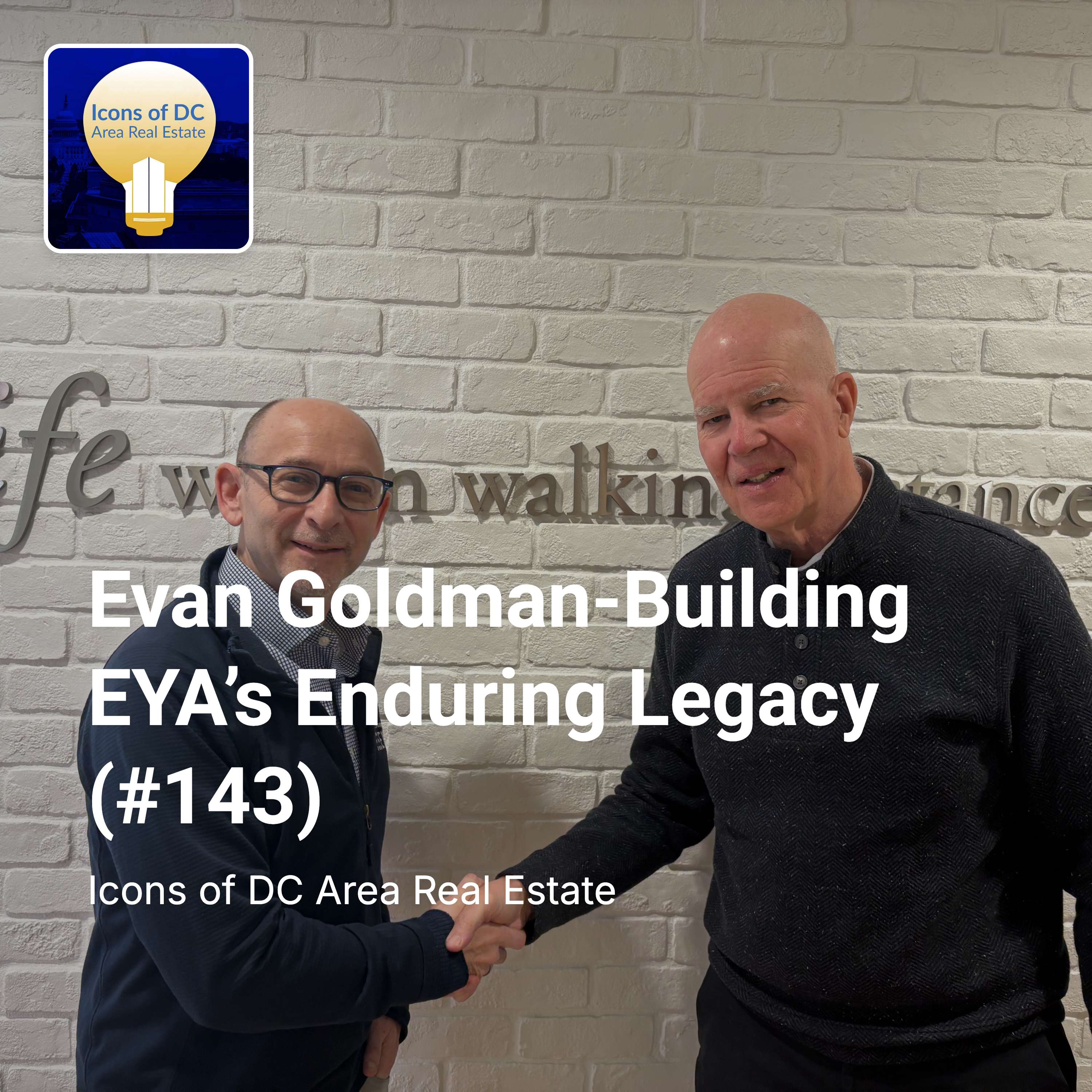
Today we are honored to speak with Evan Goldman, Executive Vice President of Acquisitions and Development at eya, formerly Ekin Yelmantaub Associates. Evan is part of the next generation of leadership for eya, a company renowned for creating high quality urban and transit oriented residential projects all dedicated to the principle of life within walking distance.
Evan's arrival at EYA formalized a deep professional relationship that began years ago. He credits his current position and success significantly to the mentorship and friendship of Bob Youngentaub, EYA's late founder, whom he met through ULI.
Evan recalls Bob as an incredibly inquisitive individual who offered guidance rooted in incredible experience and intelligence, but delivered in a supportive, humble way that never felt condescending.
This relationship was fundamental to Evan's decision to join eya and Bob's legacy lives on in the company's commitment to strategic succession and the formal Project Visioning Committee, A tool for the vital transfer of knowledge.
Evan brings a dynamic background to his role. He holds an MBA from Wharton and led the complex 24 acre pike and rose development while at Federal Realty. He now shepherds EYA through immensely challenging infill projects such as the redevelopment of the historic Providence hospital site in D.C.
and was involved in the Robinson Landing in Old Town Alexandria where construction was halted for 14 months due to the discovery of three Revolutionary War era ships. One of the largest architects archa archaeological digs on the Eastern Seaboard.
Despite the demands of work and civic life, Evan's number one priority is his family in Adams Morgan where they consciously maintain an urban, walkable lifestyle.
Finally, we hear from Evan's core belief on urban life.
If he could put one message on a billboard, it would be a reminder that the spaces we love, that house you love, the coffee shop, the grocery store, the office are all brought to you by your neighborhood developer.
He argues that rather than attacking development, solving regional issues like affordable housing requires us to view the urban environment as an ecosystem and work collaboratively with developers.
[00:03:35] Speaker B: In an honest way.
[00:03:37] Speaker C: Stay tuned for our insightful conversation with Evan.
[00:03:41] Speaker B: So, Evan Goldman, welcome to Icons of DCRA Real Estate. Thanks for joining me today.
[00:03:46] Speaker A: Thank you, John. Happy to be here.
[00:03:48] Speaker B: So as Executive Vice president of Acquisitions and development of eya, how do you define your high level mandate and primary focus areas today?
[00:03:58] Speaker A: Great question.
[00:03:59] Speaker B: So.
[00:04:01] Speaker A: I became an executive vice president of Acquisitions and development a number of years ago when me and my partners and I became part owners of eya. And this brings up the sad fact that it's in the past week that Bob Young and Thomas passed away, our founder. And I wouldn't beer today were it not for him. And it's been a trying week. It's been a trying number of months because obviously he's been sick well before he passed away. But when he made the decision that he wanted to create a sustainable long term plan for the company, we worked with him collectively and the people who had been lead developers for projects. We all took the role of executive vice president for acquisitions and development. And that was myself, Jack Lester, akash Thakar and McLane Quinn.
And the four of us who are now four of the five owners of the company.
In that role, we are out there looking at potential sites to bring into the acquisitions to look at. We work through the development process.
That's where things were a number of years ago as we have progressed the as we've progressed over the last number of years into more of a typical corporate structure. McLane Quinn has taken the role of President CEO.
Akash Thakar really focuses primarily on acquisitions at this point, despite his excellent experience with development.
And then Jack Lester and myself both work on acquisitions and development in varied ways. And that's where that role really comes in. So for me, I probably spend about a third of my time working on acquisitions and the rest of my time working on development. And I spend a lot of my time at the interface or intersection between acquisitions and development where we're coming up with a vision for a project, making sure that it works economically, mentoring and working with our great incredible development team on the implementation of the project and acting as kind of project executive on many of those.
[00:05:58] Speaker B: So you're on the front end mostly.
[00:06:00] Speaker A: Yeah, that's right.
[00:06:01] Speaker B: You're not doing, you're not doing the zoning and all that kind of thing?
[00:06:04] Speaker A: No, no, I am. Yeah. So. So my role starts from the second we're starting to look at a site all the way through entitlement.
And then we have eway. We're very lucky. We have a hundred employees and about 60% of our company works on the construction, operations, engineering site, permit review, site permit approvals, sales, marketing of all the projects that we build. And so there's a handoff.
[00:06:30] Speaker B: So you're mostly in the pre development side then.
[00:06:32] Speaker A: That's right.
[00:06:32] Speaker B: Okay, got it.
[00:06:33] Speaker A: Yeah, got it.
[00:06:35] Speaker B: Your responsibilities include sourcing new deals, shepherding projects through development process, what specific type of acquisition opportunities are currently prioritized in EYA's strategic pipeline?
[00:06:47] Speaker A: So we townhomes will always be a big part of what we do. That's where we got our start back in the 1990s.
And so when, whenever we can find a great, well located 3 to 10 acre townhome site, especially if there's high barriers to entry or some difficult entitlement that would lead a land seller to want to work with someone like us. That's our bread and butter and we love that. And that's, that's our core business.
But in the last 10 years, really 15 years, we've expanded pretty dramatically into commercial mixed use with apartments, retail where appropriate, larger scaled, master planning. And so that's the other half of what we do. And that's probably, if you look at us from where we were 10 years ago to where we are now, we have now thousands of units in the.
[00:07:31] Speaker D: Pipeline and a pretty substantial multifamily practice which is new, relatively new.
[00:07:36] Speaker A: And I think the market, the market now is understanding what EYA does in full. I think for many years people thought of us as just the Tantem developer and we love being Tantem developers. We're one of the biggest in the region. But this other side gives us a lot of flexibility.
[00:07:51] Speaker B: We'll explore those details when we get into your conversation later. And it's interesting you're joining them, I think had a big influence in that, I imagine because of your background. So I'd like you to talk a little bit about that.
[00:08:02] Speaker A: Yeah, sure, I'm happy to. I think it's almost the other way around. It's. EYA was already headed in that direction.
[00:08:07] Speaker B: Oh, okay.
[00:08:09] Speaker A: And, and they needed your help to. Yeah, I think so. I think so. I, I think that they would have been successful regardless of whether I'd come there. It's an incredibly talented company. But I do think Bob, Bob and I had been friends through uli. He was a mentor of mine of sorts for many years and was a. When I was working at Federal Realty when Pike and Rose finally opened and people understood the vision and the transformation of what you could do on a 24 acre shopping center, I think he had a lot of respect for the level of detail and the vision and the architectural design.
And at one point, I actually gave him a tour around pike and Rose. And if you knew Bob, he's someone who likes to ask incredibly detailed questions, again, to the details of everything. You interviewed him, of course. And so he was asking me everything from what was the price of this and what was where did you get this material from and why did you make this decision?
This was before we had even started talking about me coming to eya. It was almost like a pre interview, but it was a phenomenal time spent together.
And we then continued talking. A few months later, I made the decision that I wanted to pursue eya, and as a result, I came over. But I think my background has contributed to the success, but I think it would have been successful regardless.
[00:09:24] Speaker B: All right, well, let's shift back now to your origin story a little bit if we can, Evan.
[00:09:29] Speaker A: Sure.
[00:09:30] Speaker B: Where did you grow up and what influences did your parents and family have on you?
[00:09:34] Speaker A: So I'm from Suffern, New York. I'm originally born in Brooklyn, but I was primarily raised in Suffern, New York.
[00:09:39] Speaker B: Where's Suffern?
[00:09:40] Speaker A: It's in Rockland county, so the other side of the Hudson river from Westchester, just north of New Jersey. And I grew up in a. What is now suburban, but at the.
[00:09:49] Speaker D: Time in the 70s and 80s was.
[00:09:50] Speaker A: Pretty rural part of New York. We were 25 miles from New York City. Both my parents commuted into the city and there were no sidewalks. We lived, I think we were at least a mile from the closest store, which was a 7 11.
[00:10:03] Speaker B: So it was a rural area.
[00:10:04] Speaker A: Yeah, it was pretty rural.
[00:10:05] Speaker B: You're in the western part of the country.
[00:10:06] Speaker A: The western part of Rockland.
[00:10:08] Speaker B: Okay.
[00:10:08] Speaker A: And it's developed over time. It's become more built up, familiar with it. Yeah.
[00:10:12] Speaker B: So one of my. Another podcast guest of mine grew up there, Adam Ducker.
[00:10:16] Speaker A: Oh, yeah. Yeah. Adam and I grew up really close to each other.
[00:10:19] Speaker B: Yeah, he told me.
[00:10:20] Speaker A: Yeah. And he grew up in an area that was a little more developed than where I grew up on the north side of the highway. But yeah, so I grew up in Suffern. I, as I said, both my parents commuted to the city and I.
I'm someone who often I'm willing to share very openly, so I'll just share openly about my past. But I grew up in a. I think from the outside we were a middle class family, but we struggled a lot economically.
[00:10:45] Speaker B: So what'd your dad do?
[00:10:47] Speaker A: So my father ran a law firm, but he, and he's passed away, but he was in a gambler and that, that fed into his business decisions as well. And so as a result we were always struggling financially. We'd have a good year and then we'd have two or three bad years and that type of ponies.
[00:11:05] Speaker B: Was he into race horse racing or more Atlantic City? Ah, yeah.
[00:11:10] Speaker A: It's funny as a kid, gaming, looking back now, I think I would say this in the moment growing up, I think I had a very normal childhood.
Looking back, as you get older and you have some distance, you can understand the flaws or the issues and also how it made you who you are. And they like our first vacations were always to Atlantic City. That's where we would go on trips. And I didn't realize that that wasn't a normal thing for like a 7 year old or 8 year old kid to do. But we'd go to Atlantic City, my parents would go gamble for the weekend. I had an older sister, they would kind of give us a thing of quarters and say go to the game room. And I would basically spend the whole day, I was probably 8, 9, 10, really, just wandering around these enormous hotels. I would, I wasn't supposed to, but I would often go out on the boardwalk and go to other hotels and I mean looking back, I would never let my kids do that. But it was a different time and I got just enthralled by the beauty and majesty of hotels and lodges.
[00:12:03] Speaker B: Oh my God.
[00:12:05] Speaker A: But yeah, so that was how I grew up. But as a result of that, there was a lot of anger and fighting and strife in the family.
And so I, I think a lot of my current design focus comes from the fact that I turned inward and really started just drawing. And anytime I could, I would sketch houses, I would sketch neighborhoods, I would draw.
[00:12:27] Speaker B: So when did that start and how did it generate?
[00:12:30] Speaker A: I think I was five when I started drawing.
[00:12:33] Speaker B: So did you like Legos or I mean, loved legos.
[00:12:35] Speaker A: Loved. Did you ever these.
My grandmother was a teacher and she was a huge force in my life and she had all these building blocks.
[00:12:42] Speaker B: Sure.
[00:12:43] Speaker A: Apartments. So I would just build for hours and create things.
[00:12:46] Speaker B: As a kid I started girders and panels. I played that when I was a kid. And the Erector set.
[00:12:52] Speaker A: Yeah, exactly.
[00:12:52] Speaker B: All that.
[00:12:53] Speaker A: Yeah, I loved it. And so that I think for me, like it was my outlet. It was something that I love to do. I didn't know that it would ultimately turn into a career development, but at the time I could lose myself in it.
[00:13:05] Speaker B: That's Cool.
So high school there locally and then.
[00:13:10] Speaker A: Yep. Yeah, I went to high school there. I. I had.
I became pretty independent. And so by the age of 10, I was doing my own laundry, making my own food. I was really.
[00:13:20] Speaker D: Yeah.
[00:13:21] Speaker A: I got my first job at McDonald's when I was 14.
So I kind of, as a result of the situation, kind of figured out ways to.
To live the life I wanted to live. And then also.
[00:13:31] Speaker B: So did your grandmother kind of divert you that direction or how did you get oriented to do that, to get away from.
[00:13:37] Speaker A: Great question.
[00:13:38] Speaker B: Gambling, Father.
[00:13:39] Speaker A: It's a great question. She. She was definitely. We saw her every weekend and she was a huge influence on me. She was steady, she was intellectual. She. She lived till she was 92. She read the paper every day. She taught till her mid-70s.
[00:13:51] Speaker B: I'll bet. She was a huge influence on me.
[00:13:53] Speaker A: Yeah. And. And she encouraged me. She was like, you're good at this. You're good at drawing, you're good at sketching. Like, keep this up.
[00:13:58] Speaker B: Yep.
[00:13:59] Speaker A: And then as I got older, I think for me it was.
I wasn't going to put myself or my kids or my family in a position where we didn't have economic stability. So that just became a driving force. It's. I think it's definitely part of my inner drive is a desire to make sure that we have stability.
[00:14:17] Speaker B: Did religion have any influence. Influence on you at all?
[00:14:20] Speaker A: Less so. I'm probably more religious today than I was then. I'm Jewish.
[00:14:23] Speaker B: We were that age. You're into the whole Hebrew thing, right?
[00:14:27] Speaker A: Yeah, but it wasn't. It was probably more. I was in. I was a childhood actor.
[00:14:31] Speaker B: Oh.
[00:14:31] Speaker A: So acting kept me focused as well.
[00:14:33] Speaker B: That's interesting.
[00:14:34] Speaker A: And, yeah, between that and art and drawing, I think that that kept me busy.
[00:14:39] Speaker B: Interesting. Yeah. So that. Did you do that in high school, then? Did you do performing art?
[00:14:44] Speaker A: Elementary and all the way through middle. Once I got to high school, I think I became much more focused on art and architecture, and I started taking classes in architecture and drafting.
Okay.
Yeah. I was also a band geek. I heard. I listened to Hillary Goldfarb's session that she did with you, and she mentioned she was a bandy, too, and it makes sense why we're such good friends.
I was a bandy. I was the drum major, so I. I always found outlets. I've been. I'm pretty extroverted, and I always found folks to be with, friends to be with. And so I had a great community of support beyond that, which was really nice.
[00:15:21] Speaker B: Well, that's Interesting.
So you went on to Cornell?
[00:15:24] Speaker A: I did.
[00:15:25] Speaker B: So why Cornell and what drove you? That's a state school. So that, I imagine, helped.
[00:15:31] Speaker A: Yeah, that was a big part of it.
I went into. I actually went to Michigan first.
[00:15:36] Speaker B: Oh, did you?
[00:15:37] Speaker A: So I was. I like to say I was like an expert of backdoor entries into universities.
[00:15:42] Speaker B: Got a scholarship to get to Ann Arbor or what?
[00:15:44] Speaker A: No, I initially got into. I did not get into Michigan initially.
And I called up the admissions department. I was pretty dogged. And they told me to reapply as a summer entrant, which is not something they do anymore. But at the time, they did, and it increases your chance of admission by, like, twofold. So I got into Michigan as a summer student to start freshman year in June. And then Cornell, which I'd applied early to, didn't accept me, initially deferred me, wait listed me, and then literally three days before I was headed to Ann Arbor, I got into Cornell as a January transfer my freshman year. So I ended up having two freshman semesters at different Colle.
I got to go to Michigan, which I love, and I'm a huge fan still to today, I'm on the loan. Oh, I didn't know that.
[00:16:26] Speaker D: Really?
[00:16:26] Speaker A: Oh, that's so cool.
[00:16:28] Speaker B: The way I got into Ann Arbor.
[00:16:30] Speaker A: Are you from Michigan?
[00:16:31] Speaker B: Oh, yeah.
So the way I got in was I did very well on the sat.
[00:16:37] Speaker A: Math.
[00:16:38] Speaker B: Math was my thing. Numbers.
So I went to the engineering school first.
And that was. The admission bar was lower than LS and A.
[00:16:50] Speaker A: Opposite now.
[00:16:51] Speaker B: And then. And then I. And then I. I transferred after my freshman year.
[00:16:56] Speaker A: To what major?
[00:16:58] Speaker B: Well, from general engineering into poli sci.
[00:17:02] Speaker A: Oh, interesting.
[00:17:04] Speaker B: And I learned that I didn't want the law.
[00:17:07] Speaker A: Got it.
[00:17:08] Speaker B: I hated it.
[00:17:09] Speaker A: That's interesting.
[00:17:10] Speaker B: And I hated. I hated political activity, and to this day, I do. So I'm a businessman, and I learned that while I was there. But I didn't get into the business school, so I just kept going with that anyway.
[00:17:23] Speaker A: Interesting. So it's funny, when I showed up, I probably knew in my heart that I wanted to be an architect.
But once again, going back to economic stability, I also knew architects didn't make a lot of money, and I was worried about that. And so I started college as a undeclared liberal arts major with the idea of going to either business or law school.
And. And then I was there for a semester. I transferred to Cornell. I was a business major at Cornell, and within a few months, I was. I just knew it wasn't for me. Like every class had two to 300 kids. All the tests were scantron tests, if you remember, multiple choice scantron tests.
[00:17:59] Speaker B: So economics and all those things.
[00:18:01] Speaker A: Yeah, yeah, it was marketing and business management, economics and statistics and.
[00:18:05] Speaker B: Yep.
[00:18:05] Speaker A: And I liked the content but wasn't engaging enough for me. I'm much more of a hands on learner and I kept falling asleep in class and so I just knew by the end of my freshman year I was like, this isn't working. And I was doing well. My grades were fine, but I just wasn't excited. And a friend of mine was in this really small department at Cornell. It was the design environmental analysis school within Human Ecology.
[00:18:33] Speaker B: Interesting.
[00:18:33] Speaker A: And within it there was an interior design major at Cornell. So I was. Sorry. So the reason we. I transferred from Michigan to Cornell, but it was private. So the reason I transferred from Cornell, Michigan to Cornell was obviously because of money. I was in state at Cornell and it was just incredibly cheap back then. And. But within Cornell there are private schools and public schools. So architecture was a private school. That would have been four times the price of the public schools.
And within human ecology they had this design major that was in the public school.
So my first choice would have been to go for architecture but I couldn't afford it or we couldn't afford it. But the design program was this amazing small program I wouldn't have even known to think about when I was applying to college. But because of this girl that I was friends with, I ended up taking a few classes and falling in love with it. So it was a combination of environmental psychology.
[00:19:27] Speaker B: Environmental psychology.
[00:19:28] Speaker A: Explain what is that? Yes, so it's. Great question. So environmental psychology is like the reason.
It's the reason McDonald's is red and orange, red and yellow, and the seats are hard and the surfaces are hard and the restaurant is loud. Right. Like they design their spaces for quick movement. They want you in and out. They don't want you comfortable, they want you eating and ordering a lot of food. They want the energy. Whereas you go to a top restaurant where the mood is a little darker and the seats are comfortable and the tables are bigger.
[00:19:57] Speaker B: That's so cool.
[00:19:58] Speaker A: It's. How do you respond to your environment from a psychological perspective and how do you design environments to evoke those emotions? That's what environmental psychology is.
[00:20:07] Speaker B: It's fascinating because I've been reading about neuro architecture recently and that sounds exactly what that is.
[00:20:13] Speaker A: Yeah. You know what?
[00:20:14] Speaker B: You know what I mean?
[00:20:15] Speaker A: Yeah, yeah. I mean all design. I think what I love about design is you're designing for purpose. That's what EYA I think does so well. When we're planning communities, we're designing with users in mind. And that's what environmental psychology really forces you to think about who the end user is and how to design for them.
So if you take that training from a research perspective and then combine it with an actual design major where you are in studio just like architects four hours a day and creating models and designing projects and learning AutoCAD and creating interior space which is where we spend most of our lives. Inside, not outside.
It was a really cool training ground.
There were only 11 kids in my major.
[00:20:59] Speaker B: Wow.
[00:21:00] Speaker A: For my year.
[00:21:00] Speaker D: Sorry.
[00:21:01] Speaker A: For my year.
So we all knew each other really well. One of my professors was at my wedding. We knew our professors extremely well. It was really. It was my home. If you think of how I grew up when I got to Cornell and I found this small intimate group with unbelievable mentors and leaders in the department like that I felt I could breathe. I felt like I was home. I had stability. It was so.
It was so cool.
[00:21:24] Speaker B: Life changing for you.
[00:21:25] Speaker A: Yeah, it really was.
It was totally different. Yeah.
[00:21:29] Speaker B: So is there any other program like it anywhere? I mean at that time, I mean we're talking. I mean today there would be but back then this is pre Internet and stuff.
[00:21:39] Speaker A: It's ironic you ask. So my daughter's one of. I have three kids. My middle daughter is applying to college for design or architecture and she literally last night was writing her essay at University of Wisconsin and Madison which has almost the exact same program also in the Human Ecology school.
So yeah, there are a few of them.
There aren't many because most interior programs are architects. Well mostly are more interior decorating programs and not as research based. And then you have architecture programs which tend to focus more on the outside and exterior of projects. Structure. There aren't as many of this interior architecture focus or interior psychology.
[00:22:19] Speaker B: Yeah, I mean you're getting into elements. I've been looking for somebody to talk about this with this and I'm so glad because I just feel that when you. And because you're a mixed use developer.
Let's get into that. Because that whole feeling that you walk into a space, what is it about that space that's special?
[00:22:40] Speaker A: Yeah.
[00:22:41] Speaker B: And there's all six, five senses but there's actually a sixth in my opinion. And I'll let you. You can elaborate on that a little bit. But you just have this sense that you don't know what it is but you just have this sensor in the Right place at the right time. Yeah, I don't know what that is. It's hard to explain.
[00:22:58] Speaker A: But, you know, when I talk about pike and Rose, I often talk about it from that lens.
[00:23:02] Speaker B: I want to get into that.
[00:23:03] Speaker A: Like pike and Rose, the people that love going there, they don't often know why they love it, but it's the immersive environment, it's the landscape, it's the, the, it's the changing landscape throughout the season. It's the little details on the buildings. It's the, you know, you feel like it's a cared for place and. Right. And that makes people feel comfortable, it makes them feel safe and they want to linger longer than they normally would. And that's, that's what creates great places.
[00:23:31] Speaker B: So what factors influence your decision to pursue an MBA in real estate and finance from Wharton? And how critical was this foundation? And did you do that right after college or did you go to school?
[00:23:41] Speaker A: No, no, I. So after. Yeah, after graduating Cornell, I went to work at an architecture firm in New York.
[00:23:46] Speaker B: Oh, you did?
[00:23:47] Speaker A: Yeah. Brendan Beer Gorman Architecture, BBGM Interiors.
[00:23:50] Speaker B: So you, you were in interiors for them? So even without an architectural degree, you were hired by an architect?
[00:23:56] Speaker A: Yeah, I worked partly on the interiors and partly on the architecture side. They had both. And so depending on the project, I worked on both.
But I got.
Some of. This is luck. I think a lot of success in life is hard work combined with luck.
And I was working there for about a year and there was about probably 100 people or so.
The assistant to the head of architecture design was this woman who just randomly had gone to college with one of my. I'm sorry. Growing up with one of my sister's friends.
So she was older than me, but we knew each other and were friendly.
She quit and she. Because we were friendly, she recommended to the head of architecture that he replace her with me. And so I became the assistant to the head of architecture as this guy named David Beer, who is kind of an iconic legend in New York architecture.
He was a savant. I mean, he was an unbelievably creative mind. Totally disorganized. His shirt was always untucked. He had Sharpie smudges up and down his face and on his hands. He would work.
[00:24:58] Speaker B: He was a creative genius.
[00:24:59] Speaker A: He was a creative genius. And he would work till 2 in the morning. He would come in at 4 in the morning sometimes. He just was addicted and loved work and he was really creative. So I was his assistant, which meant I got to work on all of the New business, business development projects for the company, looking for competing for hotel projects around the country.
And it was like trial by fire. I always tell young people, when you first come out of college, try to find a job where you're working on as many different projects or as many different acquisitions as possible so you learn quickly about different things versus going and working on one project for eight years. I would have never wanted to have done pike and Rose right out of college. Right, you want to come out of college and get a lot of breath.
[00:25:37] Speaker B: But your curiosity was overwhelmed.
[00:25:39] Speaker A: Basically, yeah. And he taught me the basics of planning and design and creating symmetry and creating beautiful spaces. But one of the projects we worked on, and this is all related to why we ended up. I ended up going to business school.
We were working on a competition to win the Mandarin Hotel in New York City. There hadn't been a Mandarin at that point, and our client was Tishman Speyer, which owned Rockefeller Center. And so Tishman asked us to create a design to renovate one of their office buildings within Rockefeller center into the Mandarin Hotel. So phenomenal location, beautiful old historic building.
And so that for about six months of my time there, I worked on existing conditions, plans, layouts for hotels, feasibility analyses, and was presenting directly to Rob Spire, who's now the president, CEO. But at that point, I can't remember his title. I think it was svp.
[00:26:32] Speaker B: His father was still.
[00:26:33] Speaker A: His father was exactly. Was running the company.
And I started realizing that all the.
In the end, we lost the project. It went to Warner center to relate at Columbus Circle. And I was devastated because I really believed in that building, that that should be the hotel.
And I realized that the key decisions were being made across the table by the developer. And that no matter how great the architect, how great the architecture, how much you work hard as a planner or designer, at the end of the day, your client is the one driving the decision making. And I just wanted to be on that side of the table.
[00:27:08] Speaker B: And that's exactly. It's fascinating you say that because I just finished interviewing Diane Hoskins, who's the chair of Gensler, and she said the same thing when she was a young architect and went to work for Olympia New York, which is a huge developer at the time, and was on that side of the table. But she got bored and went back to architecture, which was interesting. I mean, if you're into business. She got her MBA at ucla and I said, wow, you were bored.
So I guess everybody's mind works a little bit differently. But I was like, I Would have been, wow, I'm into business now.
[00:27:46] Speaker A: I could see it on the architecture side too, depending on what role you have in architecture.
[00:27:50] Speaker B: Right.
[00:27:51] Speaker A: But for me, I just couldn't get over the lack of input into that decision making process. And so I just needed that.
[00:27:59] Speaker B: You became a steward of the developer? Basically, yeah.
[00:28:02] Speaker A: From there, actually. So I started applying to business school, but I was only two years out of college, so I took a detour and a friend of mine at my firm who was a mentor of mine, this guy Jeffrey Higginbottom, he encouraged me to come with him to another company, which was a restaurant developer in New York City.
[00:28:19] Speaker B: Oh, okay.
[00:28:20] Speaker A: So it was called Leroy Adventures.
[00:28:22] Speaker B: Warner leroy.
[00:28:23] Speaker A: Warner leroy. How do you know that name?
[00:28:25] Speaker B: Because he built the Potomac Restaurant here in. Yeah.
[00:28:28] Speaker A: Max's Plumbing.
[00:28:29] Speaker B: And he did Tavern on the Green in New York City.
[00:28:32] Speaker A: That's funny. No one ever that's impressive outside of New York. That's not a name that most people know.
[00:28:37] Speaker B: Oh, Warner leroy was funny.
[00:28:39] Speaker A: Famous. Yeah. So Warner leroy was so for those listening, he was larger than life. He was.
[00:28:44] Speaker D: His.
[00:28:45] Speaker A: His grandfather was Jack Warner, who started Warner Brothers, and his father was Mervyn leroy, who was the producer director of the wizard of Oz. And so Warner Warner, literally his dog was Toto. Growing up. He was five when wizard of Oz was filmed.
[00:29:01] Speaker B: That's funny.
[00:29:02] Speaker A: And he just was incredibly creative. Anyway, so he started this company, the Roy Adventures. He actually moved to New York to be a playwright originally. And then he started Leroy Adventures, they own Tavern on the Green and created what it is. He actually built the original Great Adventure, which is now Six Flags Great Adventure in New Jersey. And then he had a series of restaurants. So I was hired by him to work on the Russian Tea Room restaurant.
[00:29:25] Speaker B: Really?
[00:29:26] Speaker A: Yeah.
[00:29:26] Speaker B: Which is one of the top restaurants in the city.
[00:29:29] Speaker A: Yeah. And it had been derelict, it had been closed down. And so it was right next to Carnegie Hall. And he had this vision to turn it into something again.
So this designer who I had worked with at the architecture firm brought me over. I was going to be the assistant architect cad, draw up CAD plans, help design this project.
They had an in house design department as the developer of the project.
And Warner was eccentric. He just kept firing everybody. So within about six months, I was one of only two people left. In fact, me and this other senior designer were the only two left. And then he hired a new head of the department. He fired them. Then he hired a new person. Fired them. So. So at some point I was. I think I was 26 and he was like, look, he had this great New York accent. He'd be like, look, I know you're young, but I need someone to run this project.
He just, like, made me the head of the department.
I was 26 and I was VP of design. And I.
I knew. I knew enough to like, hire really good people that knew what they were doing. That was, I think, the best thing I did because I did not know what I was doing.
[00:30:31] Speaker B: The Russian Tea Room still?
[00:30:32] Speaker A: Yeah, it's still open.
[00:30:33] Speaker D: It's still open.
[00:30:34] Speaker A: We got it built. It was 30 million bucks.
[00:30:36] Speaker B: Where is it located again?
[00:30:37] Speaker A: 57Th and so it's near Rock Center. Right next to. Yeah, not far from Rock center, but right next to Carnegie Hall.
[00:30:43] Speaker B: Got it on the west side then.
[00:30:45] Speaker D: On the west side, exactly.
[00:30:48] Speaker A: So that experience gave me some confidence, allowed me to get exposure to development. I was managing all the budgets and managing the contractors. We were own general contractor, so we built the interior of the restaurant as well.
[00:31:00] Speaker B: That's quite an experience.
[00:31:01] Speaker A: It was really fun at that age. Yeah. And I'm sure that had something to do with getting into Wharton. I mean, Wharton doesn't typically accept a lot of architects into their MBA program. But having done that, had Warner developed.
[00:31:14] Speaker B: Built the Potomac Restaurant in Washington Harbor?
[00:31:17] Speaker A: That was closed by the time I was there.
[00:31:18] Speaker B: It was closed.
[00:31:19] Speaker A: Okay.
[00:31:20] Speaker B: So we financed the Washington Harbor.
[00:31:23] Speaker A: Oh, interesting.
[00:31:24] Speaker B: For Herb Miller.
And when I moved to Washington, it was under construction in 85. It opened, I think in 86 or 87. And that restaurant was the. Was the. And it had a. Apparently had a chandelier that was like 10ft across.
[00:31:40] Speaker A: Made a Tiffany glass. Man.
Yeah, he. That was closed by the time I was working there. But I.
I believe the chandelier from that restaurant is what is now in the Russian Tea Room that we redesigned.
[00:31:52] Speaker B: Oh, really? The same chandelier?
[00:31:54] Speaker A: Yeah. If you go to the Russian Tea Room. We designed one of the floors, the Russian Tea Room, around a Tiffany glass, stained glass chandelier. It was pretty cool. I think it came from that restaurant.
But yeah, it was. It was an experience. It was create. It was a lot of creativity. He fired me at one point, but then he hired me back.
[00:32:12] Speaker B: What a story.
[00:32:14] Speaker A: Yeah, he. He didn't like that I stood up to. Stood up to him in a meeting in front of. We had these. We had these design meetings.
I think it was every Wednesday. He would come into the office at about 10am and from 10 until it should be. It was supposed to be a 10 to 12 meeting, but they would always go till about three or four, you weren't allowed to bring food in. You weren't allowed to leave to get food. He would get food served to him on like a platter during the meeting. So he'd be sitting there eating in front of you while you're all slaving away and getting yelled at and working hard. And if you didn't like something, he'd throw it. I mean, it was, it was an intense environment.
[00:32:48] Speaker B: Yeah.
[00:32:48] Speaker A: And he, but he was a perfectionist. We had seven different samples of banquettes designed and created so he could, we could sit on each one and make sure we had the right banquette. The, the china, the silverware, the, the, the gold leaf samples, like everything we selected, he was heavily involved in because he was pretty creative. But he didn't like. I stood up to him in that meeting because I didn't like the direction he was going on something. And he fired me in front of everybody. And then he called me two hours later and I came into his office and I said, look, thank you. I appreciate all the work we've done together. I was accepted to Wharton a few months ago. I was going to defer, but since you fired me, now I'll go. And he then gave me a scholarship to Wharton and convinced me to stay for a year so I could finish the project.
And we had an excellent relationship from that moment further. So. But yeah, it was, it was one of the most unique experiences of my career.
[00:33:42] Speaker B: That's incredible.
So the orientation there kind of gave you how to be particular about things.
[00:33:50] Speaker A: Exactly. Did it? Yeah, that's right. Demanding particular.
But I'd say the difference is you.
[00:33:57] Speaker B: Might not be a jerk though.
[00:33:58] Speaker A: Right. So I think, I think why EYA is right, you know, why I love it here is EYA is the most collaborative and team oriented place. We are a culture. We don't yell. We're a culture where there's psychological safety. It's amazing. It's a family. And Bob created that. That's who Bob was. So I think I was able to.
[00:34:22] Speaker D: Persevere in difficult environments throughout my career.
[00:34:25] Speaker A: When I was younger.
But it then led me to make.
[00:34:29] Speaker D: Decisions later in my career to find.
[00:34:30] Speaker A: A place that was the right cultural fitness. And, and I, I'm very. I wake up every single morning thanking God that I found this place.
[00:34:38] Speaker B: So you frequently guest lecture about real estate planning and development at prominent universities such as Georgetown and Cornell. What is the most important lesson you try to convey to young professionals entering the field?
[00:34:50] Speaker A: So when we talked about. I do think it's important to Get a lot of, I call them reps. When you're young, right, you gotta work on a whole bunch of stuff in order to learn.
I also talk to people about leveraging your strengths, figuring out what your strength is and leverage it. So there's a lot of ways to be a developer. You can come at it from the business side, you can come in from the finance side. Like you had a financial background, you can come from a legal background, you can come from the design background. Figure out what your strength is and really leverage that into your work. And you need to, as a developer, be really good at everything. You need to know about everything. But you really want to have your space and where you are kind of the expert within in that sphere. And so if you're coming out of business school, let's focus on being incredibly analytical and understanding the financing, understanding the numbers, but then also dabbling and taking a class in design, dabbling and taking a class in the law, taking classes in marketing and making sure you're more well rounded. And for everyone I talk to who's a student, including my. I have a sophomore in college right now. I'm always encouraging, make sure you're taking some classes that stretch your creativity and force you to think creatively, defend your work in front of a crowd, be able to take criticism and feedback and go back and modify and come back again with a new version. I think a lot of kids these days are very protected and not used to that. You have to be able to take criticism and you have to see it as a challenge that makes you work harder and better versus something that makes you shrink from the light.
[00:36:20] Speaker B: The other thing I try to encourage people is to not be afraid and go first.
[00:36:25] Speaker A: Yeah, yeah, be first.
[00:36:26] Speaker B: Go, go. Do.
Don't let anything hold you back. Yeah, you're young, you can take risk, you can get knocked down, but just get right back off up and brush your but be bold. Because that to me, you won't get ahead unless you really push hard.
[00:36:45] Speaker A: It's an interesting story.
I agree and I talk about that sometimes because my origin story with Leroy adventures, I was 26 and was willing to accept this role that I knew I was in over my head in.
But I figured out a way to work it out and I think with pike and Rose, that came back as well. I don't know if you know how I got that job, but we'll get into it. Okay, so on that one, I basically went to Don Briggs, the head of development, had coffee with him. We had been working together on The White Film Partnership. And I, I told him, I think you need this role. I think you need, you need someone underneath you who can manage and create this project. And he, he, he said, you don't have the skills for this. You're not ready for it. And I said, just give me a chance. You can fire me if that's not working out, but give me a chance. And I agree. I think a lot of young people, including myself, maybe at times have the confidence or the nerve because they're afraid of what might happen. But you're never going to know unless you try it. And if you challenge yourself, you might find you succeed. And if you don't, you'll learn lessons from that too, from the failure. And you can then move on and create something else.
[00:37:54] Speaker B: The first, in my opinion. And I'll just learn what you're good at first.
What do you love to do and what are you good at? And then once you see something, go for it. Don't wait, don't sit back, just go. I wish I had done certain things when I was younger. Who knows?
[00:38:13] Speaker A: Totally agree.
[00:38:15] Speaker B: Just go and get it.
Your career includes fundamental roles, foundational roles at Tishman Speyer and as a partner at Holiday Corporation. What key insights did you gain from these early experiences that inform your current work at eya? Now let me amend that. I didn't know about your other experiences and we didn't bring those up, but you've got more foundation than those, obviously.
[00:38:41] Speaker A: Yeah, those helped me in those further, further roles. So my summer at Wharton, my summer I did investment banking, which also taught me some basic skills. But. And I don't think I would have gotten a full time job at Tishman's Buyer if I hadn't had that type of training. Tishmanspire taught me professionalism.
It taught me the power of a brand.
[00:39:02] Speaker B: Why did you go to Tishman?
[00:39:04] Speaker A: That's a great question too. I had three job offers coming out of business school. Tishman was. One of them was in a suburban market, which I wasn't as excited about, ironically working for Matt Bierenbaum. That's what I would have been working for at the time, but.
[00:39:16] Speaker D: So one was a suburban market and.
[00:39:18] Speaker A: The other two were urban.
[00:39:19] Speaker D: I had lived in New York City after undergrad, before business school, and I unknowingly fell in love with the idea of life in the walking distance right while there was.
[00:39:28] Speaker A: And Tishman.
I love their properties, I love their culture, I loved their. I thought it would refine my skills a bit. I'd come From a very unprofessional work environment at Leroy Adventures. Amazing.
[00:39:40] Speaker B: But they were a client of yours too, weren't they?
[00:39:41] Speaker A: Had been a client. So it came full circle. Rob Spire was probably the reason I became a developer in the first place.
And so the idea of going to work there was phenomenal. So what I learned there, they are an incredibly well run ship. They excel in beautiful design and they really hit the nicest trophy assets in every market.
But they have a rotation program.
So I got to work six months in private equity, six months in acquisitions, and six months in development.
[00:40:09] Speaker B: Well, that's great.
[00:40:10] Speaker A: It was phenomenal. And I don't know if they still do it, but it was foundational for me. The development job was down here in dc.
[00:40:18] Speaker B: What did you work on when you were with them?
[00:40:20] Speaker D: So I worked for a guy named Jim Evans.
[00:40:22] Speaker B: Oh yeah, sure.
[00:40:23] Speaker A: So great. Yeah, Such a nice guy.
[00:40:26] Speaker D: And Rustam was head of architecture.
[00:40:29] Speaker A: He still may be there.
[00:40:30] Speaker D: So I worked for the two of them on. They had Westfield's Office park out in Virginia. We worked on one building there.
[00:40:37] Speaker A: And then I worked on the Macy's redevelopment at 13th and G, which has.
[00:40:42] Speaker D: An office building above the store, which was a pretty complex project.
[00:40:47] Speaker B: Was Brian Barry there at the time?
[00:40:49] Speaker A: Oh, great question. So he joined when I moved back to New York for my last rotation, which I think was acquisitions. He then joined in dc. So we, I know him. We were friendly and we interacted. But I wasn't working directly with him because I wasn't in the office anymore. So that to me taught me quite a bit. But I knew I wanted to do after working there, I knew I wanted to do residential development, not commercial.
At the time, they weren't doing a lot of residential. So I, headhunter had called me and I found a job in D.C.
my wife and I always knew we'd live in New York forever. So we figured it'd be an adventure to move to some other market for two years and do a project and then come back. And 23 years later we're still in Washington D.C. so that happened. But I worked for Holiday Corp. So I came down to D.C.
and holiday was the exact opposite. It was 30 people. It was small, it was family run. Exactly.
It was so laid back.
[00:41:47] Speaker B: What attracted you?
[00:41:48] Speaker A: What attracted me there was Rita Bamberger. Rita Bamberger was the developer I was going to be working for on this project.
She was brilliant and she still is. And she was essentially giving me a project, a condo project to develop as the head of that project underneath her and. And So I was going to get direct experience managing and development all the way through construction and delivery with her as my mentor and educator. And so it was. It was that opportunity to be hands on, on a real project that excited me. Doing development and a small company like that, you do everything right. Like you do the leasing, you do the.
The condo docs, you do the.
[00:42:22] Speaker B: Which project was your first one?
[00:42:24] Speaker A: I was 1800 Wilson Boulevard.
[00:42:25] Speaker B: Oh sure.
[00:42:26] Speaker A: Just south of. Or just north of Clarendon. Just north of Courthouse.
[00:42:30] Speaker B: Got it. Multifamily or.
[00:42:33] Speaker A: Yeah, it was a condo building. We had a resale. It was in 2005, 6. Where the market crashed and we had to re. Sell 80% of the condos.
[00:42:42] Speaker C: But.
[00:42:42] Speaker A: But you know, you learn from that too.
[00:42:44] Speaker B: That's about the time I met you, when you were you alive.
[00:42:46] Speaker A: That's right. I was getting involved.
That's right, exactly.
[00:42:49] Speaker B: Because Rita was pretty active.
[00:42:50] Speaker A: She was at that time. Yep.
Yeah.
[00:42:54] Speaker B: So you were there for a few years. Couple years, yeah.
[00:42:59] Speaker A: I think almost like four to five years somewhere in that range.
[00:43:01] Speaker B: And then you started to tell the story about how you got to federal. So what?
Go. Go to talk. Evolve to that if you would.
[00:43:10] Speaker A: So, so Holliday Corporation owned a property called Metro Pike Plaza.
[00:43:15] Speaker B: Yes.
[00:43:16] Speaker A: At the corner of Marinelli and Rockville Pike.
[00:43:18] Speaker B: Right. On the east side of Rockville, on.
[00:43:21] Speaker A: The west side, actually. Across from the Nuclear reg Building. Right across from Lerner's Nuclear Rail.
[00:43:25] Speaker B: Oh, okay.
[00:43:26] Speaker A: Got it, got it. And although everything in that area is called like either Mid Pike, Metro Pike.
[00:43:31] Speaker B: Is that a strip retail property?
[00:43:32] Speaker A: It was a strip center.
[00:43:34] Speaker B: Yeah.
[00:43:34] Speaker D: Still there.
[00:43:35] Speaker B: Right.
[00:43:35] Speaker A: Had a McDonald's at the corner.
[00:43:36] Speaker B: Yes. Okay.
[00:43:38] Speaker A: So they, they'd owned that for a long time, actually. Terry Akin, who, you know is the.
[00:43:42] Speaker D: Founder of ua, was still a partner.
[00:43:44] Speaker A: In that project from his time having been in the. At a Holiday Corp. But they own that site. They. We had this idea of trying to upzone the density and create something bigger. JBG was either under construction or getting approval. For North Bethesda. Yeah, for North Bethesda Market.
So. So I started working on that project at the same time Federal Realty and Lerner both decided they wanted to redevelop their major sites, which was Mid Pike Plaza for Federal Realty and of course the mall for Lerner. And so they were talking to the county about a sector plan process for the Wifeland sector plan or redo of the sector plan.
And that wasn't going great initially.
So they then brought JBG in, who was also interested in A sector plan, redevelopment. The three of them started working together and collaborating.
I had met all the net. The sector plan meetings, and I'd become friendly with some of them. And so I kind of asked if we could join the partnership. And eventually the partnership became five or six different companies. So Gable, bf, Sol, Holiday, Federal, Lerner Tower.
[00:44:48] Speaker B: The person that was the coordinator for that was my next door neighbor for 20 years. Oh, who? D. Metz.
[00:44:54] Speaker A: Oh, I love D. Metz.
[00:44:56] Speaker B: Yeah, that's so great. He was my neighbor. And her husband Bob was one of the leading zoning council in Montgomery County. Worked directly for Joe Blocker, the founder of Limited Blocker, and was well known.
And so they were our neighbors for about 20 years.
[00:45:13] Speaker A: So Dee came in a few years later. She came in when the partnership had become a real. Almost like a bid for the county.
[00:45:20] Speaker B: Yes, because she had run the Bethesda.
[00:45:23] Speaker A: Exactly.
[00:45:24] Speaker B: And she was great partnership before.
[00:45:26] Speaker A: The original Waifland Partnership was a private group of developers working collectively to try to get a sector plan approved.
And it was, I think, one of the first times you saw developers collaborating and coordinating for the greater good versus competing, which is how most developers typically work.
So through that, I got to know the federal realty people. Don Briggs in particular, who's brilliant, and he's probably one of the most talented people I've ever worked for. And as I said, I recognized after a year that he didn't have a lot of support. He was working a lot of hours and that I could learn a lot from him. And so I, over time, convinced him to take a chance on me.
And I was.
[00:46:06] Speaker B: So you had been watching the planning process for pike and Road?
[00:46:10] Speaker A: Oh, not just watching.
[00:46:11] Speaker B: We were.
[00:46:12] Speaker A: We were driving it. I mean, so. So within the partnership.
[00:46:15] Speaker B: Yeah.
[00:46:16] Speaker D: Of the six firms that were part.
[00:46:17] Speaker A: Of it, I was pro. Greg Trimmer from jbg. Yeah. Were two of the youngest members of the partnership. And so the two of us, along with Francine Waters from Lerner, were doing most of the day to day work.
[00:46:30] Speaker B: Interesting.
[00:46:31] Speaker A: Of driving the sector plan process, working with the county and working with the community. Community.
And then. And so that's how I got to know them so well. Most of the other people in the partnership were more senior and didn't have as many hours to dedicate to it. So I convinced. I convinced Don to give me a chance. And I came over to Federal Realty.
And what was unique is I was the. I think I was the only person within the partnership who was 100% dedicated to one project, which was now pike and Rose. But Mid Pike Plaza. Everyone else, Greg Trimmer, had multiple projects. Francine was working on different things.
So I ended up becoming the de facto, kind of head of the Lifelin Partnership.
[00:47:07] Speaker B: So you worked with Dee pretty closely at that point?
[00:47:10] Speaker A: No, she wasn't part of it yet. So. Dee Dee. So after the sector plan was approved, which took five years, then the county created Friends of White Flint. And ultimately, like a bid. Well, we created Friends of White Flint, but ultimately that became this bid. And she ran that. So she was. She came in later and was pivotal to the implementation. But during the approval process, we were running that process. And what we did, I think uniquely there was. We kind of used.
We had a planning commission hearing that did not go well. Where the opponents came out from every community, they were worried about traffic. They were worried about the environment. They were worried about heights of buildings.
[00:47:51] Speaker B: Was White Flint still open at that point?
[00:47:52] Speaker A: The mall was still open, yep. Worried about the mall closing?
[00:47:55] Speaker B: Yeah.
[00:47:56] Speaker A: So we had. At the planning commission hearing, there were some Smart Growth advocates that spoke. There were a few residents who spoke in favor, but most people were opposed to the project. And we recognized. We had a meeting after that. And we recognized, if we don't figure out how to build community support, we're not going anywhere. We were trying to get almost 30 million square feet of development approved, which ultimately got approved. 29 million square feet. So. So we had this great meeting. And it was JBG that had this idea. It was Rod Lawrence at have this idea of bringing in a consultant to help us, a third party political organizer to help us learn how to. And figure out how to engage the community.
And they.
[00:48:33] Speaker B: Who was that?
[00:48:34] Speaker A: It was. Hold on.
Was it Dewey Squared? It was a guy named Tom McShane and Kiki McLean.
Tom was based in Boston, I think they were called Dewey Squared.
[00:48:44] Speaker B: Came out of town. Out of town, yeah.
[00:48:46] Speaker A: He came from Boston. She was local. And they literally taught us and trained.
[00:48:50] Speaker D: Us on how to.
[00:48:52] Speaker A: How to present in a community meeting, how to respond to questions.
[00:48:57] Speaker B: So you didn't rely on local council to do that?
[00:49:00] Speaker A: We had no. We had. All of our land use attorneys were in the room too, providing the local portions that you needed.
[00:49:04] Speaker B: Right.
[00:49:06] Speaker A: That stuff. But they were teaching us how to.
[00:49:10] Speaker D: Persuade an audience how to make an argument.
[00:49:12] Speaker A: And they did polling for us so that we understood the issues in the community.
And then we could highlight the things that the community were most concerned about. And what was phenomenal at the time was the polling was pretty clear. People wanted major change.
They wanted to have a downtown. They were proud of. They wanted solutions for traffic. And we were able to show through the infrastructure plan that we were coming up with and through the 3D visualizations of what we were going to create, that we were going to solve for some of their biggest concerns.
And through that polling effort, we then also were able to find hundreds of supporters within the community who were willing to write letters, who were willing to show up in hearings. So over the course of a year, we had over 80 community meetings. Wow. Yeah.
I had a two year old daughter. My wife was pregnant with our third.
[00:50:05] Speaker D: Kid, or no, sorry, my wife had just given birth to my second kid.
[00:50:09] Speaker A: Apologize. So I had two little kids at home.
She was not very happy with me at the time.
[00:50:14] Speaker B: 80 meetings, my God.
[00:50:16] Speaker A: Anyone who wanted night church group, book club, Rotary club, Tea club, hoa, civic association, business group, anyone who wanted to meet with us, we would accept the meeting and we would come in and have a conversation and listen and show empathy.
[00:50:32] Speaker B: And did you have counsel with you at all these meetings?
[00:50:35] Speaker A: At every meeting.
[00:50:36] Speaker B: Who was your main counsel?
[00:50:38] Speaker A: Oh, my God.
[00:50:38] Speaker D: So we worked with Barbara Sears, of course. Steve Robbins was in the room, Pat Harris was in the room.
[00:50:43] Speaker B: Was this when Lino's and Blocker still was around?
[00:50:45] Speaker D: Yeah, Linnos was still around and everyone had their counsel, but Robbie Brewer was in the room representing Lerner. So I'm sure I'm missing somebody, but there were a lot of employers.
[00:50:54] Speaker B: Bob Harris, was he involved?
[00:50:56] Speaker A: Tangentially, I don't think.
[00:50:57] Speaker D: I don't. Not directly, I don't think so.
[00:50:59] Speaker A: I could be wrong, but we. So but we felt that it was.
[00:51:03] Speaker D: Important for the developers to be the ones presenting and not the architects, not the council. We had to tell the story because.
[00:51:10] Speaker A: It was what we were creating.
[00:51:11] Speaker B: Of course.
[00:51:12] Speaker D: And I remember our first meeting was at this condo called the Wisconsin and. Right on.
[00:51:16] Speaker B: Oh, yeah, that's Forest Cities project.
[00:51:19] Speaker D: Exactly. Yeah, yeah, exactly.
[00:51:21] Speaker A: And we didn't know what to expect.
[00:51:22] Speaker D: We showed up early. I thought we were showing up early, but it was a condo with a bunch of older folks living in it. So they were there like a half hour before the meeting started, sitting right in the front. And there was some heckling initially, but by the time they saw the imagery, we knew our answers, we knew our talking points. We understood how to tell them that what we were going to create was going to make their lives better.
[00:51:41] Speaker A: And by the end, we had converted.
[00:51:43] Speaker D: A whole bunch of people to be supportive, that they ended up being one of our biggest supporters throughout the process.
[00:51:48] Speaker B: Let's get into pike and Rose design thought process.
You had this Mid Pike Plaza talk about that shopping center. This was a Toys R Us. I mean, we shopped there when I was a kid.
My children are 39 and 35.
So when they were little, 30 some years ago, that was Christmas time.
[00:52:10] Speaker A: I didn't realize you grew up here. Yeah, totally.
[00:52:12] Speaker D: Oh, yeah.
[00:52:12] Speaker B: Well, 40 years.
[00:52:13] Speaker A: Yeah.
[00:52:14] Speaker B: So, I mean, that center was old when I moved here.
That center was built in the 60s.
[00:52:19] Speaker A: So that was one of Federal Realty's first assets.
[00:52:21] Speaker B: Yeah, it was built in the 60s, I think maybe late 50s. 50s, yeah. But it was an old center then.
[00:52:27] Speaker A: It was. And it was. That is the original Toys R Us.
[00:52:29] Speaker B: Yeah.
[00:52:30] Speaker A: In the world. And the actual original Toys R Us that.
[00:52:33] Speaker B: I thought it was in New York City.
[00:52:34] Speaker A: No, the original Toys R Us, which wasn't named Toys R Us, was a toy store in Adams Morgan.
[00:52:38] Speaker B: Oh, okay.
[00:52:39] Speaker A: And then they moved out to Rockville Pine, Toys R Us. So, yeah, I mean, it had a linens and things, a Toys r us, an AT&T store, a CVS.
[00:52:47] Speaker B: It's a big center.
[00:52:48] Speaker A: Gold's Gym, I think was there. Silver, the diner.
[00:52:51] Speaker B: Right.
[00:52:52] Speaker A: So. So pike and Rose, what. What is now pike and Rose was Midpy Plaza, 24 acres, 330,000 square foot retail shopping center. And Federal Realty had the insight back in the early 80s as the Metro. I think the Metro opened in 85 or 86.
They got control of the property. I believe in 83.
[00:53:10] Speaker B: Actually, Metro opened in the late 70s in White Flint.
[00:53:14] Speaker A: I don't like White Flint Station opens.
[00:53:16] Speaker B: A little later, maybe early 80s. Yeah, yeah.
[00:53:19] Speaker A: So they had this vision with the Metro opening that this project should be something better, something different.
But it took them about 20 years to get site control. From a leasing perspective, CVS had parking restrictions and visibility restrictions. Toys R Us and Linens and things the same.
So they really couldn't redevelop much of the center. And I think it's often something that I think most people don't recognize when.
[00:53:41] Speaker D: They look at a shopping center or.
[00:53:42] Speaker A: Retired center and they want to see change or they want to see redevelopment. The landowners often don't have control of that site and don't have the ability to redevelop it.
[00:53:51] Speaker D: You almost have to de tenant the.
[00:53:53] Speaker A: Project and lose all your income in.
[00:53:55] Speaker D: Order to get to a place where you have control.
[00:53:57] Speaker A: So they aligned all their leases over time to expire around 2008 to 2010 and started working on the.
[00:54:04] Speaker B: Whose decision was it? Was it Steve, the former chairman?
[00:54:09] Speaker A: I don't think that's a great question. So I don't know the history in the 80s about who first had this idea of aligning the leases to expire. That's a great question.
[00:54:16] Speaker B: And to redevelop the site.
[00:54:17] Speaker A: Right. By the time I joined and it was likely going to be a bigger mixed use project. Don Wood was the present CEO, a visionary, if you haven't.
Okay, good.
[00:54:28] Speaker B: And he talked about how he got there. And of course. And of course, I don't know if you knew this. He was before he joined Federal.
[00:54:35] Speaker A: I know.
[00:54:36] Speaker B: Yeah. I know who he worked for.
He worked for Donald Trump. That's right.
Yeah.
[00:54:42] Speaker A: So Don was. Don is and was brilliant and incredible negotiators. He was running the company. Don Briggs was the head of development.
[00:54:49] Speaker D: Underneath him we had Chris Wamons who was running leasing, who was a mentor.
[00:54:54] Speaker A: Of mine and a phenomenal human. Just I loved working with him. Wendy Cyr is now president of the.
[00:55:00] Speaker D: Region of the think of the East Coast.
[00:55:02] Speaker A: She was running leasing on the project.
[00:55:04] Speaker D: And is also a phenomenal person.
[00:55:07] Speaker A: I mean, it was a full a team. Robin Ziegler and Debbie Colson on legal leasing. I mean an incredible team of people.
Such great resources. So I came in and by that point, the decision was already we were.
[00:55:19] Speaker D: Going to turn this into something.
[00:55:20] Speaker B: Was the vision already on the table at the time you joined?
[00:55:23] Speaker D: Not to the level of what we created.
[00:55:24] Speaker A: So when I joined, we had to come up with the development plan for the project.
[00:55:28] Speaker B: So you didn't even have a schematic at that point.
[00:55:31] Speaker D: We probably had some blocking diagrams and.
[00:55:33] Speaker A: Maybe a street grade.
[00:55:34] Speaker B: So you had a massing.
[00:55:35] Speaker A: Yeah, you need to go through a sector plan process.
[00:55:37] Speaker B: Right.
[00:55:38] Speaker D: Probably not even amassing.
[00:55:39] Speaker B: And did you even know what kind of far you could get?
[00:55:42] Speaker A: We were fighting for a 3. We were fighting for. We ultimately got a 3.4 far.
We didn't know if we would achieve that at the time. So the county, I think initially had us in the two and a half range. And so we joined forces with Lerner because they also wanted density. Yeah. And basically said JBG and jbg, if you guys want our tax revenues to redo the roads. Right. You need higher density. We did an economic analysis that showed the minimum FAR needed in order to justify tearing down the existing income of the shopping center. And that was pretty eye opening. And once the planners and the economic development folks of the county recognized that threshold, there was a willingness to increase the far to justify development, which was pretty huge.
[00:56:25] Speaker B: Well, the metro had to be A big part of that think thought process, too. The walkability of. To that and transit.
[00:56:32] Speaker A: Well, yes and no. So the Metroid, by the time the Wifeland sector plan was Starting, which was 2005, the Metro had already been open for at least 20 years. There had been little towers built here and there, but there wasn't the connectivity. There wasn't the grid of the streets.
[00:56:45] Speaker B: Well, Elcor had a big project too, right next to.
[00:56:49] Speaker A: They did. So at that point, they had built.
[00:56:52] Speaker D: I think the Harris Teeter building and.
[00:56:54] Speaker A: The apartment were under construction at the time.
[00:56:55] Speaker B: Well, they did the office building, too.
[00:56:57] Speaker A: Oh, right. And they did the Nuclear Reg building, Right? That's right. But even those at the time, they were kind of buildings.
[00:57:03] Speaker B: They were the first really, as I recall. Maybe I'm wrong, but Lerner was obviously already there with the mall.
[00:57:11] Speaker A: Yeah.
[00:57:11] Speaker B: But as far as office development, Elcor was right there, one of the first people doing it.
[00:57:17] Speaker D: Well, before Elcor was the original Nuclear Reg headquarters.
[00:57:20] Speaker A: Well, that's Lerner across.
[00:57:21] Speaker B: Lerner did that. That's right.
[00:57:22] Speaker D: And then you had. And then, as you said, the Elcor folks came in with a beautiful building.
But even then, you had these buildings.
They were set back from the street. In the case of the Nuclear Reg headquarters building, there wasn't retail at the base. There wasn't a grid of streets created at the time.
So it was kind of buildings in a suburban context. And what the sector plan, I think did, and the county drove this, as did the partnership, was how do we create a real grid of streets that can then help solve some of the traffic issues?
How do we create more pedestrian and bike walkability and bikeability? And how do we create continuous, beautiful retail streets? And that's what the sector plan really needed to do and did very successfully.
[00:58:04] Speaker B: It's interesting. Elcor kind of hit the wall there.
And now Hines owns that site.
[00:58:09] Speaker A: Yeah. Which is exciting. I think that's really exciting.
[00:58:11] Speaker B: It's interesting.
[00:58:11] Speaker D: Yeah.
[00:58:12] Speaker A: They're a phenomenal developer.
[00:58:12] Speaker B: So I'll be interviewing Andrew next soon.
[00:58:15] Speaker A: That's great.
[00:58:15] Speaker B: So it'll be interesting to hear what he has to say. So.
So you didn't have the massing even at that point.
[00:58:22] Speaker A: Yeah.
[00:58:23] Speaker B: So evolve that.
Did you hire an architect or was this internal first when you're thinking about it, or how did that all happen?
[00:58:32] Speaker A: Well, the making's even better. So I came in in the spring of 08.
We had just had our second kid, as you may recall, something big happened in the fall of 08, when Lehman Brothers collapsed.
[00:58:42] Speaker B: Of course.
[00:58:44] Speaker A: The Whole world changed at that point. And I felt very lucky and blessed to be working on a long term entitlement right where we did probably the.
[00:58:53] Speaker B: Most successful real estate company in the Washington region at the time.
[00:58:56] Speaker A: Yes, yes. I got, as I said, a mixture of hard work and luck.
And so we hired Street Works, had for, worked with Federal Realty for a long time. They worked on Santana Row in California. Their design team is phenomenal. They were working with us to plan the property.
And the big driving factors that ended up influencing what pike and Rose is today, I'd say were two things. One was because of the economic fallout from 2008, we had to have both a interim plan and an ultimate plan. We had to have an initial phase of development that if worse came to worse, would allow us to keep the rest of the shopping center.
And it could have just been a renovated shopping center with a parking lot and our initial phase of apartments, movie theater, fitness center and restaurants on Old Georgetown Road and that would have been it. We had to have that as a viable economic phase.
And the reason, I remember when we first opened the project all along Old Georgetown Road, there was some criticism about the main street is so small, it's only 300ft and why are you starting here versus on Rockville Pike?
We had leases.
So the two main restrictions were, number one, the economy and number two, I believe it was CVS at the time had a bunch of parking restrictions. The entire square parking field in the middle of the project had to be preserved. CVS ended up moving to the NOBE project shortly thereafter and that opened up that center field for development. If not, we would have had to wait a few more years until our second phase got built in order to develop that parking lot. But that's why the project was designed the way it was. And it then had to survive to the second phase, which is when the meat of the project got delivered. The street grid, the park space, the lion's share of the retail.
So there was a lot of complexity around both the economy, around currently the existing tenancy. And then how do you create a place and a there there with a.
[01:00:51] Speaker D: Very small initial phase.
[01:00:52] Speaker B: So what architect did you work with?
[01:00:55] Speaker D: To we had multiple architects.
[01:00:56] Speaker A: We had Design Collective, did the residential apartments, WDG did the office building in phase one and then in the future phases. What about the streetscape? Oh, the streetscape was so Streetworks was our master planner. Vika was the civil engineer.
[01:01:10] Speaker D: Sandy Clinton was the landscape architect who was phenomenal.
[01:01:14] Speaker B: You had to have a vision for the street there.
[01:01:16] Speaker A: So so that I would say Don, Don Briggs was.
He is one of the best urbanists.
[01:01:22] Speaker D: That I've ever worked for.
[01:01:23] Speaker A: His the way he thinks about streets and parks and open space.
[01:01:26] Speaker B: Was he involved in the Beth.
[01:01:28] Speaker A: He had been involved in Bethesda Row. He had been involved in Rockville Town Square. He knew about Santana Row from having worked.
[01:01:33] Speaker B: So David Kitchens, the architect was Bethesda Rowe. But I don't know if he was involved at all with park pike and Rose or not.
[01:01:42] Speaker A: He was not involved with pike and Row. That's right. But Don drove along with Street Works and myself drove this vision of what the streetscape and the setbacks and the cafe zones and the open spaces would look like.
We had a place making consultant named Paula Reese out of Seattle who was phenomenal. She had worked on Santana Row and she A lot of the. We call the moments of inspiration that you see throughout pike and Rose, the fountains, the art on the buildings, the really cool design and artifacts that was from her.
So she was at the table. So it was all about collaboration and teamwork. We had a team of incredible consultants and we focused in every meeting about the vision of what we were creating. And every decision was seen through a lens of how are we going to create long term value for the company. How are we going to create a beautiful place that will be enduring.
And yeah, it was an incredible training ground for me.
[01:02:37] Speaker B: Well when I interviewed Don Wood, his key word, his favorite word was balance.
I don't know if you ever heard because he's an accountant took course but he saw when he came in the company was so involved with Santana Row and then the fire on there. And so the development side of the business was just blowing and going but he had to make sure that the income was there to cover all that because they're a public reit.
So he won the war in the board meeting and of course then there was a big tumult. I don't you was at before you got there.
[01:03:13] Speaker A: That was before I got there, but I know about it. Yeah but that's. I think that's why the project was developed. The way it was was developed is he had the, the, the smarts or the, the, the gut instinct to make sure we had ourselves covered if the economy continued to go bad and we couldn't build the next phase and what happens if we can't continue to build? And so that's why that initial phase had to be built in a way that was sustainable. Yeah, I, I learned a lot from him. It's ironic from Both him and from Bob about risk.
I'd say when you, when you come into development from the design perspective, your natural inclination is obviously towards design.
And then what you. You have to learn the opposite side of things, the risk side. And that's something that Don Wood would push all the time. And Bob was all about that. How do you manage risk in the context of the beautiful projects that we deliver?
Where is the money best spent? What are the key elements that are really most important to the project?
Where can you cut something where it's not as valuable? And how do you make sure that the project has that balance of both economics and vision?
[01:04:17] Speaker B: So of everything you've worked on, what part of that project was unique? I mean, what, at pike and Rose? Yes.
I mean, there were so many elements that you had to put in there. I mean, you've got just about every kind except industrial. You've got about every use there. You don't have a data center. You don't. But you've got a hotel, you've got apartments, you have condos, you have retail, you have office.
[01:04:45] Speaker D: That's right.
[01:04:45] Speaker B: And the office has evolved kind of even after, which is interesting. That office came after the rest of it.
[01:04:51] Speaker D: That's right.
[01:04:52] Speaker B: And that's because the amenities were there and the office users said, oh, this is great.
So talk about the uniqueness of this project and why it was so successful. It is why was and is so successful.
[01:05:05] Speaker D: So I.
[01:05:06] Speaker A: And you generally just hit the most complex part of it.
[01:05:09] Speaker D: Financing any project is difficult. Financing four different uses, including a movie theater and a fitness club and restaurants on top of. Even within the retail, there were many uses all at the same time so that they can all deliver together.
[01:05:24] Speaker B: But you had a common ownership.
[01:05:26] Speaker A: Right.
[01:05:26] Speaker D: It's almost impossible. But for the fact that Federal was a REIT and could do it all equity and didn't need to have a whole bunch of different lenders and different buildings that would have made things really complicated.
[01:05:38] Speaker B: Well, the debt they would use would be corporate debt, not project debt, which is a whole different underwriting.
[01:05:44] Speaker D: Totally different underwriting. So I don't know that you could build a pike and road. You certainly couldn't build a pike and roads today, given the economy and the inability to finance most of the uses at the time.
Federal had incredible track record.
[01:05:56] Speaker A: Right.
[01:05:56] Speaker D: They were one of the few companies that have been able to deliver these major mixed use visions. They had the confidence of Wall Street As a result of that, which was critical. They had the stock price and the PE ratio to allow them to do it.
[01:06:09] Speaker A: And so it is unique and it's.
[01:06:12] Speaker D: Not something that any company can do.
[01:06:15] Speaker B: Well, I would beg to differ when you say no one can build today. So I look over in Northern Virginia and I see what's going on over there in Reston.
[01:06:23] Speaker D: Sorry, meaning no one could build all of these uses today. Well, it would be pretty hard to get.
[01:06:27] Speaker B: There's a project that I interviewed Chris Clementi, Reston Station. They have going on the same time. Office, hotel, condo and apartments simultaneously under construction.
[01:06:39] Speaker A: Yeah.
[01:06:39] Speaker B: So I would beg to differ with that statement.
[01:06:41] Speaker A: I'll say it's extremely difficult to do.
[01:06:43] Speaker B: And there it is.
[01:06:46] Speaker A: There are the exceptions to the rule. And it was extremely difficult back then too. But federal had the track record and ability to do it. So I'd say the most complex parts.
[01:06:55] Speaker D: Of that project were pulling all of that off together.
[01:06:58] Speaker B: Yeah.
[01:06:58] Speaker A: And making sure that all the uses worked. The thing we were most worried about.
[01:07:01] Speaker D: At the time was the office, which is why the initial office building is.
[01:07:04] Speaker A: Only I think it's 60,000 square feet, maybe 80, maybe 80,000ft. Because we just didn't know if we'd lease it. Time 2012 when we started construction.
Most of the office space on we.
[01:07:17] Speaker B: Were just coming out of the.
[01:07:18] Speaker D: Yeah, we're coming out of the recession.
[01:07:19] Speaker A: Most of those buildings were leasing at 25 bucks a foot.
[01:07:22] Speaker B: Right.
[01:07:23] Speaker A: And we needed to get 40 out of 45 in order to make that building make sense. And what's been phenomenal to see at pike and Rose is the strength of the office tenancy. Because as you said, the amenities that we've delivered or they've delivered allowed them.
[01:07:37] Speaker D: To continue building office after office after office at rents that are double what.
[01:07:41] Speaker A: You can get in the suburban market there.
[01:07:43] Speaker B: So I've recently made this assertion with other guests and my feeling is that the best mixed use projects in the country the foundation is the retail knowledge and experience.
[01:07:56] Speaker A: That's right.
[01:07:56] Speaker B: You have to bring or hospitality. But I haven't seen the big hospitality developers develop except. Well, I guess I can't.
Great mixed use comes from retail. To me the street level activity drives mixed use development.
Am I on base there?
[01:08:17] Speaker A: 100%. And what I'd say what I like what we do here at EYA is we can create life within walking distance with great parks, with access to schools, with access to amenities.
It doesn't have to be retail, but sometimes it should be retail and we're able to do that too, which is really nice. So it's nice to be not to be forced to do Retail, where it doesn't make sense, but to do it selectively and then when you do it, you got to do it really well.
[01:08:46] Speaker B: Mm.
How has your professional focus shifted from working on large retail based properties at Federal to leading acquisitions and development specific for EYA's urban and transit oriented residential focus?
[01:09:00] Speaker D: Great question. So I am, I'm one of the leaders of acquisitions and development. We have a head of acquisitions, so I just want to make that clear. Akash, my partner, is awesome and Jack Lester is my fellow development and acquisition person is phenomenal as well. So. But within that, the difference, like the reason I left Federal to come here was I could have stayed working on pike and Rose forever. They're still building buildings every few years.
But to me, the part that I think I'm best at and that I love doing the most is the front end. The visioning, the acquisition strategy, the entitlement, the planning. That's. That's where my expertise lies.
And so once the phase two of the project was delivering and the place had been created, generally I felt like my skills would be better served somewhere else. And I also, after having spent eight years on one project, wanted to work on multiple things.
[01:09:53] Speaker A: And I loved the idea of coming to a mid sized company that wasn't public, where we had a longer term window in mind rather than quarterly reporting, and where we could look at projects over the long term and work on eight or 10 or 12 different things and at different phases in development.
So that to me is, that's why I came. I'd say Bob was quintessential to that because I already knew him and trusted him and he was a friend. And so he, I think as I said earlier, he kind of saw the benefits of bringing someone else who really loved the visioning process into the company.
[01:10:33] Speaker D: And that's where I focus a lot. So within eya, I'd say my core area of focus is I run our pvc, which is our project visioning committee.
[01:10:43] Speaker A: And we created that a number of.
[01:10:45] Speaker D: Years ago as Bob. We'll talk about this at some point, but Bob is fairly unique as a visionary to have started thinking about the next stage of the company five years ago.
Well before he was sick, he had this idea of how do I engage the next set of leaders and how do we make EYA a long term enduring entity? And as part of that, we needed to come up with a way for transfer of knowledge from his experience as the visionary and the entrepreneur of the company to the next generation of leaders of the organization. So we have a pvc we meet every two weeks.
[01:11:19] Speaker A: It includes our head of engineering or our head of site to site engineering, our head of architecture and planning, our.
[01:11:27] Speaker D: CFO, our president and CEO, McLean, myself.
[01:11:31] Speaker A: Our head of marketing.
[01:11:33] Speaker D: Sure, I'm missing somebody, so I apologize. But that group plus whoever's working on the development project, we come in every.
[01:11:40] Speaker A: Few weeks and we go into detail.
[01:11:42] Speaker D: About the progress on the project from a design and vision perspective and whether it's still holding the design is still.
[01:11:48] Speaker A: Holding to the vision that we created initially.
[01:11:50] Speaker B: When, at what stage would a project come into that committee? For the first time.
[01:11:54] Speaker D: So for the first time you're going to do it during acquisitions while we're in letter of intent negotiation and we're just coming up with the initial vision.
[01:12:00] Speaker B: So the site's already been identified, Site's been identified.
[01:12:03] Speaker D: We come in, it's at that point, it's very basic, but it's what is the market? Who are we targeting? What is the product?
What are the challenges? What are the risks?
[01:12:12] Speaker B: So is your feasibility study internal or do you hire somebody to do that?
[01:12:16] Speaker D: Internal, yeah, we do all that internal. Well, we hire consultants for geotech and.
[01:12:19] Speaker A: Other specialties and civil engineering, things like that.
[01:12:22] Speaker B: But we match for the market analysis piece, though. You do that internally?
[01:12:25] Speaker A: Sometimes internal, sometimes not, depending on how complex the project is. I'd say most of the time, if it's a townhome site, we do it internally.
But the. So that was this opportunity for Bob to transfer knowledge. And he would be, in his kind of humble way, giving feedback and pointers on various design aspects of the deal. And then through that we would all get to absorb best practices. And now we've created that muscle memory within the organization where throughout every part of the organization, we know what Bob would do. Right. It's a little sappy, but you know, when I am planning something, like if I'm sketching, if I'm drawing something now, I will. I told him this before he passed. Like, I will stop myself and think about, am I looking.
[01:13:05] Speaker B: What would Bob do?
[01:13:06] Speaker A: What would Bob do? Is this. Am I thinking about the risks? Am I thinking about the view of this building? Am I thinking about how this is going to feel? And that drives a lot of.
[01:13:14] Speaker B: So for listeners, everyone listening to this should listen to my interview with Bob because he talks about this process.
I mean, their first project was in Alexandria. And one of his most challenging projects was on the river.
And he talks about some of the underground challenges he had in that project because the water and controlling that Ford's Landing. Yes. And then he also talks about why they felt infill townhouse development made sense at that time. This was late 80s, early 90s.
[01:13:51] Speaker D: Yeah.
[01:13:51] Speaker A: 93.
[01:13:52] Speaker B: Yeah.
Because no one was doing it. I said, well, what about Georgetown? I mean, it's there.
Old Town Alexandria. He said no one was building that at that time.
[01:14:03] Speaker A: That's right.
[01:14:04] Speaker B: Everyone was in the suburban greenfield type thing, not doing the infill residential. So it's just. It's interesting how the company evolved a little bit. So you this. I'm setting the stage here where you came on board then.
[01:14:18] Speaker A: Yeah, that's right. I mean, ultimately the company EYA is still. We pride ourselves in delivering homes. Like we love giving people a place to live.
[01:14:26] Speaker B: Right.
[01:14:27] Speaker A: We've provided 10,000 residents with homes, whether it's rental or.
[01:14:31] Speaker B: But you're not Pulte, you're not Dr. Horton.
[01:14:34] Speaker A: That's what makes us unique.
[01:14:37] Speaker B: You are a production shop to some extent like them, but you're really focused on finding infill location type settings.
[01:14:47] Speaker A: That's right. We're willing to.
[01:14:48] Speaker B: You're not going to do a Greenfields project out nowhere.
[01:14:51] Speaker A: That's exactly right. So we're willing to spend time and energy with deep community outreach to get complex projects approved in difficult places and in infill locations in order to create our tagline, which has been for 20 years, life within walking distance.
And what's so exciting and fun about that for us is we get to create that life within walking distance and we get to see residents move in to our communities and really get to enjoy them, which is a lot of fun.
[01:15:19] Speaker B: So I'll cite a few that I can think of off the top of my head of interesting sites and why they were built.
So I think of Rock Spring Park.
So the site that EYA developed there was an old office building that was originally built by IBM, was one of the first buildings built in Rock Spring park in Montgomery county, which is one of the oldest office parks in the county outside of downtown Bethesda and built by the Cameleer family, Davis Cameleer. And it's now. Most of the uses now in office there are medical uses.
[01:15:55] Speaker D: That's right.
[01:15:55] Speaker B: Because that's really the area. But you've got a site there that is big. It was a big. And you came up with it.
IBM owned the land. It was one of the few sites where they owned feed free and clear. So that made it easy for you to be able to do that deal at the time. And I don't remember who the seller was on that but you know, when you bought the land. But that's an interesting. Could have been opus. Yeah, that's a good thing.
[01:16:23] Speaker D: I think so.
[01:16:24] Speaker B: So it's a unique. Because it's a middle of an office park. Why would you build a townhouse development in the middle of an office park?
[01:16:30] Speaker A: Yeah.
[01:16:31] Speaker B: A suburban office park.
[01:16:33] Speaker A: Yeah.
[01:16:33] Speaker B: So I'll let you.
[01:16:34] Speaker A: So that's Montgomery Row is what we're talking about. Right. When we looked at that, we had to convince staff, planning staff.
[01:16:40] Speaker B: Yes.
[01:16:40] Speaker D: That that was a reasonable location, whole different use.
So we were kind of on the.
[01:16:44] Speaker B: Cutting edge of that only residential project in the entire. At the time.
[01:16:48] Speaker D: At the time.
[01:16:48] Speaker A: Right now Marriott's headquarters is being developed.
[01:16:50] Speaker B: Of course.
[01:16:51] Speaker A: Senior housing.
[01:16:51] Speaker B: Yes.
[01:16:52] Speaker A: So what we saw when we looked.
[01:16:53] Speaker D: At that location was incredible demographics, incredible macro, of course.
[01:16:59] Speaker A: Right.
[01:16:59] Speaker D: You're.
[01:16:59] Speaker A: Yeah, you've got some of the.
[01:17:01] Speaker B: Right there at 270, the beltway. I mean. Right.
[01:17:04] Speaker A: All the highways, Democracy Boulevard and the whole thing. You've got a really successful mall. Montgomery down the street you had Plaza, which is one of the most successful strip centers in the entire region. Also realty property just down the road you have incredible schools. So it had all of these great. It had great. You had Marriott headquarters right across the street.
[01:17:23] Speaker B: So you had Walter Johnson High School is a block away.
[01:17:26] Speaker A: Block away, yep, exactly. So you had these amenities, but it wasn't knitted together and it wasn't, it didn't feel certainly walkable at the time.
And we had this idea that where you have all of this office space in the area, if you bring the residential there, you can create a mixed use environment without retail in that case, with park space and open space and trail and then with the connectivity to the office there. And I think the idea is over time the biggest reason the office park hasn't developed more is the grants, the fact that it would have to be a ground lease as you mentioned, because the family owns the fee. But that site was unique in that you could get the townhomes built. And yeah, we proved people thought no one would want to live there. And that project was one of our fastest selling projects when we initially launched it.
[01:18:11] Speaker B: Hole in the donut.
[01:18:12] Speaker A: Yeah, it was a hole in the donut. That's right. And everyone has a different view of what is life within walking distance. Right. And sometimes that's life within biking distance. But from that location, if you're living in an urban townhome, you're a seven minute walk to the mall. You're probably a seven minute walk to Wildwood. Plaza, you've got the park space that we developed. You still can have a car, you can still drive where you need to go. But it was just enough of that walkability.
[01:18:39] Speaker B: It's a mindset change. It is, in my opinion. I mean, people wouldn't grew up in Montgomery county, really residential there.
[01:18:48] Speaker A: Right.
Well, now you're sitting at West Bard, which is quite frankly one of the most successful properties.
[01:18:54] Speaker B: I've got two more in Montgomery County I want to talk about.
[01:18:56] Speaker A: Go for it, Go for it.
[01:18:57] Speaker B: Let's go to Northern Virginia after that.
The other one is Seminary Square, whatever I think it's called Park Seminary, which, I mean, I don't live far from there. I live in Kensington.
[01:19:09] Speaker A: Nice.
[01:19:09] Speaker B: So just east of there is this really funky road next to the Beltway going around, and I've forgotten the name Linden Lane. And then next to that is this new castle. And you climb up this really steep hill right. Parallel to the Beltway in Silver Spring.
And then you get on Seminary Road, which leads into downtown Silver Spring. Eventually it goes to Georgia Avenue to the east.
[01:19:34] Speaker A: That's right.
[01:19:35] Speaker B: But in there was this. I'm sure it was 19th century, originally built like a seminary of some sort. I think it was a convent or seminary. And then adjacent to it was a medical or a military.
[01:19:50] Speaker A: Walter Reed.
[01:19:51] Speaker B: Walter Reed's annex building.
And then WSSC's headquarters is right down the street from there, if I'm not.
[01:19:58] Speaker D: Mistaken, their regional headquarters.
[01:19:59] Speaker B: Regional headquarters.
[01:20:00] Speaker A: They're in Montgomery County.
[01:20:01] Speaker B: Yeah, right off of there. So this is really a funky area.
And somehow EYA found this site. So talk to us a little bit of the story about that one and how that came about.
[01:20:11] Speaker D: So it's a great question.
[01:20:12] Speaker A: I was not here when that one.
[01:20:13] Speaker D: That's an older project, so that predates me. I don't know the origin story of it.
[01:20:18] Speaker A: I know that our history at that point of having worked on some other.
[01:20:22] Speaker D: Historic preservation type projects, we had done.
[01:20:25] Speaker A: Some work in Capitol Hill.
[01:20:26] Speaker D: We'd done a lot of work in.
[01:20:27] Speaker A: Old Town Alexandria at that point.
So we knew how to work within historic context.
And that was, I believe, largely why we were selected for the site. And what's unique about it, if anybody were to go drive there today, is.
[01:20:40] Speaker D: There'S all these old pavilion buildings from.
[01:20:42] Speaker A: The school that used to be there.
[01:20:44] Speaker D: And they were international pavilions. So there was one that was designed.
[01:20:47] Speaker A: I believe it was with like a Japanese pagoda and it was a Spanish mission style building.
[01:20:52] Speaker D: So you had all these different styles. And we had to come up with.
[01:20:55] Speaker A: This idea, obviously this predates me, but I know that as a team, we came up with this idea for having.
[01:21:02] Speaker D: The townhomes reflect the style of the various pagodas and existing buildings that were there. So it's one of our projects that has the most diverse architecture because you'll have different styles of buildings depending on what block you are within the development.
And then there's some old historic buildings that were preserved, some of which have been converted to condos, some of which have not been converted yet, but ultimately need to be. But yeah, it's a very unique location.
But that's the type of stuff where.
[01:21:29] Speaker A: I think UIA.
[01:21:32] Speaker D: Really specializes. We are pretty tenacious.
We're willing to roll up our sleeves.
[01:21:37] Speaker A: And work hard and be really creative.
[01:21:39] Speaker D: We're willing to work on our Tacoma project.
[01:21:41] Speaker A: We've been at it for 20 years.
Were willing to spend time to get something right. And that was a type of site.
[01:21:48] Speaker D: That needed a developer who could really.
[01:21:51] Speaker A: Work hard and understand the uniqueness of the property.
[01:21:53] Speaker B: You carved out a site there, literally.
[01:21:56] Speaker A: Yeah. It's pretty cool. It's one of the ones that whenever we have new employees, I always have them drive that site or walk that site early on in their tenure. Yeah, yeah.
[01:22:04] Speaker B: And then the other one, of course, is under construction right now and not far from where I live on the other side. And that's Strathmore Square.
[01:22:12] Speaker A: Yeah.
[01:22:13] Speaker B: Which is an interesting project as well. There was an existing townhouse development. I don't know if DIA built that.
[01:22:19] Speaker A: Was not us. No, I didn't think so.
[01:22:20] Speaker B: It was pretty high end.
[01:22:22] Speaker A: Yeah. Very beautifully done.
[01:22:24] Speaker B: Yeah. So I don't know if you're going to be analogous in quality to that.
[01:22:27] Speaker A: One or better or different style, but certainly, certainly that level.
[01:22:33] Speaker B: This is on Strathmore, behind the Strathmore Pavilion and the George and the Grosvenor Strathmore Metro is walking. Walking distance.
[01:22:42] Speaker A: That's right. And you had Holy Cross.
[01:22:44] Speaker B: That's your. That was your seller, Right.
They sold the land to you.
[01:22:48] Speaker A: That's right. And yeah, that's an example where we have. We've created a practice. Some of the areas we're most focused on is buying excess land from churches or seminaries, districts, schools, vacant office buildings, or to be vacant office buildings. That's generally one of our biggest target areas for redevelopment. And. But as a result, that we've worked with a bunch of religious institutions and have built up credibility with how to work with nonprofit partners who are not necessarily real estate professionals, want a good partner and a good steward of the Land.
And so I'd say the reason we were selected by Holy Cross was for that reason they, they came to know us and trust us. Saw the other work we had done with The Josephites in DC, with the Saint, the Paulists at St. Paul Seminary, and through that were comfortable that we would deliver on the promises that we were going to deliver on or that they wanted us to deliver on. So yeah, that, that is one of our core ways we get work on acquisitions. It's about partnership and who we can partner with.
And they've been a phenomenal partner to work with through this whole process. We had a situation in that project where the. We were supposed to have a senior housing component that fell out because of the economy. They couldn't finance that project. And so we had to rejigger at the last minute and modify our design. And they were great to work with. They stayed with us throughout that process, gave us the time we needed to get through that separate entitlement. And then, yeah, you're seeing the project today. It's a mixture of single family homes and townhomes kind of set within the hillside and preserving some of the green space with a great view of the Strathmore Music Hall.
[01:24:24] Speaker B: I haven't seen the, the plan, but maybe before I leave I can look at what you have.
[01:24:30] Speaker A: Yeah, it's really, really beautiful.
[01:24:31] Speaker B: And then another one, I want to get into the district now, which is obviously a very unique project. And that's the macmillan Reservoir project, which may be the most complex project you've ever done.
[01:24:43] Speaker A: Yeah, I'd say that. And Robinson Landing and Old Town are probably the two most complex. But yeah, McMillan is 15 years in the making.
There was a piece of land owned by the federal government that was transferred.
[01:24:55] Speaker D: To the city and then ultimately sold to a partnership which was us, Jair.
[01:25:00] Speaker A: Lynch and Trammel Crow, with Trammell Crow doing the commercial component.
[01:25:05] Speaker B: So how did that partnership come about?
[01:25:07] Speaker A: So we, when we were competing for that project, we created a team of people to go after that RFP who led the team.
So EYA generally led the team. We often do on most of our projects. Projects, because of our community engagement and master planning expertise, will often lead the effort. But they were right with us the whole way throughout that process.
[01:25:27] Speaker D: And Jair is a phenomenal developer.
[01:25:29] Speaker B: As I've interviewed Jair.
[01:25:30] Speaker D: Yeah, and Adam Weirs from Travel Crow was running that portion of it. So those were the main three partners. The city in that case was funding and funded a beautiful pool and 8.
[01:25:42] Speaker A: Acre park for the community.
[01:25:43] Speaker D: So that Was an awesome buffer, or created this awesome buffer between us and the existing community.
Delivered a huge amenity for the neighborhood. Something that a private developer just couldn't do. Really too big of a scale and a cost. But the city delivered something.
[01:25:57] Speaker B: What about renovating the historic underground facility there? Now how was that financed? And who did that? Who was.
[01:26:03] Speaker A: The city was responsible as part of the sale for doing the demolition and for the restoration work associated with the old sand filtration.
[01:26:12] Speaker D: Oh my God, the structures. And so that was, that was a risk that would be too great, I think for most developers to take.
[01:26:20] Speaker A: And that's when you need a public private partnership, is when you have something unique and difficult and potentially expensive, but hard to know what the costs are going to be. That's where you really need a.
[01:26:31] Speaker B: The only historic filtration plant in the United States. It's got to be one of them.
[01:26:35] Speaker A: I don't know. I don't know that answer. I don't know that answer. But it was pretty amazing. I know if you remember, if you follow the battles, but it had been a cordoned off property. Right? No one had ever had a long time forever. And. But God. Our, our, our supporters were largely the local residents who lived there that we worked really closely with on design, as we do on all of our projects. And we modified our project to make the local community happy. They like the amenities, they like the grocery store in the park, they like the grid of streets. Our opponents were largely not from the local neighborhood. Neighborhood. There were other people from outside of that neighborhood, from D.C. sometimes not even from D.C. that were opposed to development in general and fought us on that project. And I mean, if you just read a typical article, you would have thought that we had taken down a 30 acre park, a beloved park where people had been picnicking in the sunshine for the last hundred years. And we're turning it into development. But of course we all know that no one could access the site. It was a sand filtration site.
So I think over time we love working.
That's one of the best examples of. But we love working and getting deep into community engagement and listening and hearing and being empathetic. I think our nature as a company, the fact that our culture is we try to be humble, we try to be collaborative.
I think that helps us in working with community and that those work really well together. But we also recognize sometimes there are, there are community members who aren't working in good faith. It doesn't happen a lot. Normally you sit down face to face, you have Coffee. You can even, you can agree to disagree on some things, you can agree to agree on others. If nothing else, we have people who typically come to our hearings, even if they oppose a project, they'll usually say, ey, listen, they did make some changes we requested. I still don't want development. But they're not a bad, they're not bad people. That's usually what happens with our opponents. But from time to time you have opponents that, that really act in good faith and might spread rumors on the Internet that aren't true and that, that happened in McMillan and we ultimately got sued by some community members there and it held up the project for many years. But we won and the project got started and under construction and it's, it's been selling really well. It's beautiful. The views of the Washington Monument from there are phenomenal.
It's, it's a really special site, something we're really proud of.
[01:28:52] Speaker B: So you're the first developer to deliver there, right?
[01:28:55] Speaker A: Were the first ones. Right. So next will be Jair's project which he's working on the financing of right now.
[01:29:00] Speaker B: How did that all allocation of resources happen? Is that something right up front that was talked about?
[01:29:06] Speaker A: Yeah. We had a joint venture agreement up front on who was going to do what, who was going to pay for what, what the land value was. All that was determined up front as part of the partnership.
[01:29:14] Speaker B: How does EYA balance expansion of its core townhouse business with the dedication of resources toward building and executing a market leading multifamily arm, as mentioned in 2022?
[01:29:26] Speaker A: Good question. So we've, we've grown quite a bit. We're 105 people now, but we've grown.
[01:29:32] Speaker B: How large were you when you joined?
[01:29:34] Speaker A: When I joined we were around 85 to 90, I think.
So we've, I'd say we've probably doubled our capacity in what we're working on. So we've, you know, from a business plan perspective, we're delivering about double the number of townhomes per year from where I started. And we have a lot more multifamily and mixed use projects under entitlements, but we've only added maybe 10 to 15% more employees.
So we've added key people in certain roles, one of which is our new head of multifamily who started recently.
And so she comes from a big mixed use background having worked on phenomenal mixed use projects.
[01:30:11] Speaker B: Where was she?
[01:30:12] Speaker A: So she was at. I can share this because this won't air until December because not public yet, but Robin Bedrel's joining us from Hoffman.
She had been at Hoffman and then Middleburg.
[01:30:21] Speaker D: She'd worked on the Wharf.
[01:30:22] Speaker A: So she's going to run our multifamily division.
[01:30:24] Speaker B: Oh great.
[01:30:25] Speaker A: We also hired another great Hoffman employee, Tuck Said, who had worked on the construction side. So he's running construction for multifamily for us.
[01:30:33] Speaker B: I want to stop you for just a moment because you're talking about doubling the company since you've been here as far as getting projects in a financial environment that I've been told is very challenging to develop projects.
So the question is, is the pie expanding where you're finding new things that nobody else is doing, or are you taking deals from other developers that couldn't finance them to develop them? Or is a combination of both?
[01:30:59] Speaker A: Phenomenal question, John. So it's a combo of both. So I would say the negative that we're all experiencing in suburban office markets is leading to a lot of opportunity for conversion to townhomes and residential development.
And we were one of the first, as we talked about with Montgomery Row, we were one of the first groups in the region to do something like that. And we've repeated that success throughout the region, whether it's buying vacant retail or under leased retail like we did at grand park, which was the Lowmans Plaza in Virginia, or it's buying office parks in RESTON or the AT&T headquarters that we were purchasing in Oakton, Virginia. So a lot of these projects are the result of opportunity due to distress in suburban office market. And it doesn't mean that those office tenants are going away. A lot of them are moving to more like we wanted, moving towards metro oriented locations, class A buildings where they want to be in walkable communities. And so there is inevitably going to be fallout within the suburban market. And that's something we've been taking advantage of. So some of that is opportunistic.
And I'd say secondly, and you know this from all of our work at uli, we're in such a housing crisis and shortage in the region that even with the current headwinds that we're all experiencing, there is a shortage and a need for new housing, especially for a lot of our buyers are probably half of our buyers or so are typically empty nesters. They're people who are selling their house, they want an elevator unit, they want to be have less maintenance, they don't want to do yard work anymore.
So our types of communities appeal to that type of resident and that is a portion of the market where they're very underserved. Their choices are to move to a condo or buy a ranch house where they can have their bedroom on the main level of their house.
But a lot of those folks don't want to live in a condo. They don't want to live with people below them or above them, but they're willing to live in a townhome, a fee simple house with their own elevator.
And so we've been able to deal with the ups and downs of the last 10 years in the economy by targeting a portion of a segment of the market that is less or more immune to impact from that market.
And where there is such a high demand and a need that even in a bad environment you can still get those projects done.
[01:33:18] Speaker B: How are you financing them?
[01:33:20] Speaker D: So all of our.
[01:33:22] Speaker A: We have for our townhome projects, we've.
[01:33:25] Speaker D: Only had three equity partners in our.
[01:33:27] Speaker A: History of our company over Bob talked about 30 years. Yeah, they're our most meaningful and important relationships. Our current one we've been working for the last eight years with Bernstein Management Co.
[01:33:37] Speaker D: Which is Josh Bernstein, who was a close friend of Bob's, an incredible person.
[01:33:41] Speaker A: And so we have a regular investment committee with them. But they have the right to work on all of our townhome deals and have done some so. And they've been a really steady partner.
[01:33:50] Speaker B: But they're in the multifamily business. So.
[01:33:53] Speaker A: Yeah, they are in the multifamily business. They own a lot of multifamily.
[01:33:56] Speaker D: But.
[01:33:57] Speaker A: But from a townhome development perspective, they invest with us on our. And they. So they.
[01:34:01] Speaker B: So it's a programmatic relationship.
[01:34:03] Speaker A: Programmatic relationship. Which is really nice. We're not out shopping for equity. Every project got it. On the debt side, we have relationships with a number of banks and we generally go to those three or four banks for every deal.
[01:34:12] Speaker B: But you're not borrowing at full limit. I assume you're buying pretty leverage. Pretty conservative leverage. I assume.
[01:34:17] Speaker A: Well also because it's townhomes, we're not building the whole building at once. Right. So you're, you're never. You. If you need 100 million of debt, you're probably never more than.
[01:34:26] Speaker B: So it's a revolver type of structure like home builder.
[01:34:29] Speaker A: That's right.
[01:34:30] Speaker B: It's a home builder bobber situation.
[01:34:32] Speaker A: Yeah. And you mentioned that before. You said you made that comment, which is definitely right.
[01:34:35] Speaker D: Like we pride ourselves in building homes.
[01:34:37] Speaker A: But we're not a home builder per se.
We are a hybrid organization which is.
[01:34:42] Speaker D: Unique where we are both a developer, a traditional developer and A home builder combined.
[01:34:45] Speaker B: But if you're building townhouses, you're financing them like a home builder.
[01:34:49] Speaker A: Totally. Yeah, exactly.
[01:34:50] Speaker D: Well, not a public home builder, obviously.
[01:34:52] Speaker B: No. Because you're not getting corporate debt.
[01:34:54] Speaker D: That's right.
[01:34:55] Speaker B: I could go that direction. Why hasn't EYA thought about rolling up and doing something corporately as a company?
Because you could probably make it work now that you're going in the income producing realm. So maybe I'm jumping ahead. Maybe we should talk a little bit more on the evolution of the income producing side of the business and why that.
[01:35:18] Speaker A: So the income producing side of the business came from.
We were regularly getting entitlements and master plan communities approved. And then we would do the townhome development, but partner with someone else to do the apartments. We'd sell the apartment, essentially.
And at some point, what we realized internally about 15 years ago is we were doing the hard work of getting the approvals, which is often the most.
[01:35:41] Speaker D: Difficult part of the process, or tying.
[01:35:43] Speaker A: Up the site and getting approvals and then kind of giving away the value or the income to someone else to develop. And so we, we. And we'd already been building some condos, so we knew we could build multifamily effectively. We just hadn't done rentals at that point.
And so we.
I don't know if you've met. Have you ever met our CEO and President McLain Quinn?
[01:36:02] Speaker B: I met McClain, yes.
[01:36:04] Speaker A: So he's. He has an incredible financial mind. He comes from a private equity background before joining uia and, and his financial mind, along with Bob's creativity, the two of them working jointly with our other partners in the organization, came up with this comfort level around doing our first multifamily buildings.
[01:36:23] Speaker B: Well, I think of the DNA of your company too, to some extent. So I know the first equity partners I recall was the Mundy Property family, which was office.
[01:36:34] Speaker A: That's right.
[01:36:35] Speaker B: And they knew at that time, here's a guy doing residential that sure, we'll finance them. We're not competing with them.
No problem. Lot of money there.
Family and the whole thing.
And then JBG comes along.
[01:36:50] Speaker D: Yep.
[01:36:51] Speaker A: And so both were great partners.
[01:36:52] Speaker B: Yeah. So.
But you know, we know the DNA, we know what JBG companies is, of course. And one of the, perhaps the preeminent mixed use developer in the region.
[01:37:03] Speaker A: That's right.
[01:37:03] Speaker B: At the time.
And so there's the DNA for that. AJ's there now. He was here when he started his career.
[01:37:12] Speaker A: That's right.
[01:37:13] Speaker B: So that's where the affordability Side comes.
But you had that. And so what was interesting is the timing of getting in the multifamily. Was that because JBG was slowing down or was it because of the shift in working with Josh Bernstein or how.
[01:37:30] Speaker A: That transition predated Josh? Because our first deal with hoc, which was our Chevy Chase Lake deal, was while we were still had JBG on the townhome side. So it predated Josh.
[01:37:41] Speaker D: It's a.
[01:37:42] Speaker A: It's an interesting question. Like, was it because we were at that time when we. When JVG was our lead investor and they. The only reason they're not today is because they went public.
[01:37:51] Speaker B: They're a public company.
[01:37:51] Speaker A: Invest in townhomes anymore.
[01:37:53] Speaker B: Right.
[01:37:53] Speaker A: Our. Our investment committee approval would be going to their investment committee.
[01:37:56] Speaker B: Yes. That's how we Rob Stewart and you.
[01:37:59] Speaker A: Know, so we, we were around for that period of time a lot of folks who were certainly doing major apartment projects throughout the region.
[01:38:06] Speaker B: Yep.
[01:38:06] Speaker A: So that may have been part of it, that we were seeing other people do it successfully. Successfully. And that might have led to the thinking that we should try this on our own. But I think it was also opportunistic in that hoc Housing Opportunities Commission in Montgomery county had this piece of land at the Chevy Chase, what is now the Chevy Chase Lake Purple Line station will open shortly or in a few years.
They had a piece of land there.
[01:38:28] Speaker D: With an existing aging project or affordable housing project that they needed to redevelop. And we came up with this idea of, you know, instead of just replacing this with one big multifamily building, why.
[01:38:41] Speaker A: Don'T we work together and we'll build.
[01:38:43] Speaker D: Really beautiful townhomes that will provide equity.
[01:38:46] Speaker A: And land value to hoc that will then plug your gap to build the apartment building. And we'll be your development partner for the apartment building as well.
And that partnership was our first rental.
[01:38:58] Speaker D: Apartment building that we worked on.
[01:38:59] Speaker A: And really we got to kind of.
[01:39:02] Speaker D: Learn from that experience working together on this project.
[01:39:06] Speaker A: And it also fit with the values of the company where most EYA folks, EYA developers, people that come to eya, we have a phenomenally talented development department. And a lot of us care deeply about giving back in some way. And often that's through increased levels of affordable housing in our projects. And so that project was like, yeah, right down the fairway for what makes EYE tick and was kind of the perfect first.
[01:39:32] Speaker B: But what's interesting about that project, of course, is the adjacent owner, which is Chevy Chase Land company.
[01:39:39] Speaker A: Yeah, yeah, yeah.
[01:39:40] Speaker B: And that site went through a lot of changes over the years.
[01:39:44] Speaker A: It did.
[01:39:45] Speaker B: So before Busuto came in, there was another development team on it that trying to get it rezoned. Buenos and Brocker was involved.
I saw what was going on. And then the change in management at Chevy Chase Land Co. Kind of evolved to where Busuto came and was brought in. And Busuto, I believe, manages the HOC project now for.
[01:40:10] Speaker D: I believe.
[01:40:11] Speaker A: That's right, they did.
[01:40:12] Speaker D: Yeah, that's right.
[01:40:13] Speaker A: Yeah.
[01:40:13] Speaker D: Most of our apartment projects that we work on, we partner with Busudo. They're best in class.
[01:40:18] Speaker B: So it just. I'm wondering if Busuto had some influence there or whether they were.
[01:40:24] Speaker A: We predated them so we were before them.
[01:40:26] Speaker B: Right.
And then the other question I have is, were you interested in developing the mixed use project or was that even a discussion when Chevy Chase Land Company was looking at that?
[01:40:40] Speaker A: Ironically, when I was at Federal Realty, we were competing for that site. I believe we came in second to Busuto for the redevelopment of that property.
[01:40:48] Speaker B: Really? With Chevy Chase Land Company? Yeah.
So that's interesting.
[01:40:51] Speaker A: Yeah, but that was before I had come to uia.
[01:40:53] Speaker B: Yeah, but it kind of ties together.
[01:40:56] Speaker A: I could ask that question. I don't know the answer to whether EYA competed for that. My gut would be they didn't because at that time, EY wasn't. And even to today, we're not going to compete for a typical.
[01:41:09] Speaker B: But you brought a team.
You could have brought Brazuto in or somebody else.
[01:41:14] Speaker A: I think our interest. Our interest in that parcel would have only been if there was.
Well, no, no, we would have. If there was a nice four acre town component. And then you're building two apartment buildings.
[01:41:25] Speaker B: There is. On the east side or on the west side of Connecticut. There is, there is.
[01:41:29] Speaker A: But not part of that.
[01:41:30] Speaker B: Right.
[01:41:30] Speaker A: Part of that parcel. So that is where we excel. I think our Oakton property, which is the old AT&T headquarters building, is one of the best examples where the property is about half townhomes and we're able to generate the land value from townhomes and then the other half is apartments and retail.
And that's right in our sweet spot where we can deliver both of those uses now as one company, but we still get to hit our core value, which is still the focus on the townhomes.
[01:41:57] Speaker B: So one quick side.
When I moved to Washington in 1985, I worked for the B.F. sOL company.
[01:42:05] Speaker A: Okay.
[01:42:05] Speaker B: My office was on the second floor of 8401 Connecticut Avenue.
My view was the gas station literally across the street from that site. So actually it's part of it there.
So the purple line right behind the, right next to the building is the actual purple, which at that time was the Bethesda Trolley Trail.
When I started, the train was running going down to Georgetown and we had across there at Connecticut Avenue there was a train that went.
And it closed almost a year after I started.
So watching that site and of course Chevy Chase Supermarket was there and that little strip shopping center that Chevy Chase Land Co. Owned and watched the evolution of all that, it's just fascinating to see how that's all developed.
[01:43:03] Speaker D: Well, and it also hits on this idea that there's a lot of demand for suburban light or urban light, sorry.
[01:43:11] Speaker A: Where you have a urban walkable node.
[01:43:13] Speaker D: Within a suburban context.
[01:43:14] Speaker A: I think Chris Lineberger, I'm sure you've interacted with like he has done so.
[01:43:19] Speaker D: Much research in that area.
[01:43:20] Speaker A: And that is what the Chevy Chase.
[01:43:23] Speaker D: Node, that Chevy Chase Lake area really is becoming.
[01:43:25] Speaker A: If you live within a mile of.
[01:43:27] Speaker D: It now, you have a destination you.
[01:43:28] Speaker A: Can walk to or bike to so you don't have to drive for.
[01:43:30] Speaker B: So how much value was created by that mixed use development after your project was built and without townhouse?
[01:43:37] Speaker A: Great question. So we one of the nice things about townhome sales is you can sell.
[01:43:40] Speaker D: A home based on a future vision that's coming.
[01:43:43] Speaker A: The townhome purchaser doesn't have to see the finished product while they buy the house.
So we certainly sold homes with the idea that there will be this mixed use project coming at some point and that was, I'm sure helpful.
[01:43:55] Speaker B: So EYA positions itself as a Leader in Washington D.C. and Urban and transit oriented living. What Competitive advantages allow EYA's award winning neighborhoods to consistently be in demand?
[01:44:07] Speaker A: So I think the most important thing is site selection.
Location, location, location, right. So we in our investment committee spend a lot of time focused on is this an eye location?
Does this have the life of the walking distance traits that we're looking for? And if not, can we bring that to the project and in a way that makes that life within walking distance happen?
If we don't think that that is possible, we typically won't pursue a site.
So that is part of it is that we're looking for the right locations. And when you find those right locations where you, as we talked about earlier, there is a shortage of housing. So there is built in demand.
And if you provide the supply in a really quality home in the right design, the right market, the right location, generally you feel confident you're going to be able to sell those homes or at least those apartments. So location is really critical to us and I think for us, why we feel have loved the D.C. market and feel comfortable in this market is we have the relationships throughout the various jurisdictions and with various communities to generally know what we can get approved on a site and what's appropriate for a site. And as a result of that, we can, I would say, take very measured risk on sites that others might not be willing to try to entitle. So that once again creates those barriers, allows us to be even within a supply constrained market, delivering houses in a market that's even that much more supply constrained. So when we buy a vacant office building, Tyson's ridge on Route 7, a half mile east of Tyson Mall, where there hadn't been any residential infill, nobody would have thought of townhomes in that location. We felt pretty confident within our due diligence period that we could get a.
[01:45:52] Speaker D: Project approved there and that those townhomes.
[01:45:54] Speaker A: Because of the market and the schools were going to sell appropriately. So that's generally how we position ourselves for strength.
[01:46:01] Speaker B: Why haven't other residential developers competed with you on those things?
[01:46:07] Speaker D: Awesome question too. I think this goes back to the founding. So.
So Bob and Terry founded the company. Frank Connors was, I believe, the first employee. He was our COO and cfo. And they recognized early on that we had to have our own construction company that you couldn't really competitively bid a townhome project in the market.
You either had smaller general contractors who could build a single family home or two, and you had big GCs that.
[01:46:34] Speaker A: Charged a lot of fees or had higher prices, but you couldn't really build 100 townhomes or 50 townhomes economically. And so early on they took the risk to create our own construction company, our own land development company, and to give ourselves price competition or the price structure that was needed to build these houses appropriately.
[01:46:55] Speaker B: Why would Pulte or Dr. Horton?
[01:46:58] Speaker A: Because they're not going to take the entitlement risk. So we are willing to put millions.
[01:47:03] Speaker B: Of dollars at Toll Brothers did.
[01:47:05] Speaker A: So Toll is unique. Toll will sometimes do it. That's right. But not. That's not their core. No. Right. So if you look at Toll's portfolio and they're one of the best home builders in the country, if you look at their overall portfolio, in most markets, they're doing what most homebuilders are building, right. They're taking sites, farms, other space on.
[01:47:24] Speaker D: The fringe of an urban area and.
[01:47:26] Speaker A: They'Re building beautiful communities in some markets like dc, where they're high barriers to entry, they will do entitlements as well.
[01:47:32] Speaker B: But.
[01:47:32] Speaker A: But that's not their core business as a company nationwide for eya, that's our core business. That's what we do. That's what we do best. And so to some extent that allows us to. Sure, if you're a home, a land seller, and you've owned a property forever, and it's your only property you own, let's say, and your grandkids are going to eat off of the sale and the land value you're generating for this site, you want surety, you want to make sure you're going to get this project approved, that the owner, the buyer is going to close.
In our 30 years, I think we've only had one project that we weren't able to get entitled out of 50 deals. And so our track record is pretty stellar. And that allows us to make land sellers feel very comfortable that we're the right choice for them. And we also pay competitively.
[01:48:18] Speaker B: So you're not going to make a deal unless pretty much in your head you're going to get this thing rezoned.
[01:48:23] Speaker A: That's right. And we never close.
We almost never close on land unless it's fully entitled. So even once we tie it up, we have it under contract, we put up a deposit, but we're not going to close on that land until we have it fully entitled. Because the last thing you want is to own a $10 million piece of land that's worth $2 million. No.
[01:48:42] Speaker B: If you don't get the entitlement. No. Got it.
So I wanted to dig a little further into. We tragically lost your company's founder, Bob Young, and Tom, whom I interviewed here in 2022, I think we did that remotely. I didn't sit with him personally because at that time the pandemic was restricting us from physical contact.
But Bob was very open with me on everything. And I'd known him for 15 years before, so I've known Bob a long time.
How much did he mean to you and what did you learn from Bob?
[01:49:20] Speaker A: It's been a rough week in the company, as you can imagine.
Bob started as a friend for me.
I met him through uli, which I think is how I met most of my good real estate in the industry. It's how I met you, Bob.
So because I had worked at Holiday Corporation, there was a comfort level. And he sat down next to me at a advisory board dinner. Remember we used to have them at the Overlooking the White House in the. Was it Riggs bank building.
He sat next to me, and in Bob's way, he just started peppering me with questions. How's Holiday Corp? What's the market? How are your projects doing? He was such an inquisitive person and always wanted to learn, always wanted to know more.
And through that we developed a friendship where from time to time, pretty regularly actually, we would sit next to each other or at the same table, whatever, at various events.
And he was a mentor. He was willing to give advice.
[01:50:15] Speaker B: You. You must asked him a few questions.
[01:50:17] Speaker A: Yeah, a hundred. A hundred. A hundred questions a day. Sorry, I'm getting emotional here. So he. He would give advice in a way that was it. It was coming from a place of incredible experience and intelligence, but never in a way that felt condescending. It was very. It was like he was being a mentor in a. In a way where you genuinely knew that he was trying to teach you and mentor you in. In. In the most supportive way.
And it's part of who he is. He's just this humble guy, very unassuming, but obviously extremely talented. So that's how we got to know each other.
And when we started working together, my goal was to kind of soak up and learn what I could. And that's where we've interacted probably the most, was when it comes to design related projects or really understanding risk around projects, it was important to him that he passed that knowledge on. And I was kind of one of the people that was most important to receive that, given the role that I'm in.
[01:51:14] Speaker B: So.
[01:51:14] Speaker A: Yeah, so I'd say the past week has been one of a mixture of shock and a lot of appreciation.
[01:51:22] Speaker B: How long had Bob been suffering?
[01:51:24] Speaker A: He'd been ill for about two years. He's a very private person. So while we knew what was going on, most people didn't. And that's what he and his family wanted.
[01:51:34] Speaker D: But he.
[01:51:34] Speaker B: So he was honored in 2023 by ULI.
[01:51:38] Speaker A: Yes.
[01:51:38] Speaker B: And I was at that dinner, and that night I got him and several other people to get together for a joint picture. And I think Josh Bernstein took that picture, if I'm not mistaken.
[01:51:51] Speaker A: Yeah, they were really close friends.
[01:51:53] Speaker B: Yeah. Cause I was trying to get icons at the time, and I didn't notice that Bob was ill, but apparently, if you said it was about that time, and he probably was diagnosed or close to that time, I'm guessing didn't seem ill then.
[01:52:06] Speaker A: Yeah, no, he. Even throughout most of it, he did not.
Well, here's What? I'd say a few things. So, to your initial question, I think a lot of us in the company feel obviously, sad, incredible appreciation, like it's not. Sorry, give me a second. With what we do in real estate, most corporate leaders who are visionary and entrepreneurial, they don't walk away. They don't hand a company off to other people, right? They either create a family company, a dynasty, where they hand it off to the next generation, or they go public and cash out, or they, it's very rare.
Or the company folds, right? Like the entrepreneur decides, I don't want this anymore, it's too risky. I'm going to go sit on the beach and I'm done. And then the company goes away. It's really, really rare to be an individual who is so successful and so entrepreneurial, but then had the foresight to say, because he loved EYA so much.
[01:53:08] Speaker D: Sorry. And he loved the people here.
[01:53:14] Speaker B: That.
[01:53:14] Speaker A: He wanted this company to continue on.
And so even before he was sick, five, six years ago, he was at a point in his life where he was comfortable financially.
He has an incredible family, he had a lot of hobbies, he was a photographer.
[01:53:28] Speaker D: He loved the Grateful Dead as well.
[01:53:29] Speaker A: Of course, he had worked tirelessly for 25 years to create a EYA.
[01:53:34] Speaker D: And at that point he wanted to also enjoy life. He wanted to travel more and do things. He didn't want the daily stress of running the company.
[01:53:41] Speaker A: And EYA had been a model where.
[01:53:45] Speaker D: Every developer, you worked on acquisitions, you worked on development, you worked all the way through. We had one analyst from. For five developers, you did everything soup to nuts.
[01:53:54] Speaker A: And that's how Bob had always existed. He was very detail oriented. And we were transitioning because of growth in the company to a model where we had a whole team of developers working on projects. And he recognized that we had a number of leaders within the organization who could step in. And while no one of us has.
[01:54:12] Speaker D: All of his talents.
[01:54:15] Speaker A: I'd say collectively, we certainly do.
And so we had a conversation about five years ago about whether he'd be willing to transition half the company to the next generation of leaders.
And he was amazing. I mean, we hired a consultant who went through a full year process of.
[01:54:36] Speaker D: How to hand the.
[01:54:37] Speaker A: It was like going through marriage therapy. We sat in a room together.
Our head of strategy, Lisa Montenegro, ran the process. She's amazing. And we sat across the table and talked about our flaws and talked about our strengths and what, what we're going to contribute to the company and what, where our deficits are and we did personality tests and we, we came up with what would be the ideal structure long term for the company to exist. And of course, in that moment, the idea was Bob was going to be around for 20, 30 years as part.
[01:55:02] Speaker D: Of that, but that the leadership would transition, the ownership would transition over time.
[01:55:07] Speaker A: And McClain Quinn, unanimously, we agreed he's the right guy for president and CEO. Ultimately, he's just so brilliant and financially minded. Akash Thakkar is this incredible acquisitions guy. Everybody knows him and he's a dear friend. They both, they all are actually. And so we, you should be focused on the acquisition side.
You're good at development too, but let's have you focus on where you add value the most. Jack and I were going to be kind of development leads and development executives. And then Millie, our CFO was another owner in the company who would take care of the financial side of things. And we each had our role to play.
Bob would become chairman, Frank would retire over time. And then we had a next tier of incredible leaders at eya, our vice presidents and senior vice presidents who would be able to participate in the value of the company over time. So to me, to be someone who's selfless enough to think about. Sorry. To be someone who's selfless enough to think about the long term health of this organization and these people, it just shows who he was as a person.
[01:56:09] Speaker B: And then.
[01:56:13] Speaker A: This is very raw who he was as a person and what he means to us and our, our family at EYA as well as our family at my house.
So, yeah, it's, it's, it's really sad.
[01:56:25] Speaker B: It's almost losing a father.
[01:56:26] Speaker A: It is.
Yeah. I guess you're right. Like, yeah, he was a father figure to a lot of people here.
[01:56:33] Speaker B: That's the way I hear it.
[01:56:34] Speaker A: Yeah. So it's hard, but he is, he.
[01:56:36] Speaker D: And Frank and Terry have set us up to be successful over the last few years.
So we have that ability to continue.
[01:56:44] Speaker A: What we're doing and what we're doing now.
[01:56:46] Speaker D: All these projects, they're in his honor.
[01:56:48] Speaker A: We're delivering the vision that he's worked.
[01:56:50] Speaker D: With us for so many years to create.
[01:56:51] Speaker B: When I interviewed Bob, he referred to Terry Akin like you're referring to him.
He had the same emotional feeling about Terry Akin.
He wasn't quite as. Because Terry's alive.
[01:57:06] Speaker A: Right.
[01:57:07] Speaker B: But very powerful, strong paternal type relationship almost.
And maybe that's part of it because he kept referring to Terry all the time in our conversation.
And I don't know if Terry has any involvement still. With the company.
[01:57:23] Speaker A: Yeah, Terry's. So Terry's retired, but he still invests with us. And he's still here about a third of the year he's here in the office. And he, like Bob, they're both just incredibly giving and collaborative people. And I think that's the culture. It's the culture they created. It'll live on.
[01:57:41] Speaker B: Yeah.
EYA positions. Well, okay.
How does the culture and legacy established By Bob Guide EYA's projects and commitments to building innovative neighborhoods?
[01:57:53] Speaker A: So I mentioned earlier the pvc, the Project Visioning Committee, and I think that is the tool we use going forward to make sure we're living up to the EYA culture and values and brand as we build our projects. And that's going to continue on for many years as the tool for doing that. But the culture here is.
We talked about my job at Leroy Ventures where I had a boss who was firing everybody and it was constantly stressful.
EYA is the opposite. EYA is a place where you work.
[01:58:26] Speaker D: The problem, not the person. You figure out what is the solution.
[01:58:29] Speaker A: Let's figure it.
[01:58:30] Speaker D: Let's work together, roll up our sleeves and solve it.
[01:58:32] Speaker A: And I think because of that, we have people here who feel safe to make a mistake, ideally not make it over and over again, but they can feel safe to make a mistake. They feel safe to try something creative or to make a comment in a meeting that might be a unique way of looking at a problem without worrying about what people might think.
And that culture was really created by Terry and Bob and then by our leadership team here today. And that's what we'll carry forward. And that will guide the vision and the process that we continue to innovate. So we are always, in fact, we're working on a regular basis. How can we innovate our existing product? How can we create new products that might be interesting in the market? And we'll do that with the same level of rigor that we've always done in the past.
[01:59:18] Speaker B: We're going to go into a few more projects, if that's okay.
[01:59:21] Speaker D: Sure. Yeah, go for it.
[01:59:21] Speaker B: Your project at Graham Park Plaza involved converting a shopping center into a walkable, mixed use, urban neighborhood, providing housing at attainable prices. How important is leveraging existing retail assets for EYA's current residential pipeline and explain where Graham Park Plaza is and its best?
[01:59:41] Speaker D: I'm happy to.
[01:59:42] Speaker A: I'm happy to. So for anyone who grew up in Northern Virginia, you would remember it as Loman's Plaza.
[01:59:46] Speaker D: Yes, it's at Graham road and Route 50 in the.
Just south of Arlington in Fairfax County. And it's a shopping center that has been owned by Federal Realty for a very long time.
It was really, it almost looked like two shopping centers next to each other. It was 2L shaped buildings where the back of one of the buildings faced the front of the other.
And the back half had just not been as successful from a leasing perspective over time. So the front end was, well, leased, had a giant grocery store, some restaurant spaces, a Starbucks, and the other side of it just had been sold.
[02:00:18] Speaker B: Had Federal developed it?
[02:00:19] Speaker D: So I don't think Federal developed it.
[02:00:21] Speaker A: I think they acquired it, I think so.
[02:00:23] Speaker D: Most of the shopping centers have federal loans they've acquired, but they had been working on an entitlement to redevelop the.
[02:00:30] Speaker A: Back half as a port apartments for quite a while.
[02:00:33] Speaker B: Did you know that when you were at Federal?
[02:00:35] Speaker A: Yeah, so that started when I was at Federal.
[02:00:36] Speaker B: That's what I figured.
[02:00:37] Speaker A: I wasn't, I wasn't involved in it, but the idea started while I was at Federal. And so anyway, so they were working. They had gotten an entitlement approval for apartments there, keeping some of the retail, replacing some retail, and then a big surface parking lot in the middle for the existing retail and then an apartment building. And that is a, it's, it's a.
[02:00:56] Speaker D: Market that is, it's interesting. It's close to Mosaic. It's a few miles from Mosaic, which is one of the hottest parts of all of Fairfax County. It's a few miles from Ballston and.
[02:01:05] Speaker A: City of Falls Church. So it's from a macro perspective, it's a great location, but the market itself right there was a little bit depressed. The apartment rents were definitely lower in that market. The house sales prices were definitely lower in that market. But it had great visibility.
[02:01:19] Speaker B: Not walkable to Metro either.
[02:01:21] Speaker A: Not walkable to Metro. There were buses on Route 50 you could take to the Metro, but. Right. Not walkable to Metro. And it's on a major road. Route 50 is a major highway.
So Federal actually approached us and I think this gets to the heart of what we talked about before. Right. They, they wanted certainty. They wanted a partner that could do a difficult entitlement that would. And, and, and then lastly, Federal is going to own that shopping center hopefully forever. And they wanted a partner that was going to deliver a really high quality product next to them.
[02:01:51] Speaker B: Plus they knew you and the, and.
[02:01:53] Speaker A: They knew me and they knew Bob.
They knew Akash. So yeah. So they came, they approached me about the site and I had a really good conversation with them.
[02:02:01] Speaker D: And initially my, I looked at the house prices in the area as we often do. I looked at the rental market and I, I struggled initially to see how we could get house prices that were high enough to justify the construction and the development costs. But then we delved deeper and you asked this question before, do we do our due diligence in house or not? And so we did. We went out to the market ourselves. We walked the neighborhood, we walked the single family neighborhoods. We went, we did some open houses at existing houses that were reselling that had been renovated in the neighborhood.
[02:02:30] Speaker A: We did do a third party market study in that case to really understand the broader market because we hadn't built townhomes directly near there. And all of that pointed to this idea that the renovated homes in the market were selling at a price point around where we needed to approach.
And so there was wealth enough in the market to sustain a price point that made sense.
And by delivering. That was our, I think that was.
[02:02:55] Speaker D: Our first project where we did 14.
[02:02:57] Speaker A: Foot market rate units. I think maybe our second. But we came up with a smaller prototype for our entry level townhome unit so that you could have a three bedroom house for 600 to $650,000. And that gave us comfort that we could hit the right price point. So all of that combined, we ended up going through a two year entitlement process.
Not much had been approved in that quarter for a really long time. But the community there was phenomenal to work with.
Some of the smartest, most detail oriented people I had come across and they were excited about something new coming to their community because nothing new had come in so long. But they also wanted to make sure that there were going to be pedestrian improvements and traffic improvements and all the things you would typically expect, that there was going to be a park, that it wouldn't feel like a gated community.
So we worked really hard to gain their trust and over time ultimately got approval of that project. And at Seoul that was. And when that project opened, it was at the time, it was during COVID that was one of our fastest selling projects initially because of the fact that Covid reminded so many people that they needed more space. Right? You needed to work from home, you needed an office space, you needed a second space. And our rooftop decks as well as our ground floor, little bedroom spaces or dens create that separation that people desired so much during COVID And so that that hit the market at the perfect time has been a really, really successful project for, for us as well, as for.
[02:04:24] Speaker B: So you sold out quick.
[02:04:25] Speaker A: We sold out relatively quickly. We built 182 homes there.
I can't remember exactly how long it took, but it was much quicker than we expected it to have taken from a sales perspective.
And federal, as part of the agreement, Federal agreed to renovate their shopping center, which they did, and they brought in a coffee shop. And so the synergy between the two has been phenomenal. So that's our third. We've done three of these retail redevelopment plays for projects. They are harder to do because you have to justify replacing existing retail rent. They work well if you have an empty box or an empty shopping center that you're replacing. But if it's generally tenanted or you can re lease it for decent money, a lot of retail centers are cash cows and it's hard to justify tearing them down.
[02:05:06] Speaker D: Down.
[02:05:06] Speaker A: But in this case, it made selling.
[02:05:08] Speaker B: A pad, but a big pad.
[02:05:09] Speaker A: That's right. That's right. That's right.
[02:05:11] Speaker B: That's right. So if you're a retail developer, you're thinking pad sales.
[02:05:14] Speaker D: Yeah.
[02:05:15] Speaker A: And this was eight acres. Yeah, it was big. The other retail shopping center redevelopments we've done, Cabin John and Westbard were much smaller pieces of land adjacent to a larger retail center.
[02:05:24] Speaker B: I mean, I don't know if you've ever developed a shopping center, but if you develop a shopping center, how do you finance it? So one of the ways to finance it is selling dirt.
[02:05:34] Speaker A: That's right.
[02:05:34] Speaker B: As a pad site.
[02:05:35] Speaker A: That's right. That's right.
[02:05:36] Speaker B: I mean, that covers a lot of your equity sometimes.
[02:05:39] Speaker A: Exactly.
[02:05:39] Speaker B: You can finance out in some cases. Some people have.
[02:05:42] Speaker A: Yeah, that's exactly.
[02:05:44] Speaker B: Mall developers sometimes financed out by selling pad sites.
[02:05:48] Speaker A: That's right.
[02:05:49] Speaker B: Without equity.
[02:05:50] Speaker A: Yeah. And Federal kept. They kept the main pad sites along the highway. Yeah, the. There was a.
One of the challenges at grand park is there's a gas station that was not owned by Federal Realty. That's still there today as an Exxon.
And so we had to come up with creative ways to how do you screen, how do you work around what you would normally consider to be a nuisance use in a residential neighborhood? And I'm proud of the way our team internally, from a design perspective and an engineering perspective, came up with solutions for that. It worked out really well.
[02:06:18] Speaker B: But one of the things that I think is important for your business is to think how other partners think.
So kind of put yourself in that. And so you could put yourself in federal shoes and say, how do we create the most value here for Them and us in doing this.
[02:06:36] Speaker A: Yeah, we try to do that on.
[02:06:38] Speaker D: All of our acquisitions.
[02:06:39] Speaker A: Like the.
To me, one of the most important things is I try to be.
[02:06:44] Speaker D: I try to have a lot of empathy.
I try to really put myself in other people's shoes, whether it's a community or it's a land seller or whatever it might be. And then together we kind of work.
[02:06:54] Speaker A: What's the win win? How do we get what you want? How do we get what we need for infill?
[02:06:58] Speaker B: You almost have. I don't know how you could be successful without doing that.
[02:07:01] Speaker A: Yeah, you're going to end up having to need an easement from a neighbor or it's complex that you have to know how to work collaboratively.
[02:07:09] Speaker B: In the competitive D.C. region, EYA is focused on urban infill projects. What factors present the greatest constraints or opportunities for acquiring and developing land today?
[02:07:19] Speaker A: So the region is more institutional than it was 20 some odd years ago when I first came here. There's a lot more eyes on the market, a lot more developers from out of town interested in the market. So we have to be that much more nimble and we have to use our relationships that much more in order to win deals. Entitlements have gotten harder, especially in Virginia, I'd say in the old days, I think Montgomery county was viewed as a.
[02:07:45] Speaker D: Difficult place to develop.
[02:07:45] Speaker A: I think Montgomery now is actually one of the the most user friendly planning departments and planning boards in the region.
[02:07:53] Speaker D: They understand the benefit of high density near transit and inner housing like ours.
[02:07:58] Speaker A: As transitional uses, I'd say in parts of Northern Virginia. Because it's so competitive still and because so much land has been rezoned for such high density, it's hard to compete for lands.
[02:08:12] Speaker D: A landowner in Tysons might have unrealistic.
[02:08:14] Speaker A: Expectations that they're going to build a.
[02:08:16] Speaker D: 30 story tower and 700 units on.
[02:08:19] Speaker A: A piece of land. Well, that might never pencil but when they get to the point where they recognize that they're going to have just as much value or maybe not just as much less value, but more certainty from the townhome development, that's when all of a sudden those properties start breaking.
[02:08:32] Speaker B: And are you doing projects in Tysons now?
[02:08:34] Speaker A: We're always looking, yeah. Tyson.
[02:08:36] Speaker D: Tysons is hard because of the high level of far that was granted through most of those properties. It's hard to make unless you couple.
[02:08:44] Speaker B: With somebody else doing a higher divinity. It is adjacent.
[02:08:46] Speaker D: That's right. But in other. All throughout we have a big project in Mosaic, near Mosaic in Dunloring that's roughly 20 acres.
Prosperity.
[02:08:55] Speaker A: We've got our AT&T campus, so we.
[02:08:57] Speaker D: Have a lot going on in Fairfax. I think we have seven or eight active deals in Fairfax. But the entitlements have gotten harder because.
[02:09:04] Speaker A: The community I'd say there's such a.
[02:09:07] Speaker D: Concern about traffic and there aren't necessarily the long term infrastructure projects that are visible enough to make community members comfortable. So we have to then go above.
[02:09:21] Speaker A: And beyond to make the case for.
[02:09:23] Speaker D: How this is going to work from a traffic perspective. And then as Fairfax doesn't own their roads. So VDOT really calls the shots but is less focused on the economic development.
[02:09:33] Speaker A: And community engagement side of things.
[02:09:35] Speaker D: So it puts the county in a difficult position where they by and large want to do the right thing from a walkable, pedestrian, bike friendly perspective. But they often are hamstrung by a VDOT and it makes it hard to develop some sites.
[02:09:49] Speaker B: Okay. We talked about the Reservoir District.
Environmentally friendly. So the Reservoir District features environmentally friendly all electric design for home silver certification LEED.
How does public demand for sustainability influence EYA's material and construction choices?
[02:10:10] Speaker A: So we, we do almost all of.
[02:10:11] Speaker D: Our projects are certified in some way, whether it's Earthcraft or lead or and.
[02:10:17] Speaker A: All of our projects have EVV charging.
[02:10:20] Speaker D: Or EV charge ready have solar hookup capabilities. So we focus on environment as a company quite a bit.
[02:10:27] Speaker A: We don't that's coming I think more from a jurisdictional requirement and an internal.
[02:10:33] Speaker D: Desire to deliver deliver sustainable projects and less from a market demand perspective. So there is a demand obviously for electric vehicle hookup.
[02:10:43] Speaker A: Clearly in D.C. where the tax credits are really good, there's demand for solar.
[02:10:48] Speaker D: But we haven't seen the moment where a home buyer says I'm willing to pay 10% more for this house because.
[02:10:54] Speaker A: I want it to be more environmentally friendly.
[02:10:57] Speaker D: It's just when their option is to buy a beautiful new townhome from us or by a single family house, we're competing with existing product that doesn't have these environmental features.
[02:11:09] Speaker A: And they generally we don't see them.
[02:11:11] Speaker D: Making their decision based upon the environmental side. It's a check the box. It's really nice to have. They like it.
[02:11:17] Speaker A: Maybe they talk about it with their friends, maybe they don't.
[02:11:19] Speaker D: But they're certainly not saying I'm going.
[02:11:21] Speaker A: To pay a premium for it. So as a result of that, as you've seen, it's a requirement in most of the jurisdictions. It's that's probably the right way to do it because I Don't think the market will naturally demand it. For now, I think that will change. I think as the price of materials come down and it becomes less expensive to deliver materials and solar and all these other features, you will start seeing it in demand because it won't drive up the price and you'll be able to offer it at a similar price point to a non environmentally friendly home and people will then be excited by it because it's not driving up the price.
We are doing our first geothermal project. So Strathmore View will have geothermal for houses there.
McLean Quinn is an environmentalist at heart. He's a big cycling enthusiast. He cares deeply about the environment. All of us, I'd say, at eya, care about it, but him more than most. And so he does push us and drive innovation in that area. And we had the opportunity to try it at big, essentially as a trial for eya. The economics seem to make sense and we got comfortable with the fact that it's extraordinarily low risk from a construction perspective. So it's a trial and we'll see how it goes. We're excited about it, but we think that that could be something we do on more sites.
[02:12:37] Speaker B: Is that for H vac use?
[02:12:38] Speaker A: Yeah, it's the. You're basically getting your hot water from the core of the earth. I mean, not all the way to the core, but you know, I mean from underground.
[02:12:46] Speaker B: That's interesting. For sale product to do that.
[02:12:49] Speaker A: Yeah, it's exciting.
[02:12:51] Speaker B: Are your standards different for your multifamily projects or are they the same?
[02:12:55] Speaker A: So multifamily we're typically going for a LEED certification of some sort, whereas for our homes we typically use Earthcraft. So there are different models and standards, but similar goal.
[02:13:07] Speaker B: When developing large scale projects like Providence imagined, which I'd like you to talk a little bit about as well.
You emphasize that community outreach is extraordinarily important.
What steps does EYA take to ensure community input shapes the vision? You talked a lot about that before, but talk about that project.
[02:13:27] Speaker D: Yeah, I would love to.
[02:13:28] Speaker A: So for those who don't know.
[02:13:29] Speaker D: So Providence Hospital is. It was the oldest hospital in the city. It was founded when Abraham Lincoln during the Civil War.
Abraham Lincoln founded it as a hospital for the wounded during the Civil War. It was in Capitol Hill originally and actually was redeveloped, I believe.
[02:13:45] Speaker B: I think eye.
[02:13:48] Speaker A: No, it was originally in Capitol Hill.
[02:13:51] Speaker B: Oh, okay.
[02:13:52] Speaker A: In D.C. they moved up. Providence Hospital moved to the Michigan park neighborhood just north of Brookland back in the 1950s, I believe.
[02:14:02] Speaker B: Oh, okay.
[02:14:03] Speaker A: So it's directly across the street from the seminary that we redeveloped into the towns at Michigan Park.
So we got to know the folks at Providence just as part of our neighborhood outreach for that neighboring project, but didn't expect that the hospital was going to close or redevelop at some point. And then unfortunately, the economics of that hospital were difficult. They generally were serving a poorer part of the city and so they didn't have a lot of market based pay. They weren't able to renovate the hospital over time. And so it kind of fell into a state of disarray. The Ascension closed the hospital, I think it's six years ago now. And they started looking for a partner for redevelopment.
We were selected as a redevelopment and this also was a partnership.
[02:14:49] Speaker D: It's us with Mankiti Group.
[02:14:50] Speaker A: It's a great development company in the city with a lot of experience in Ward 5, this incredible opportunity. It's 25 acres in the city.
[02:14:58] Speaker D: The existing hospital has to be demolished.
[02:15:00] Speaker A: It's going to cost about 30, 30.
[02:15:02] Speaker D: Million dollars to demolish the hospital.
There is two medical office buildings as part of the site that need to.
[02:15:07] Speaker A: Maintain, be opened and maintained throughout the.
[02:15:10] Speaker D: Entire demolition process around them.
So that are owned by a company called Ventas, which is a public company.
So the complexity of the demo work, we have to replace all the utilities for those two medical office buildings because they're served through the hospital from the central power plant.
[02:15:25] Speaker A: Then we can demo selectively rebuild the walls.
[02:15:30] Speaker B: How do you keep an office building in operation replacing all of its H VAC systems?
[02:15:34] Speaker A: So we have to replace everything and then take out the old. So it's. So we're literally putting new H VAC system on the roof of the building.
[02:15:44] Speaker B: On top of what's already there.
[02:15:45] Speaker A: On top of what's there. And then you can disconnect it from the old system. Yeah, for the water, we have to do that for the electric. I mean, for every utility in the building.
[02:15:53] Speaker B: You're residential developers, you're doing this for an office building.
[02:15:56] Speaker A: We are, we are, we are. But we, in this case, we've hired some phenomenal consultants, have been working with us on this for the last three years. You need a good contractor and really good contracting. Yeah, but that. So that's the complexity of the site.
Ultimately. We had worked on the project next door, so we had relationships with community members.
And on that site we had done easily 50 community meetings, if not more. And as I said, similar to Pikes and Rose in the living rooms, church groups, chat groups, whatever Anyone that would meet with us every anc, every community meeting, every association.
And we now have these incredibly deep ties with the residents there. When I go to a community meeting, I was just at an ANC meeting last week for the project, and I walk in the room, and I know at least half the people in the room. They're people I've known now for seven, eight years. We delivered on the towns at Michigan park, so they know that we deliver on what we say.
And I think that's what eya, what we love to do is let us prove it to you. Let us build this project, show you what we say we do is what we're going to do.
And then you gain the trust of the residents. And they understand that when you tell them what you can and can't do, it's because it's what you can and can't do.
[02:17:06] Speaker D: You're not just trying to make more profit. You're not just trying to pull the wool over their eyes.
[02:17:10] Speaker A: But it's really hard to do that if you haven't built a project in the neighborhood. So when we've built within a community, we often like to go back to other projects within that same community because of the relationships we built, because they know us and they trust us. In the case of the Providence hospital site, we had to get over the anger about the hospital closing, which was a broader citywide issue.
[02:17:31] Speaker D: And then on top of that, build trust and faith again.
[02:17:34] Speaker A: And where we're focused there is the site will have a minimum of 20% affordable housing, likely more like 30% affordable housing. It will have a number of acres of open space and parks.
[02:17:46] Speaker D: There'll be a dog park, a children's playground.
[02:17:49] Speaker A: We. We've been able to work with the city's OAG to agree to the transfer.
[02:17:55] Speaker D: Of the land from the nonprofit to us as the developer of the site. And as part of that ascension, is.
[02:18:00] Speaker A: Giving a $5 million grant to the city that will be used for healthcare purposes within the district.
Really slated to create and fund an urgent care on the site so that the residents will have an urgent care.
[02:18:13] Speaker B: So other than Mankati Group, do you have any other partners? Is the city a partner here, or is this a public private deal?
[02:18:19] Speaker A: No, this one's not a public private deal yet. It is just us and Minkiti, the urgent care.
Depending on what partner is brought in.
[02:18:27] Speaker D: To manage that urgent care and own it, that will be another party. We haven't identified that yet. And whether it's public or private.
[02:18:34] Speaker B: Interesting.
So what role are you taking and what is Menkiti taking in this situation?
[02:18:40] Speaker D: So we are the kind of master developer. They are side by side with us in all the meetings, but we are running that process. And then we will be the infrastructure developer and the townhome developer. They will be the. There's an affordable building we're building that will be about 120 units of affordable housing. They're going to be managing and building and developing that.
[02:18:59] Speaker B: And is there retail?
[02:19:02] Speaker D: Hopefully we've preserved a little piece where we're hoping to have a cafe or a coffee shop and this urgent care that we've been talking about.
[02:19:09] Speaker A: So that will be within our pud.
[02:19:12] Speaker D: And we'll be out there trying to market that. Bring it. We think there should be a market for it given the lack of that amenity within the market and the density of housing.
[02:19:20] Speaker B: Is there an existing drug facility there?
[02:19:22] Speaker D: There is a.
[02:19:24] Speaker B: In the office buildings?
[02:19:26] Speaker A: No.
[02:19:26] Speaker D: There was a pharmacy. There's no pharmacy that is no longer there.
[02:19:30] Speaker B: There's an opportunity.
[02:19:31] Speaker D: Yeah.
[02:19:31] Speaker A: So.
So potentially.
[02:19:33] Speaker D: But there is also a CVS just up the road not far and a Walmart in the other direction. So you've got some pharmaceuticals available.
[02:19:41] Speaker B: Another large project is Robinson Landing.
EYA undertook extensive work to investigate and preserve historic artifacts, including the Culture Builds Community Award.
How does this commitment to preserving past fit into modern forward looking offices or development?
[02:20:01] Speaker A: Urban development.
So Robinson, for those who don't know it, if you haven't seen it, it's worth going to see.
It's on the waterfront on the water in Old Town Alexandria. It is just south of King street by two, two or three blocks. It is a. It was the old Washington Post printing facility or warehouse building. And we've converted it into a mixture of townhomes and condos with some phenomenal restaurants. There's two really great retail spaces that we developed, one of which has a.
[02:20:28] Speaker D: Bar that goes out into the middle of the Potomac river on a pier that we restored. It is beautiful.
[02:20:35] Speaker A: That'll be one of Bob's biggest legacy projects, quite frankly, from a design perspective. He loved that project.
[02:20:41] Speaker B: Who was the arch on every detail?
[02:20:42] Speaker A: Shalom Baranis was the architect.
[02:20:43] Speaker B: Shalom, yeah.
[02:20:44] Speaker A: They did a phenomenal job, as you may not know if you have not been to the site yet. At one point it was the largest archaeological dig on the eastern seaboard. Which is not a phrase as a developer that you often want to hear about your project printed in the New York Times.
[02:21:01] Speaker B: Bob talked about it in our interview.
[02:21:02] Speaker A: Oh, he did?
[02:21:03] Speaker B: Yeah, yeah.
[02:21:04] Speaker A: I mean we we so the site next to us, when the hotel next to us had developed, they found a revolutionary era warship. Not warship, sorry, Revolutionary era ship underground as they were developing the building next to us. And so we assumed we might find something similar. And we budgeted, I think we budgeted a million dollars for archaeology, knowing we were going to hit stuff in. In old Town Alexandria. Literally, if you take a spoon and dig in the dirt, you're going to hit something archaeologically significant. So we knew we were going to.
[02:21:30] Speaker B: Hit something 100 years older than Washington D.C. exactly, exactly.
[02:21:33] Speaker A: I mean, George Washington literally walked on this property. I mean, he went to the old buildings that were there. So we knew what we were getting into. We had a phenomenal partner in that one, JBG and Mitsui. Because the project was so big, we had both of them as partners, and Mitsui was a really patient equity development partner on this deal. And we're phenomenally good to work with. So that site, as we started digging, we just kept coming up with more and more and more. And ultimately we uncovered three revolutionary era ships that had been used when they built out.
What we currently think of the shoreline of the city of Alexandria used to be much further inland. They built out the city into the Potomac river over time. And one of the ways they would do that is they would sink old ships into the water and then cover them with dirt and that would become the new land.
[02:22:23] Speaker B: Washington, D.C.
exactly, exactly.
[02:22:25] Speaker A: So that's the Robinson landing site. Luckily, our garage wasn't bigger because we probably would have found even more. But as a result of it, we had to stop work for 14 months for archaeological review, and we had over $7 million of costs.
[02:22:42] Speaker B: Did you have to dredge up these. These boats?
[02:22:44] Speaker A: No, they. Great question. So the boats.
I think I have this right. Two of the boats, we were taken apart and were given to the city of Alexandria, one of which is at. I believe is. I believe they actually have tied one of them up in the Potomac river down a ways because the water from the Potomac keeps it fresh and makes sure it doesn't disintegrate. I don't know if they did that for both ships or just one. They created a little museum.
It was in the. It was highlighted in the torpedo factory. As one of the. As a project, we have a small retail space on site that actually tells the story of the ship. So those were taken up, the rest of the artifacts. There was over a hundred thousand artifacts found.
A lot of. Yeah. All of which ended up getting dedicated to the city or Left in situ. So there are some things that you'll find, whether they were old walls or a privy or things of that sort, where the city will come, they'll document it and then let you cover it over with dirt again and redevelop and leave it in situ.
[02:23:47] Speaker B: So was that project the most expensive per square foot of any of your projects? Yes, that's what I'm.
[02:23:54] Speaker A: Despite the archaeology, it would have been regardless, because it's the highest end condo project we've ever built.
[02:23:59] Speaker B: You're over a thousand a foot there, aren't you?
[02:24:01] Speaker A: Yeah, we're over a thousand a foot there.
[02:24:03] Speaker B: I thought so.
[02:24:04] Speaker D: Where?
[02:24:04] Speaker A: Well over.
[02:24:04] Speaker B: And was the construction costs as high as any of the other projects?
[02:24:08] Speaker D: Yes, the construction costs were phenomenally high too.
[02:24:10] Speaker B: So it's almost like a Ritz Carlton type finishes, right?
[02:24:13] Speaker A: That's right.
[02:24:13] Speaker B: Very high end.
[02:24:14] Speaker D: That's right. Every level of detail. I mean, it is, it's. The units are beautiful. The views are phenomenal. I keep using the word phenomenal. Sorry.
[02:24:22] Speaker A: The views are amazing.
[02:24:23] Speaker B: Is it sold out?
[02:24:25] Speaker A: Yeah, that project sold out years ago.
And the. What was unique there was the city of Alexandria did not want any bedrooms facing towards the riverfront because they didn't want complaints from people trying to sleep as people were walking up and down the water. And so we had to design a project where everyone had river views, but their bedrooms were on the back of the building.
And so if you go to Robinson Landing, there's multiple elevator cores, and those elevator cores come up and each floor has only two units on it.
And those units are. Are through units where you have windows on both.
[02:24:58] Speaker B: So the Riverside and over 2,000 square foot average units or what?
[02:25:02] Speaker A: Oh, God, I wish I remember the average unit size.
[02:25:04] Speaker D: I don't, but that sounds right. Probably 1800 to 2000 on average. Yeah. Somewhere in that range, the third condo building which is removed from the water is.
[02:25:15] Speaker A: Had smaller units.
[02:25:16] Speaker D: So maybe on average.
[02:25:17] Speaker B: So 2 million the base price.
[02:25:19] Speaker A: Yeah, yeah, yeah, it was. It was really fun to work on. Challenging, but really fun.
[02:25:25] Speaker B: So you were the recipient of the 2012 Livable Communities Leadership Award from Coalition for Smarter Growth and serve on the ULI Advisory Board, which I served with you on.
How valuable is the civic and public planning involvement to your professional success?
[02:25:43] Speaker A: That award is one of the things I'm most proud of in my career. It was granted because of the work we had done at pike and Rose on the entitlements there and the community engagement.
Stuart Schwartz is amazing. I know Stuart. I mean, his whole crew is Amazing. But Stuart literally has dedicated his life to improving the pedestrian, bike, environmental and affordable housing landscape in the D.C. region. And he shows up. Him and his folks show up. You often meet advocates or people that are excited about something. But you know, until you show up to a hearing and do battle, until you write letters, until you talk to council members and really advocate for something, the value is not there. And he does that and his staff does that over and over again.
So I, I'm a huge supporters of CSG from their. I think their mission is phenomenal. I assume they're going to go through the same long term transition planning that we went through at UIA because Stuart's around my age 2. And that is something that just from a, from a regional perspective, that organization needs to go on and on and on. And we need other advocacy organizations in the region to take a similar viewpoint. Whether you're an affordable housing advocate or affordable housing organization or you care deeply about the environment. Many of them do and CSG will organize a lot of them. But it's not easy to get projects approved and that's why we have a housing shortage. So until we stand up in mass, that's going to continue.
[02:27:09] Speaker B: I think if I'm not mistaken, you were involved. I know I was very deeply involved with Stuart on what we had the ULI initiative that was led by Len Forkas at the time, which was called Reality Check.
[02:27:23] Speaker A: Yeah, that was phenomenal.
[02:27:24] Speaker B: Do you remember that?
[02:27:25] Speaker A: Yes, that was one.
I was a newbie. I had just moved to D.C. i think a year or two earlier.
[02:27:31] Speaker B: Yes, 2007. And that occurred.
And Stuart was very big advocate on that committee and it would be nice to have seen that seed further regionalism.
[02:27:46] Speaker A: Agreed, Agreed.
[02:27:47] Speaker B: It's still being talked about. Chuck Bean, I interviewed for the podcast.
Of course, he was a big proponent of being the leader in that group. And then he was more on the public side with getting everybody. But we had the leading county leaders and the mayor. I know it was a unique experience.
[02:28:12] Speaker A: It was. And so at uli, what we're trying to do now, we've, with the help of Amazon, has been our sponsor. We've created the Future Forum. We're on our fourth one this year upcoming. And what we did for the last one, for the third Future Forum, and we're continuing now, is to broaden the partnerships, which is what's something. What RealityCheck was trying to do. So it's unique. We haven't done this before, but ULI is partnering with CSG, GGW, the Building Museum, DCBIA, the D.C. bid Council, NCPC.
Sure. I'm missing somebody.
[02:28:46] Speaker B: It's a big group.
[02:28:47] Speaker A: It's a big group. And all of us collectively working on how do we improve the economic health of the region and how do we set ourselves on, on a course for sustainability over time and how do we row in the same direction because we have so many different interest groups, so many different regions here, or so many different jurisdictions.
If we can get on the same page about where we want the region to go, we're going to solve a lot more problems collectively than if we're trying to do them individually as smaller jurisdictions or individuals. And the mission of Reality check is what we're now trying to take out of these.
[02:29:23] Speaker B: My last interview with the Hoskins, Victor talked at great length about regionalism and what he's behind. And of course he led.
[02:29:35] Speaker A: Yeah. Amazon hq.
[02:29:36] Speaker B: Well, that. But you know, he was the deputy mayor for the city during the Wharf City center, all these different projects. And what he talked about is turning the city into a business.
[02:29:49] Speaker A: Yeah.
[02:29:49] Speaker B: And so if we get that business thinking throughout the region.
And of course HQ2, that sales pitch was because of education and regional collaboration, because that wouldn't have happened without that.
[02:30:04] Speaker D: And when you have projects like that, they help the whole region. The Wharf certainly H2Q, some of our federal tenants we have throughout the region. When those things, when they thrive, the whole region thrives.
[02:30:15] Speaker B: Yep.
So having specialized experience across development, finance and architecture, what strategic advice would you offer to a young professional looking to achieve a senior executive position in complex real estate development?
[02:30:29] Speaker D: So a developer, you are a jack of all trades. You really have to know a little.
[02:30:35] Speaker A: Bit about a lot and then rely.
[02:30:37] Speaker D: On subject matter experts and know what questions to ask.
So what I tend to recommend. You talked about this earlier and I completely agree. Know your strengths, figure out what you're good at and what you like to do, because if you like to do it, you're going to be more successful doing it.
Play to that strength, but make sure you know enough about everything else that you can ask the right questions and then be really inquisitive and ask a lot of questions, especially when you're young.
[02:31:00] Speaker A: We encourage that.
[02:31:01] Speaker D: Here we have, we have a phenomenal group of young analysts and associates in our company and we, we pair them up as mentors with other people within the organization.
We're always encouraging open door ask questions. If you are sitting in a meeting and you don't feel comfortable asking the question in the meeting, come grab us after and ask that Question.
The only way you're going to learn is by listening and learning from others.
So be really inquisitive, try to learn.
[02:31:28] Speaker A: And then as you get more senior.
[02:31:30] Speaker D: Figure out what your niche is. But make sure you don't let all your other skills go, go away.
[02:31:36] Speaker A: Because you're going to need to be able to push the civil engineer on.
[02:31:40] Speaker D: Something and understand what they're doing enough. You're going to need to understand grading a little bit, you're going to need to understand market analysis a little bit. You're going to need to understand pro.
[02:31:46] Speaker A: Formas, you're going to need to understand multidisciplinary, very multidisciplinary.
[02:31:50] Speaker D: And so you've got to, you've got to keep your, you need breadth and.
[02:31:54] Speaker A: Then you need depth in a few key areas.
[02:31:56] Speaker D: So that's what I usually recommend for folks.
[02:31:58] Speaker B: So Evan, what are your priorities among family, work and giving back?
[02:32:05] Speaker A: So number one priority in my life is my family. So I have a wife and three kids. We live in Adams Morgan and so we've raised our kids to be urban walkable kids kind of life within walking distance. I'm keeping with Eya, my wife. Like me, she's a business person as well, very successful.
And the two of us, what does she do? She now is in investments, she works in investments, financial investments. But she prior to that had been doing. She started and ran a division of a company that provided autism therapy for.
I think they had three or four hundred therapists that she had kind of hired and trained and created this company and then they ultimately sold it.
[02:32:47] Speaker B: Why? I mean you have a particular, she had a particular interest in autism or.
[02:32:51] Speaker A: No, she's always cared about education in.
[02:32:54] Speaker D: General and the for profit side of education.
[02:32:57] Speaker A: So she had been at a series of for profit education companies in her.
[02:33:00] Speaker D: History after business school. And so this was kind of a logical next step.
[02:33:04] Speaker A: It was kind of the marrying of education with healthcare, which she also really likes the, the insurance business as well. So she, she loved it. She spent 12 years of her life doing that and then she went once the company sold for the second time, she ultimately left and went to an investment management company. But she's my, if I'm the kind of creative emotional development typical person, Amy is very solid and steady and she's a great balance for me. And then the two of us have three kids. So most of our time is spent with our kids. We try to be home as much as we can for dinner. Obviously community meetings get in the way from time to time and These days, sports. Amy's on a whole bunch of boards. Most of our charitable work is in the Jewish community, whether it's through the jcc, which she's on the board of the Jewish Federation.
The elementary middle school that our kids went to, the Milton Gottesman Jewish Day School, we're heavily involved in. So that's where most of our charitable work goes or charity and time goes.
And then activity wise, we love to entertain, we love to cook. Our whole family loves to ski. I spend a lot of my time, obviously, working in uli. I'm the vice chair right now, and I had been the. And also the chair of mission advancement. I've been just like you been involved with ULI almost my whole life. So that's one of the areas where I spent a lot of my time and then with our kids.
My son is a hockey player, so I'm a proud hockey dad. I love hockey. I've loved it my whole life. I grew up in a hockey town. I didn't start playing hockey till I was in grad school. But I've been a coach and team manager for the last four years for his travel team. So that takes us to places far and wide. And, I mean, I think he plays on the order of 60, 70 games a year between travel, between regular season and summer season or spring season. So that keeps me very busy. And then my. Our daughters are both.
My oldest daughter is an accomplished dancer, an incredible dancer, so we don't have quite as much commitment because there aren't 70 performances a year. We get to watch her. And our middle daughter, Maya, is the coxswain of the varsity crew team at Jackson Reed, which is one of the best crew teams in the country. So she.
We get to go to meets from time to time and watch her in the boat, which is really exciting.
[02:35:22] Speaker B: Secondary school or Jackson Reed?
[02:35:24] Speaker A: Jackson Reed is the biggest public high school in D.C. in Washington, D.C. it's the old Wilson High School.
[02:35:28] Speaker B: Oh. Oh, okay.
[02:35:29] Speaker A: Yeah. It got renamed during COVID Oh, because.
[02:35:32] Speaker B: Woodrow Wilson, kind of.
[02:35:33] Speaker A: Exactly. But so between all of that, we do our best to keep our lives together and somehow get sleep.
[02:35:40] Speaker B: I get it. Yeah.
[02:35:41] Speaker A: That's a lot.
[02:35:43] Speaker B: Yeah, that sure is.
So final question. If you could put one message about urban development or community building on a billboard that everyone in Washington, D.C. metropolitan area could see on the Beltway, for instance, what would it say, Evan?
[02:35:59] Speaker A: So this. John, this is the only question I did. I prepped for. I purposely. I read. We've had some conversations in advance of this interview, but I Tried to do my best to have this be impromptu, but this one obviously is one you have to prep for. So I think I would have it say something on the order of that house you love, the coffee shop, your favorite coffee shop down the street, the farmer's market you go to the grocery store you visit, the office you work in. All of these things brought to you by your neighborhood developer.
And I mean, I would have a branding or marketing expert play around with it and make the words better, but I think it's this idea that it's so easy, especially in the climate we're in today, to pick villains or to point at someone else as the seat of the problems that you might have. And the development industry often gets attacked. And I think people forget that everything you touch, everything you interact with, most of the things you've done in your life have been on places that have been either specifically funded and designed and built by a developer, or at least influenced by. People probably don't even realize half the time they're at a dog park or a playground or a park that's also probably been proffered or designed by a developer too. And so development itself creates the spaces that we live our lives in. It creates place. And that's what developers do. It's not inherently evil, it's not inherently problematic. Do there need to be major investments in infrastructure and traffic solutions for the whole region and affordable housing? 100%? All that stuff needs to happen, but that does not. Attacking development or stopping development isn't what's going to solve the problem. It's working with developers in a collaborative way to make sure that we're getting spaces in places that make a lot of sense. That's what UI loves to do. That's what I love to do. I will. I love nothing more than working with a community member who's truly and honestly engaging across the table and working towards a better solution. And we try on every project to incorporate the community's ideas. We're never going to be able to incorporate all of them, and they're not likely to ever fully accept everything we're proposing, but we can come to some agreement, typically. But I do think in this day and age, we're all going into our silos and pointing fingers and we're talking to each other. Less so before a community activist comes and works with me and talks with me and tries to solve a problem, they're often out there on social media already blasting the project, often with misinformation. And that's not going to solve the issue. That's not going to make traffic better. That's not going to make affordable housing be productive. It's not going to make that park get built. What makes things get built is working together in an honest way and really solving problems. Problems. So to me, the billboard is reminding people that the places you love, the things you do, the places you go when you enjoy yourself, almost certainly were built by the development community. Let's work together and build more of those types of spaces and stop demonizing each other. And I think we can solve a lot of the region's problems.
[02:38:52] Speaker B: Well, I think the big word that I like using and what you're talking about is it's all an ecosystem.
And everything works in concert with each other, other and everything interacts, people, places, things, ideas, they all kind of confluence together. And if we all think, what are we trying to accomplish here, moving on to something more positive, creating something great.
[02:39:19] Speaker D: Totally agree. Yeah, I love that word, the ecosystem. 100%.
[02:39:21] Speaker A: That's great.
[02:39:22] Speaker B: Awesome. So, Evan, thank you very much.
[02:39:25] Speaker A: Thank you.
[02:39:25] Speaker B: Appreciate your time. This has been a great, very informative interview.
[02:39:29] Speaker A: You too. This was a lot of fun. I really appreciate it.
[02:39:30] Speaker B: Thank you.