Episode Transcript
[00:00:00] Speaker A: Foreign.
[00:00:09] Speaker B: Hi, I'm John Ko and welcome to icons of D.C. area real estate, a one on one interview show featuring the backgrounds, career trajectories and insights of the top luminaries in the Washington D.C. area Real estate market. The purpose of the show was to explore their journeys, how they got started, the pivotal moments that shaped their careers, and the lessons they've learned along the way. We also dive into their current work, industry trends and some fascinating behind the scenes stories that bring unique perspective to our industry. Commercial Real Estate thank you for joining me for another episode of icons of D.C. area real estate.
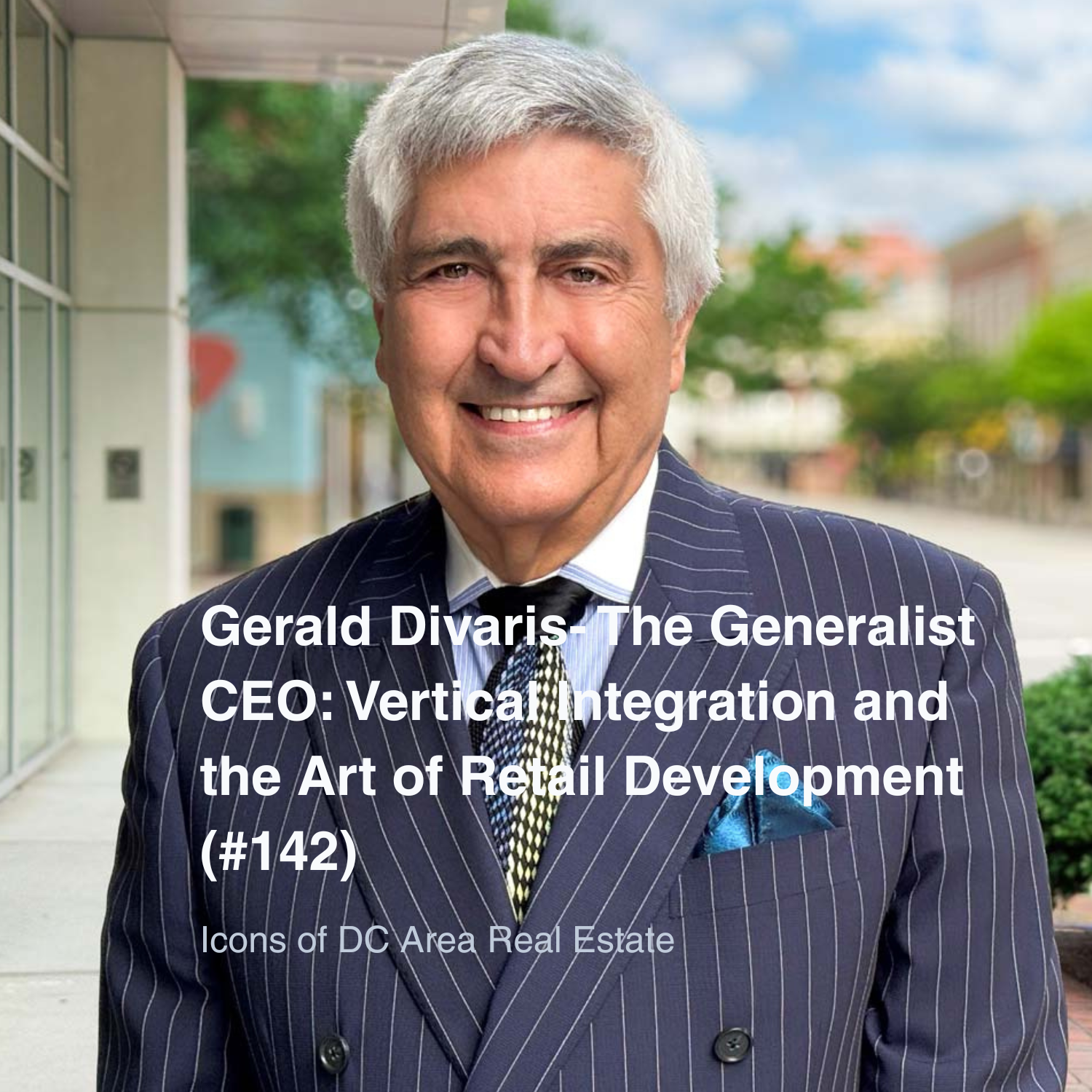
I am honored to speak with Joe Gerald Devares, Chairman and CEO of the Devarus Group on today's episode.
Gerald Devares is the leading one of the largest and most highly regarded commercial real estate enterprises on the East Coast. His firm, Devares Real Estate, which he co founded in 1974 in South Africa, is celebrating 50 years of business achievements, earning his induction into the Hampton Roads Business hall of fame in 2024.
The Navarros group is a fully vertically integrated, full service commercial real estate company that manages and leases approximately 40 million square feet of prime office, retail and industrial space nationwide. The Firm employs over 200 people and maintains offices in 15 or 16 cities across the United States.
Mr. Devaros, who moved the company's US operations from South Africa to Virginia Virginia Beach, Virginia in 1981, heads DaVaris Retail Leasing Division and its development services arm nationally. He is renowned for his visionary work, particularly championing the Town center of Virginia Beach, a mixed use project that serves as a model for successful public private partnerships. He's also a founder and board member of Realty Resources, a national network of independent retail real estate brokers. The firm's focus on strategic growth is evident in its expansion program, which included recent acquisitions like the McGarry Group and notably a strategic expansion in the greater Washington, D.C. area in May 2024. By adding new experienced agents, this move is consistent with the company's national growth strategy and focused attention on the Mid Atlantic region.
Known for his dedication to hard work and commitment to community support, Mr. DeBarris will be sharing his insights on market trends, the evolution of retail, including omnichannel strategies, and the future of real estate development in the region.
Without further ado, please join me with.
[00:03:06] Speaker A: Gerald Devares as Chairman and CEO of Devarus Group, which now manages and leases approximately 40 million square feet of office, retail and industrial space nationwide. What are the primary strategic responsibilities that consume multiple focus today?
[00:03:25] Speaker C: Gerald I would say that from my perspective the most important Thing is to service the clients that we've now brought under our umbrella and make sure that they are being transferred, treated in the manner that they expected when they signed up. Thereafter, of course, we want to make sure that the teamwork of the folks that are working with us is cohesive and is embodied in the overall ethos that we have created for serving our clients. And I guess the third thing is to try and continue to grow the platform because that's the ultimate objective.
[00:04:04] Speaker A: Okay.
Your firm, Devarus Real Estate, operates offices in 15 or 16 cities across the United States. How do you maintain consistent standards and implement corporate vision across such a geographically expansive organization?
[00:04:20] Speaker C: Well, I guess the one thing that we do is I try to travel to these offices, if not every month, every other month, particularly those that are far away, it takes a little longer because I like to be able to see the folks that are working with us and interact with them. And then also for those months that we don't travel, we use Zoom, as we talked about earlier, or teams. Either one of those vehicles are used pretty extensively. And then the other thing is we have a principal in charge of each office.
That principal, we call them a principal. There might be a broker in charge or whatever, but they are the principals and, and they should be embodying the philosophy, the objectives, the goals, the strategic objectives of the company as a whole. And we rely on them to ensure that they are carrying the message on a day to day basis.
[00:05:12] Speaker A: Did you model your firm after another one or who have you emulated a little bit as far as other firms?
Out of curiosity?
[00:05:21] Speaker C: I haven't really. As you know, I only worked for one company in my life for two years after I left college. So.
[00:05:28] Speaker A: Okay.
[00:05:29] Speaker C: Didn't have really any former experience in the, in the business that I'm in. But the company that I worked for was a large institutional, in fact the largest mining company in the world. And they had a real estate arm and I was involved in the real estate arm. So that was all the basis under which I, and I guess they had. They were very much organized along a formulaic process. And that was something that was drilled into me just in the two years that I was there. So I used the same kind of thought process rather than a specific formula.
[00:06:07] Speaker A: I'm just curious, as you've grown as a company, have you met, sat down or through industry groups like ICSC and other groups, met with other firms that, oh, I really like what you're doing, maybe I'll help, maybe I'll try to do some of that.
[00:06:24] Speaker C: Myself, well, Rotary sources clearly is a, is a great platform for us for working out best practices, learning others what they do and for us imparting what we do. And that has been a pretty good kind of channel for us to learn what is typical in the industry. We are a little bit different to most other firms because our agents are all employees. We really don't do a lot of independent contract. We do have some that are independent contractors but typically in this business most of the agents are independent contractors.
So that creates a little bit of a different process.
So there's a lot more supervision on our side, a lot more involvement. Maybe, maybe that is reflective of the principal arrangement, the principal having his team, having his committees, his groups, which you can't really do. Under independent contractor. Under independent director you have, you really have a very, very thin line between what you're allowed to do and what you can't do.
[00:07:36] Speaker A: So basically their culture is more team based and much more corporate structure as opposed to being independent contractors organization where every man and, or man or woman to himself basically.
[00:07:50] Speaker C: That's correct. And to some extent we did that because we really wanted our clients to feel they're being served by a salaried or, or, or, or employee that we could control as opposed to somebody who just eats what he can kill, which is really what independent contractor is doing. He, he's out there saying to himself, well if I'm not gonna, I'm not gonna spend months on this job if I, I may get nowhere or it's, it's too small for me to be involved with it, whatever.
[00:08:21] Speaker A: Right.
[00:08:21] Speaker C: Which I can understand that they're not getting anything but if, if they're salaried they have toe the line and perform as we expect them to perform.
[00:08:30] Speaker A: Sure. But of course, with incentives if they perform well.
[00:08:34] Speaker C: Of course, absolutely. That's.
[00:08:37] Speaker A: So you currently had Devarus Real Estate's retail leasing division and its development services arm on a national basis. How does your hands on leadership in these two specific areas directly influence the overall strategy of the Tavares Group?
[00:08:55] Speaker C: Well, retail is something that's been in our blood for years. I was kind of brought up in a family of retailers and development really interestingly enough, for the two years that I worked for Anglo American Corporation, they were really involved in major development projects. So development was something in my that and retail was in my blood, as it were, and something I understood and was not concerned or scared of it. Most people in my business don't like development because there's a lot of risk involved with it. And it requires a lot long, longer lead time for ultimately seeing the project. So development is something that going back to what I was saying earlier about employee versus independent contractor, an employee is more likely to be involved in development versus an independent contractor who really needs to figure out how he's going to get paid while you're going through the development process.
So given that I had this thought process, desire in my, in my, my being, it clearly impacted how we would proceed. And really it is the foundation of our business.
Now. We do a lot of mixed use today. We're bringing in office as well as residential and hospitality. But it's really almost the glue that ties it all together is the retail. What's happening at the street level ties in all the other component pieces. That's why these other people want to be there. They want to be there for what's happening.
[00:10:23] Speaker A: I agree. I agree completely that after being in the business for 45 years myself, my father was a retailer department store manager and 30 years with a department store.
So I saw it firsthand and actually worked in a department store. So I saw, you know, what drives it. And what's interesting is a lot of people, if they're not in retail, they don't understand that the ground level drives the value of just about every piece of property there is. And so including residential, office, whatever mixed use you have, what happens at the ground is really the critical piece. And once the retailers get that, that's.
[00:11:06] Speaker C: The vibrancy that really makes it interesting and makes it. And if you think about office tenants, that's what they want. To be able to have the employees at lunchtime and go down, find restaurants, find the shopping makes their one hour lunch period, or hour and a half, whatever the lunch period is much more meaningful than if they've got to get in the car to go somewhere because they've lost that travel time and it's taken away from the ability to benefit out of that period.
[00:11:33] Speaker A: So you mentioned Realty Resources earlier, but I'm going to ask a more specific question and have you expand on that a little bit. You were a founder and board member of Realty Resources, a national nationwide network of independent brokers specializing in retail real estate.
And I want to thank you. Just to cut away real quick, thank you for inviting me to speak at your annual meeting, which happened, what, about two, three weeks ago, and I appreciate that.
What unique leverage or advantages does this new network affiliation provide to Devares Real Estate and its clients?
[00:12:09] Speaker C: Well, I think the most important thing is it provides us with a national Platform which comprises the best in class local brokerage companies. So suddenly you're not just a large national company that has multiple offices and you are hoping that the quality of the team that might be in Phoenix is as good as the team that you might have in Minneapolis. By, by working through a network of this type that really filters and secures members that meet certain standards and, and meet the criteria that we've established for excellence, then we know that when we refer business to an area, that client will be served in the same manner as I would serve. And that's the critical element of how it works. It kind of explains why you might say to yourself, well, why does XYZ Global company refer business to me when they have an office in my market?
And that happens regularly. And they do it because they realize that their local office may not have the skills or the capabilities that I have.
And so, yeah, I intend to be the referral. So by having a network like we do, where we've got the best in class in those local markets, it helps us ensure that we get a seamless delivery of service nationwide.
[00:13:42] Speaker A: Let me step back for a moment and look at the entire retail real estate industry worldwide. Okay, I'm gonna, I'm gonna take the great big picture.
[00:13:51] Speaker C: Okay.
[00:13:51] Speaker A: So when I think of international real estate, I think of icsc, the International Council of Shopping Centers, which I believe is the largest retail membership organization in the world.
[00:14:02] Speaker C: It is, yes.
[00:14:03] Speaker A: And they have offices worldwide, but you know, the United States is the dominant members and everything else.
So in that network you have a relation, you can build relationships with retailers, with other brokers, with all the entire industry, the vendors, everything that, you know, the entire ecosystem of retail real estate is, starts there and then it divides up geographically, typically with brokerage firms. And you know, if you're a national retailer, like an apartment store, let's say, like a Macy's, you're going to have relationships around the country, but your, your main meetings are going to be tied to icsc because that's where the, everything's tied in at least the ecosystem that I grew up in, in the real estate industry.
That's how it worked. But then you have a sub, you've set up this realty resources group, which is a separate subgroup of independent firms. They're tied together by this network, but they are their own operating company.
[00:15:01] Speaker C: That's.
[00:15:02] Speaker A: And then you have a company like cbre, which is a competitor, I assume. And so they have obviously a corporate structure that has offices in all the cities you're in. And many More and they keep it under one umbrella.
So my question to you is why not become devarus nationally and encompass realty resources under the devarus umbrella or and keep more of a, you know, I would, I don't know if it's what your structure is, whether it's a franchise group, how it's, you know, structured. So that's, that's kind of the big picture question and why that means something to you relative to the big corporate structure.
[00:15:45] Speaker C: So, so the, the issue of trying to figure out how to best service the client is really at the root of this, of this whole thing. Because at the end of the day you have a national department store, it's Target, and they want you to represent them on a national basis.
Now what happens is that Target may well also have a direct competitor in some of the markets that I have offices of. So how can I service both clients? I have a difficulty doing that, which is really what happens with the nationals, which is why in some cases the nationals actually ultimately end up using us because they may also be. Their local office might also represent a competitor of the national bodies.
Our client and we similarly may also have the same conflict and we also sometimes have to switch to a different firm with a different affiliation to service the needs of the client. Because the client comes first. He's the number one party that we need to service.
Why do we want to try and do it differently? I think it's a matter of, I guess, you know, if you want to be on a national basis, you really have got to be structured in, in a similar way to JLL or CBRE or Cushman or whoever it is. Because those companies all publicly traded, they have a lot of infrastructural expense to get set up. They have to do so many other things that take away from the deal making and the actual servicing of the clients.
[00:17:22] Speaker A: Agree.
[00:17:23] Speaker C: Often the leadership of those companies have no, sometimes don't even know who the client is that they are servicing. Because it's such a large organization, 2,000 employees or 3,000 employees, it's hard to put your arms around it and deal with it. I think at the end of the day, we as a network are led by individuals who are deal junkies. Each of us who run our offices love the transactions, the whole deal, the whole deal making process. And so the larger the company comes, the further away you get from that opportunity to deal.
And actually the client loses. Because if you are really good deal maker, you are divorced from this process. And by having it smaller and working through network Operations, you tend to provide that better service overall.
[00:18:20] Speaker A: So how do you. And I know this diverges away from the set questions, but how do you manage. And I've always asked this because I was a broker for five years myself.
How do you manage the conflict between managing people and overseeing as a brokerage? It's herding cats basically. So yeah, yeah, how do you do that and then do your own deals and do it well and be able to do both well. And to me they're distinct skills and can one person be really good at both? And how.
[00:19:00] Speaker C: So that's a good question and that's really something that we think we have done relatively well. And this goes back to the, the structure you asked about at the beginning.
[00:19:12] Speaker A: Right.
[00:19:13] Speaker C: We are probably in some cases maybe over balanced on corporate infrastructure. We have a, a structural organization. And you met Steve Blum, for example.
Steve.
[00:19:29] Speaker A: I helped him introduce to the company.
[00:19:32] Speaker C: Exactly. So Steve, it heads up our brokerage operators. But he's not on a commission basis. He's on a salary basis. He's a corporate employee. Okay. We have a COO who's a corporate employee. We have a CFO who's a corporate employee.
So we have a lot of layers of management who are professional managers, let's call them that, as opposed to deal makers. So as do free us who are deal makers from the day to day drudgery of managing people. You've got to manage people. And the way we do it is lead by example, let them see us at the, at the deal table, let them experience how we do it as opposed to figuring out what their payroll is, what the hours they're working, what is the health benefits program, they're going to have all those other items which take a lot of management a lot of time.
We have professional managers, got an HR department, we've got a benefits department. You know, all those people are paid and paid staff members to manage the business. Right.
[00:20:47] Speaker A: So, but somebody in your role who basically, you know, you came up doing deals and that's how you made money starting with. So it's got to be hard sometimes. I know you like to be on point, but oftentimes you're, you're in the management role so you got to step back and let other people do the deals. I have to assume that happens.
[00:21:08] Speaker C: So, so I guess that's why I work a 12 hour day six days a week. And, and, and that's not saying it lightly, but that is really what it is. I'm in the office early in the morning at 6 o' clock having been to the gym already and through lunch without lunch, and that includes a Saturday. So is it because I'm trying to fit the management components that I have not been able to hand off to others?
[00:21:39] Speaker A: I get it.
[00:21:40] Speaker C: Addition to deal making.
[00:21:43] Speaker A: Well, I guess then the question is quality of life. But we'll get into that a little later here.
All right, now let's go into your origin story, if I can.
The sources that I've read note that you were born in Rhodesia and then lived in South Africa after that, moving to Virginia beach in 1981.
What cultural or professional lessons from your African origins informed your decision to launch and later relocate your real estate business to the United States?
[00:22:14] Speaker C: Well, again, I was born in Rhodesia and my parents were born in Rhodesia, which of course today is known as Zimbabwe.
And it was a British colony for a while, then we declared independence and survived about 10 years of independence before it all kind of came to an end. Culturally, it's not a lot different to the US or the uk.
Things are very similar. The only difference is that of course, you're dealing with a much smaller country and a much smaller economy.
So what does that mean? It means that we don't have the benefit of being specialists in activities. We tend to be generalists.
So what, what I've. What I was able to do in, in being educated, growing up in that environment was I learned how to be ambidextrous, how to be able to do lots of things with lots of people as opposed to when I got to the States, I found that they were all so silo.
You were in offices and you were only doing landlord work and you were only working this territory.
And no ways could you do retail because you didn't understand it, you didn't want to do it and you didn't have to do it, nor were you doing industrial, etc. It was so specialized that many times they couldn't see the wood for the trees. And for me, as a generous, I've been able to focus on lots of different aspects and components of real estate. And really that's what makes us really good in mixed use development, because mixed involves all these different elements. And I've done hospitality, I've done residential, I've done office, I've done retail. And so having that ability differentiates me, I guess mostly because of that origin in South Africa.
[00:24:11] Speaker A: So one day you might do an industrial deal, the next day you might do a retail leasing deal, next day you might do an office, office building deal. So every day might be a Different.
[00:24:22] Speaker C: You know, totally different type of product. Totally different type of. I mean, I. Public private partnerships is something that, you know, we learned in South Africa at the same time as doing, you know, the odd office lease, and then you'd be working with the city in acquiring land to do a city requirement or an RFP that they've issued. So at the end of the day, you had to be a generalist.
[00:24:47] Speaker A: So why real estate, Gerald? And what did you talk about, what your parents did, and what drove you in that direction?
[00:24:55] Speaker C: Well, the real estate really evolved because of what my parents were doing. We were in the retail business. My family were in the retail business, and they owned department stores, liquor stores, grocery stores. And as a result of that, because they had multiple different types of properties, they ended up having to build their own shopping centers to accommodate the various uses. And so as a child, I was growing up in an environment where a. I would.
From the age of 10, I'd be working in the store. I'd have to ring the cash register. I was selling liquor at the age of 12 when I was not allowed to sell liquor. So, you know, you'd be sitting there, and I'll never forget saying to my dad, I said, listen, how do I sell this wine? And he said to me, well, you've got to assess the customer. When the customer walks in, you assess him. I said, what do you mean, you assess him? Well, you see how he walks, you see how he talks, you see. See how he's dressed, and you get an idea of the price range based upon your assessment of the customer. Okay? I said, fine. So I assess the guy. How do I know that it was in red wine and white wine or pink wine?
Well, you got to ask them, what are they going to eat with the liquor that they're asking for? So if they're asking for, they're going to eat meat, it's red wine. If they want to eat chicken or fish, it's white wine. And if it's kind of a mix between the two, you might get rose. I said, okay, well, what about. How do I. How do I figure out anything? I said, well, you know the price points, you know the color. Now you go for it. Okay, well, how do we go from there?
So I then discovered that if you look at a bottle of wine, you know, I'd been told that you look at the clarity. So you put the wine up the light, and. And I soon found out at the back of the bottle, even to this day, there's a story about the wine.
So I Would put up the bottle. Customer walked in, picked up the right color and the right price point. I put the light, color the bottle up to look at the light, and I'd start reading the back of the bottle. The customer immediately thought, boy, this guy knows a lot of.
And I'd say, soon enough, sold. Whatever hell the guy wanted to buy, I sold it.
I grew up in the retail environment.
I, I understood what it took.
[00:27:13] Speaker A: And were your parents immigrants to South Africa or your grandparents?
[00:27:17] Speaker C: Both. My parents were born in Rhodesia as well.
[00:27:20] Speaker A: Okay.
[00:27:21] Speaker C: My grandfather originally came from Greece.
[00:27:24] Speaker A: That's right. Yes.
[00:27:25] Speaker C: On both sides.
So they. They went there in the. In the 1890s.
Wow.
[00:27:31] Speaker A: Okay.
[00:27:32] Speaker C: I'm truly a detribalized African American.
That's what. With a white skin. But the reality is that.
[00:27:41] Speaker A: That I didn't know there was a Greek culture in South Africa. That's interesting there.
[00:27:46] Speaker C: South Africa, in many ways is not too different to the United States, since it's a country of immigrants.
The original. The originals were the Dutch, and the Portuguese actually went there first. And then the Dutch and the Portuguese started going up Africa while the. The black tribes are coming down Africa, and they met at the. At the Fish River. The, The. So then there was the, The. The. The Dutch colonies, and the British ultimately took control.
[00:28:20] Speaker A: Right.
[00:28:20] Speaker C: And then there was a big fight between the Brits and the Dutch.
[00:28:24] Speaker A: And then the Boer War.
[00:28:26] Speaker C: The Boer War. The Dutch went further north and became a British colony until ultimately, of course, the Brits left and the Dutch took over again. So. Or the Africanas took over.
[00:28:39] Speaker A: Why would. Why was your grandfather interested. Grandparents interested in coming to South Africa?
[00:28:44] Speaker C: Well, well, the, The British had colonized Rhodesia or Zimbabwe, well, Asia at the time.
And at the same time, the, The Brits had also colonized parts of Greece, which you may or may not know.
So my family came from the island of Cephalonia, which is an island between Italy and Greece. It's one of. It's the largest island on the Ionian Sea.
And they, the Brits offered the. The Greeks a free passage to Africa to colonize Africa.
[00:29:19] Speaker A: Interesting.
[00:29:19] Speaker C: So here they were sitting on the island. They were offered this opportunity and said, okay, put their hands up, get on the ship. And nothing else but, you know, the fair to get to Africa. And then they arrived in. In Mozambique at the time and got onto a horse and carriage, and off they went to the middle of Africa knowing nothing what they were going to.
[00:29:43] Speaker A: Say, wow, that's an adventure.
[00:29:45] Speaker C: It is. Yeah.
So that's how they got there.
[00:29:50] Speaker A: But, you know, My understanding with the Greek culture is that, you know, merchant, merchant mercantilism is huge, always has been. So that's probably what's in your blood.
[00:30:01] Speaker C: Yeah, I would say it's probably true. My grandfather on both sides were merchants.
My grandfather on the Davor side had a company called Tavares Brothers, which was the brothers themselves. My grandmother, who was the matriarch of the family, M. Divorce and Sons was the name of the, of the cup. She was M. Marianne and that's how they started. And we naturally grew up in that environment. And as I said, at the age of 10, I was working in the store. But then as that evolved, I began to look at the real estate. I enjoyed the real estate and I saw what, how, how you would try to identify the right location to accommodate the grocery store or the liquor store, whatever the product you were trying to sell. Who are the customers that needed that product?
Where would would you place it? Would it be on the left hand side of the road? The right hand side of the road? How is it accessible? What about visibility? What about co tendencies? All those were things I was learning at a young age. So it's kind of.
[00:31:05] Speaker A: You did school help at all or your education help and learning that, or was that all practical on the street, basically?
[00:31:13] Speaker C: Well, it was the education wasn't that my grandmother wanted me to be a judge of all things. She, she, she had in her head that I had to be a judge. So I, I went through school learning Latin, learning history and English. Those are my primary items with the idea of going to law school when I'd finished. But I, I really, that wasn't really something that I wanted to do.
I love the business, I love the real estate, I love the, the whole financial and transactional nature of business.
So when I went to university, I went to do business science, which was really a business degree. I did some law as part of the courses. But you did law, finance, accounting, you did all the different elements of business?
[00:31:58] Speaker A: Sure.
[00:31:59] Speaker C: Much to chagrin. She was not very happy that I, I did that. She wanted me to be the judge. I guess. You wanted me to wear the wig and all the other stuff.
[00:32:08] Speaker A: You know, it's funny, it's.
They think that the professionals, people that came up in retailing and all that, say you've got to be more professional than just, you know, doing deals down at the marketplace, you know. But hey, it's in your blood. It's hard to fight it, right?
[00:32:24] Speaker C: Correct. Correct. It is hard. It is hard.
[00:32:28] Speaker B: Yeah.
[00:32:29] Speaker A: So as I'm going to get my next question. You were born in a family of retailers which led you to naturally gravitate towards retail representation out of this deep familiar retail background. Prepare you to lead store to develop deployment programs for major national tenants.
[00:32:45] Speaker C: Well, because of the fact that I had kind of learned it from almost by process of osmosis, working with the family and see my dad and understanding why he was picking a location, what was, and then really reversing back into the retail stores that we ran. So I could see that the strategy was being felt at the, at the store level. And when there was a bad mistake or wrong location, I also saw the implications of picking the wrong location. So store deployment is very much an art. It's not just a science, it's an art. You've got to really understand it. And unfortunately I found that in the retail world, even in the US So much of it is done by technicians as opposed to folks who really understand retail. I would tell you that the majority of people who are doing store deployment strategies have never worked in retail store.
And because of that you're relying upon them to use all the formulas and the sales forecasts and the projections and everything else and they lose that element of understanding what that location is supposed to do for the retail to succeed.
[00:34:04] Speaker A: You know, it's. There's so many elements of shopping that people don't understand unless as you say, unless you're there meeting the customer face to face and understanding what they, how they get to the store, why they travel to that store, what's, you know, what are they interested in? What experiences do they have every time they shop?
So you come to his shopping center and you walk around, where do you park? Why do you park there?
Where are you going to enter? How long do you want to stay here? Oh, are you going to do more than one store while you're here? All those things, there's just so many dynamics to it.
[00:34:40] Speaker C: And I think you have, there's even more. It goes right into the store. I will tell you what has shocked me sometimes is to see how poorly designed the interiors of the store.
I'll never forget I was asked by a major national retailer in this country to critique a new prototype that they were going to start rolling out. So I was asked, invited to go to their corporate headquarters and I had built out this prototype and they said to me, be interested in getting your feel and your fine, let's go in. So I go inside and powder immediately. I said, this is a problem.
And they said to me, why? I said, well, first of all you've put all the checkouts in the front, which is fine. This is a grocery store, all the checkouts in the front. But behind the checkouts, you had like a wall with magazines on the backside. And so the eye of the customer walking in was interrupted. They couldn't see beyond the wall of magazines.
Whereas, in fact, in grocery stores, you want them to walk to the back. That's why you put the milk and the cheese at the back. So walk down the aisle to the back?
[00:35:55] Speaker A: Yeah.
[00:35:56] Speaker C: Oh, that's interesting. That's a good point. I said, well, the second problem is your lights are wrongly formulated. I said, why? Well, you're putting your lights also across the line of sight.
So what's happening is you have peripheral vision and your eyes are stopping because of the lights going across you instead of down. So they don't go. They're not going down the aisle. Going across the aisle, two things are problem. One, I'm stopped because the peripheral vision number two, the light is shining and creating shadows on the merchandise. Instead of lighting up the merchandise, if you have them down the center of the aisle, they shine the light down onto the merchandise. So simple.
[00:36:42] Speaker A: You know, that thought process is exactly why, you know, place making is so interesting.
Because you have to look at every human sense when you're designing something and laying it out.
Not just vision, sound, scent, taste, feel, and the sixth sense, which is somehow. I've asked this, my last guest, who was a placemaking developer. I said, so what is that?
It's just this gut feeling you have. You're in the right place.
And how do you get that feeling?
I mean, it takes a lot of trial and error designing just the right setting to get that type of feeling. It's fascinating. It's a real art.
[00:37:28] Speaker C: It is an art. It's. And you talk about smell. As an example, one of the businesses my. My family owned were florist shops, flower shops, okay? And they would have the.
There was a flower called a tuberose. And I don't know if you know what it is, a white flower. It's a very strong smell, very strong smell. They always put the flower, that flower, right near the front door, always.
So that anybody walking by or walking, walking there got that scent. They immediately said, look. And that's what be inviting them into the store. So you needed that scent to bring them into the store. And I think that, that. That kind of thought process of trying to figure out how to make the customer feel invited.
The same way you go to Europe and you know how we talk to people in the States and they say, oh, a second level store never works, A two level store never works, works. But in Europe they do work. Now why do they work? Well, they work because you are, you are programmed as a customer to know that there's a second level before you even walk into the store. You look, if you stand at the pavement, you'll see that the second level has also got a storefront so you can see the merchandise, the second level from before going into the store. So you already programmed to know I need to go to the second level.
Whereas in the States most of the second levels have got a brick wall or just they cover. You don't even know there's a second level until you walk into the store and there's a sign that might say second level or whatever it is. Well, you're not programmed to go there.
At that point it's too late.
[00:39:10] Speaker A: Well, I mean I grew up with my father worked for a department store and the downtown department store that he worked managed, he was the last store manager, the one that was, it was imploded in downtown Detroit, Michigan. So it was a 24 story department store.
So obviously the street level had all the beautiful storefront things.
But people were conditioned to going to large department stores downtown and would go up an elevator to multiple levels and, but they were taught that from their, you know, that's how you shopped. And they didn't shop every day at that store. That was a weekly at most trip, but mostly monthly because it was a big, you know, usually a big shop for people.
So that's the other thing. And we'll get into this later. But to me the evolution of retail experiences in this country are fascinating to study. Just to see the evolution of the storefront, you know, in rural environments and then the urban centers with the department store and then, and then the disaggregation of the department store industry completely into big box and then now lifestyle. All the different shopping center evolution that's occurred over the last 50 to 100 years.
It's just a fascinating study and I don't know anybody that's ever really written about the whole evolution of it. Be a fascinating book I think, honestly.
[00:40:44] Speaker C: Well, I think that that's so true. And then you say to yourself sometimes why have department stores failed in the states?
[00:40:52] Speaker A: Good question.
[00:40:52] Speaker C: I have. Department stores not necessarily failed in Europe. I mean Harrods department store or Selfridges or any of those stores still do very, very well.
And in the states, you know, other than the maybe Bloomingdale's well, Nordstrom's does pretty well and Nordstrom does well. I mean, but generally speaking, the department stores have failed. And part of that has to be, in my view, the way they merchandise the stores and also keeping them relevant and keeping them exciting and interesting. I mean, I remember as a kid going to department stores with my mother and it was a shopping experience. It was something that you wanted to do.
[00:41:35] Speaker A: Exactly.
[00:41:36] Speaker C: Certainly going to the tea room, which I remember she always had the tea room. There was a tea room on the upper levels was also part of the thing. She'd meet her friends and, and family and it was a day event, you know. Oh yeah, the window shopping was as important as just going, I'm going to go and buy X, Y and Z.
The whole process of impulse shopping that has been lost in the way they merchandise the stores today.
[00:42:02] Speaker A: Well, it's just the shopping experience itself and I think it's just the evolution of the American customer and the American culture and how everything's evolved over the last, you know, 50 to 100 years. You know, the Internet and all the different technological changes have changed shopping forever. Obviously.
[00:42:23] Speaker C: Why entertainment and experiential retail is critical to the long term survival of retail. You've got you. Unless you intertwine the whole process of entertainment into your shopping experience, I agree with you. You are going to fail. And probably to me, the best example of somebody who's done it right and who survived has come out the other end successfully is Barnes and Noble. Barnes and Noble started the whole process of experiential retail when nobody else was selling books that way. You know, there were the guys selling books that you walk in, you buy the book and away you go. Barnes and Noble let you take the book, sit down and start reading it, page through it, show you the COVID get you involved, storytelling, all those things. And then Amazon came along and try to beat them by price and, and effectively killed those who didn't do it well, such as Border Books and others.
But guess who's come out the other end? Barnes and Noble. Why? Because they've stuck to their knitting and they've changed as they went along and it's still very relevant and an entertainment entertaining experience that's critical.
[00:43:36] Speaker A: I agree with that. And you know, I mean, you can. There's probably 20 examples of companies that have evolved like that. Why is Target stayed relevant and good as opposed to Kmart, Sears and these other firms have collapsed. My father worked for the Dayton Hudson Corporation, which is Target's predecessor.
And so it was interesting to see How Dayton Hudson kind of just disaggregated the department store and really focused all its energy on its discount department store to compete directly with Kmart. At the time that was when it was founded, basically, Kmart was the big, you know, discount player in the marketplace. And they out retailed Kmart completely because they.
[00:44:25] Speaker C: Their foundations and fundamentals were dead. Hudson. The foundation fundamentals were department store.
[00:44:31] Speaker A: That's right.
[00:44:32] Speaker C: Retailers, as opposed to Kmart, who was really a discount store.
[00:44:38] Speaker A: Well, they came from a drugstore background. It was S.S. kresge. Right.
So it was. It was a dime store. And that was the thought process. So it's, it's interesting how the evolution of the. The company took place. It's fascinating to look at it actually, to understand what the dynamics were. And it's usually the origin story of the firm and how they kept the culture going to make it happen. It's in my experience.
[00:45:02] Speaker C: Oh, I think you're absolutely right. It's exactly what it is.
[00:45:06] Speaker A: So let's go back here. In 1982, you moved your brokerage business to Virginia beach, looking to fill the city's need for a center. What, what unique characteristics did Virginia beach possess that persuaded you it was the right location to establish Tavares first real estate office?
[00:45:24] Speaker C: Well, I would say to you that Virginia beach was the kind of the rough diamond. It's the largest city by population in Virginia, which most people don't realize even to this day.
And yet it had no central business district, no heart and soul. It was like a suburban sprawl, and that's what it was. And I'd come from large cities in South Africa. I mean, Johannesburg, Cape Town, these are large cities, okay? And so, so I was used to an environment where the city center was really the heartbeat of the community. It is where you go, if there was a time of sorrow, to meet other friends and family, to be together at times of victory, to join and celebrate.
We never had that in Virginia Beach.
It was just a suburban sprawl. And worse still, those commercial buildings that existed were ugly. There were two stories. You could see the air conditioners on the top. The shops were kind of very suburban in nature. There was nothing, nothing decent.
That was the opportunity to me, because here was the large city. Here was a city that economically was very strong, much stronger than any of its neighbors.
It had a great tourist component. So when you had all these elements, why did it not have a city center? And so we identified a piece of property at the crossroads of the two busiest roads in the area.
So Everybody had to converge through this area, particularly because there's a lot of water. So you had to go around to get there. And so it made sense that we could try to figure out how best to satisfy that need. And at that time, there was no competition. None of the big guys were here. So I'd arrived from South Africa speaking with a funny accent. I still speak with a funny accent. Driving on the wrong side of the road, all those other things. I didn't have to compete with the JLLs and the CBRE and the cushions, none of who were here. All I had to deal with was the local guys who were more focused on answering the telephone instead of getting the border. They were ordered takers, not auto getters. So I said to myself, this is the opportunity. Great on the ground opportunity and no competition.
[00:47:46] Speaker A: That's interesting. So that was.
Yeah, I mean, you just saw something that no one else was doing, and you had this experience.
[00:47:55] Speaker C: Right.
[00:47:55] Speaker A: You know, bringing. Bringing this urban core together, basically.
[00:48:00] Speaker C: And I'd worked in South Africa on a public private partnership, which something Lord Buell had not done. I worked on the waterfront in Cape Town, where I worked with the city of Cape Town to secure the leasehold rights of the harbor area and to make that a public private partnership.
In my mind, when I arrived here, I said, this is the way we're going to make this happen. It's going to be a public private partnership. And frankly, that's what happened. And today it's highly successful public private partnership.
[00:48:33] Speaker A: Yes. Well, your partners in developing that are somebody that I've done business with in the past, Armada Hoffler.
[00:48:40] Speaker C: Right.
[00:48:40] Speaker A: So I met Dan. Dan Hoffler and his partners on the Mandarin Oriental Hotel here in Washington D.C. that they developed. That's correct. So that was an interesting development.
[00:48:51] Speaker C: Yep.
[00:48:51] Speaker A: And their evolution as a company was interesting outside of Virginia beach and, you know, the rest of the area.
But it's. It's an interesting amalgamation. That property that you developed down there. I've been. I've toured it. It's very nice.
But I want to step back a little bit about Tidewater, not just Virginia beach, but kind of the evolution a little bit.
You know, it's the oldest colony in the United States is. Is right there in Jamestown, which is, you know, part of it.
And so it evolved as a British colony over 400 years, and it became a military center probably around the Civil War, maybe even earlier than that, where you had the naval presence. And now I think all five services have bases in Virginia in the Tidewater Area and my guess is probably drives at least a third of your economy in that market, if I'm not mistaken, as far as employment and economic development and everything else there.
So you have this huge defense base which of course Washington has here.
But ours is obviously more not the physical side but the brain power side of the industry. But just to see the infrastructure there and how you could see the vision of, as you said, the sprawl Virginia beach area coming together. Because Norfolk obviously had the most central urban type of feeling of all the different cities there. Maybe Chesapeake too to some extent. But in my experience going down there, it was interesting to see how this all evolved. So maybe you can elaborate a little bit more on what I just said.
[00:50:40] Speaker C: Yes, I would say to you that a couple of things. Number one, most people don't really appreciate what the military components in this area are made up of. For example, NATO's headquarters for the United States in the United States is here. Most people don't realize that when we had the, the problem with the planes that were coming from June 911 towards the Pentagon, the planes that defended Washington flew out of Langley Air Force Base, which is here.
So we are really in some ways the first line of defense for Washington. We have a large Cyber command facility. We have a major, we have the largest frost free port in the United States. So when you start taking all these component pieces together, you begin to realize the strategic importance of, of this area and the amount of infrastructure and money that is invested in that enterprise. We're not really talking about foot soldiers.
[00:51:47] Speaker A: Billions or drag or bag.
[00:51:49] Speaker C: We're really talking about a totally different element. You know, the, the Oceania Naval Air Station for example, is, you know, these are all pilots and engineers, highly competent folks.
[00:52:01] Speaker A: The, the, we have the largest naval base in the world there.
[00:52:06] Speaker C: So, so you take all those things into account, you begin to realize that the economy is extremely strong and very stable.
That's the other thing. We don't do the ups and downs that you find in many other economies. We are pretty stable, you know, so the, the, that is a, a very important aspect of where we are. And we're three and a half hours drive from where Washington D.C. so it's not like we, you know, days away. Actually, interesting enough, we are one day's drive from, from two thirds of the population of the United States.
[00:52:40] Speaker A: Yeah, well that's the biggest new report. That's your port's promotion of course there. The port of. Yeah, the Port of Norfolk and Virginia Beach. The scholarship fund honors your late son, Alexander Devares recognizing his passion for mentorship and its role as a founding member of cbdx. How does Navarros group continue to honor his legacy and commitment to fostering young talent and regional community growth?
[00:53:12] Speaker C: We're very focused on internships. And the internships start really at a young level. One of the things that Alex, my son, instituted was an internship program at the school level, high school.
So they would have a full day at which high school students would be invited to join CBD members and spend a day in businesses. So they begin to learn a little bit about commerce, about businesses, and they begin to help them frame their career choice and what universities they may want to go to and what particular professional careers or degrees they may want to pursue.
[00:53:55] Speaker A: This high schools in the area.
[00:53:57] Speaker C: Yes.
So that was one of the early things that he did. And in fact, one of the scholarships that the CBD is named after him is to fund that, that enterprise and to provide a scholarship to the students that are selected as the top of those that come to these internship days. This is followed up with additional internships for those that now are at college. So we have internships for those that might be interested in pursuing a career in real estate. And we tend to take about 10 interns a year to work with us during the summer holidays. And so they work and they get rotated around the different departments, different divisions, and they learn from that process. And ultimately we like to recruit new young students once they're graduating. They might have come out of a degree course in real estate or they might have done planning or something else, but they're interested in real estate. We would take a fairly large number every year and begin to train them and get to mentor them in their future careers.
[00:55:06] Speaker A: That's great.
So education is really important to you and your family. That's great.
You championed the vision for the town center of Virginia beach, even though city leaders thought it was crazy initially.
What specific elements of your vision, such as mixed use and vitality, allowed the town center to eventually become a successful model of public private partnership as it is today?
[00:55:31] Speaker C: Well, again, it goes back to what I said earlier, that Virginia beach didn't have a heart and soul.
And this really was the logical process. The question was to, to try and build a community based environment that was going to reflect the personality of the local citizens and that they could call their own. The beachfront is really something that they, they have got there. But when tourists come, they don't go near the beachfront. The locals keep away from the beachfront. And so this is the place that they go to the focal point being the fountain Plaza, which has got a statue of an egret bird. And it's become the place that people come to be photographed, whether it's a wedding or it's whatever ceremony.
And that's one of the most photographed icons in the area.
So that is a place they come to.
And the success of it really was it caused the city to stop and say, well, because we not only got the senators to take offices here, we got the congressman to take offices here, we got the city to take offices. We've got the Economic development department to bring offices here. The chamber, all these people began to come here, which is the normal facilities that you see in a traditional downtown.
So it had those components. Then we had. We brought in the. The Sandler center for Performing Arts. So we've got a cultural component. We wanted to make sure we had culture, and then we had the residential. So really, if you look at what the town center is, it's a microcosm of. Of a true city center and reflects that personality. Plus it's iconic. We've got the largest, tallest structure in Virginia. The Western building is almost 40 stories tall. It's taller than anything else in the state of Virginia. So it gives us something that people can actually point to anywhere else. Because it's flat.
[00:57:37] Speaker A: Yes, very flat. There.
[00:57:39] Speaker C: You can see it sticking up in the air, and it begins to be a landmark.
Mm.
[00:57:46] Speaker A: So your firm has been credited with bringing major national retailers like Ikea, Best Buy and Kohl's to Virginia.
What was the biggest challenge or obstacle you faced overcoming during the successful development of the town center of Virginia Beach?
[00:58:02] Speaker C: I think the biggest thing, and a good example, I would say, is Lego. We were the first people to bring Lego to. To Virginia as a store, and we opened the first one here at Town Center.
The key was communicating the strengths of the local economy. A lot of people don't realize that we have what I call a hidden economy.
And the hidden economy is the fact that we have so many military people. The military people actually retire at a young age, age about 33. Okay. When they retire, they retire on a full salary, and they still economically active. They go back into the workforce, and they get a second salary. Now, what's interesting is the normal demographics only report the active salary. That does not report your pension or other. So in other words, government salary, which is pretty high because you're retiring as a pilot, you know, peanuts. Okay. That income is not reported in the demographics. Only the second income is reported.
[00:59:09] Speaker A: That's Interesting.
[00:59:10] Speaker C: Might be worth double. The second thing is he continues to get medical services for life.
All of us pay 450, $500 a month. Sure, they get it free. They also can go to the club being the officer's mess and so on. They get that for free. We pay how much for a round of golf? They get VA loans which are much cheaper than what everybody else.
[00:59:37] Speaker A: It's fascinating when you start adding all interesting.
[00:59:41] Speaker C: Realize that we are underreported to the tune of about 28%.
When you take that 28% and you factor that into projected sales, because those are all go to the bottom line, you suddenly realize there's a lot of money to be made in this market because this is a hidden economy.
And when you talk about that and you explain it to them, and the only way to explain, by the way, is to get the information from the government. The government Department of Commerce produces a document called the tpi Total Personal Income. It's a specific report which if you take that and you compare that with the normal demographics, see with 28% of us.
[01:00:23] Speaker A: So you've educated all the big retailers, hey, you're missing 28% of sales here.
[01:00:28] Speaker C: Absolutely.
[01:00:31] Speaker A: Okay, I get that.
Because they need to know that and.
[01:00:35] Speaker C: Sure makes a big difference because if you add to that that our cost of living is lower. So your rents are low, your labor is lower, your cost of occupancy is lower, your profitability with the added revenues is tremendous.
[01:00:54] Speaker A: Well, you could bring luxury retailers there that wouldn't have thought, wait a minute, why do I want to be in Virginia Beach? You know, and then you can show this to them. Say there is some wealth here that you may not know.
[01:01:06] Speaker C: Well, ask yourself why the volume of expensive cars sold in Virginia, the largest volume is in Virginia Beach.
[01:01:17] Speaker A: Isn't that interesting?
[01:01:18] Speaker C: Not Richmond, not in element, not Northern.
[01:01:20] Speaker A: Virginia, which you think is where the wealth is.
[01:01:22] Speaker C: Of course, there's a lot of wealth. Yeah, a lot of wealth.
[01:01:25] Speaker A: That's fascinating.
So, having been recognized in 2024 by Junior Achievement for 50 years of achievement of achievements, inducted into the Hampton Roads Business hall of Fame, how do you reflect on the shift from the viewing the Pembroke area as underdeveloped to witnessing the long term positive impact of Tavares projects across the region?
[01:01:52] Speaker C: That's a hard question to ask because it provides me with a great deal of satisfaction to see the ultimate evolution of what we dreamed about and wanted to occur. However, you can't be complacent. You got to be on it all the time. Because there's forever something planned or designed that could cause it to be derailed. Many great projects in this world started off being great, but ultimately failed because somebody lost focus. And as an example, right now, I'm fighting a fight right now with VDOT because VDOT is planning an interchange, a new replacement interchange, which they desperately need, but have stupidly designed a plan that will bifurcate the entire area. Doesn't make sense because they never talk to us about what we're doing and what we plan to do. So it's typical engineering study where they do not take into account the planning and economic realities of what you're trying to service. Instead of separating through traffic from destination traffic, they said, let's just get the traffic through here.
And that is the kind of example I'm giving you of why you've got to be focused. And on top of it, don't be complacent. Because even if this is going to happen 10 years time or 15 years time, now's the time to kill us.
[01:03:14] Speaker A: It seems to me that you sit down with your local state representatives, you sit down with a governor, and you say, you know, let's look at the economic impact of what this is going to do.
And then that's a simple luncheon meeting. Should they be able to get that done that way? Maybe two or three luncheon meetings, but explaining the facts and how that happens.
There it is. Right.
[01:03:38] Speaker C: Gone. You can't do it passively, unfortunately.
[01:03:40] Speaker A: Oh, I get that.
[01:03:41] Speaker C: You're doing in a very gentlemanly fashion for me. You've got to get the hammer out there and get it done.
And I can assure you, every single city council member, every single legislator that has any impact, the governor and the governor elect, they've all received letters from me already.
[01:04:03] Speaker A: I'm sure you have to be proactive, obviously.
So you did celebrate your 50th anniversary in 2024.
What were the driving motivations behind launching the Rapid Expansion Program?
Program during and after Covid, which included acquisitions like St. Burke Retail Partners and forming the KLNB joint venture?
[01:04:31] Speaker C: That is easy. You know, when Covid hit and everybody went into hiding and shut down their offices, we didn't lose one day. We remain open every single, single day throughout Covid.
That was the time when others were sitting on their hands and I saw the opportunities. So I said, this is the time to build because everybody else is scared of their own shadows. And frankly, that's when I recruited the St. Burke. That's when I recruited the group and also formed the joint venture With Calvin, these are all three ventures that I'm very, very proud of and feel will earn us a lot of benefits going into the, into the next 10 years.
[01:05:17] Speaker A: So that's the interesting. That gets back to the question I asked earlier about Realty Resources.
So in this case, you decided to incorporate them under the umbrella instead of, oh, okay, well, you guys can join realty Resources as a separate entity. So talk about that thought process. Why in the umbrella as opposed to the separate, you know, affiliate type of thing?
[01:05:43] Speaker C: Well, that goes back to the, to the vertical integration of services.
So for us, we have a, an ability to service a client's needs from the very day that they have an idea of what they need to do in a market to finding the location, getting the entitlements, working on the design, building the building, leasing or selling, the ultimate program, property management, maintenance services, and ultimate disposition. So it's. The whole thing works together. Now if you look at the Gary and you look at Burke, you'll see that both actually work well within the realty Resources umbrella. Also because Burke is a national tenant representation company, so they work with a retailer on a national basis. But again, in order to effectively execute that assignment, you need the best in class local brokers to assist you who've got ground.
So Sean Burke will work with the best guys in Phoenix or the best guys in Boston.
He'll work with our realty Resources affiliates to get those assignments effectively executed. So that's that part of it.
But for us, having him really bring that into the, into the house, it's really in and out the house, as it were, if you see what I'm saying. We have the vertical integration, but we also have the ability to use the Realtor resources arm to service the needs of the client.
The advisory services of Margarita, similar, similarly service our need because they work with large institutions throughout the country on major projects. And what that helped us do is to enter major markets such as Los Angeles, such as San Diego, Las Vegas, Phoenix, all these are major markets where they're pretty distant from where we are. But because McGarry is an advisory firm to large institutions, we are able to go in there and also with local brokers as needed to effectively execute the assignment on behalf of, of the client.
[01:07:54] Speaker A: Okay, so basically client driven thought process.
So you, what you were, what you were witnessing is how strategically can we grow and here's the way to do it. And these are areas of business that we need to further develop that kind of organically grow with our business, you know, effectively.
[01:08:15] Speaker C: It sounds like and also the beauty of McGarry as a matter of interest is that they have also worked a niche which is related to entertainment and sports orientated development.
Those are two elements that I think are the long term survival of retail. So having that component in, in our in house really differentiates us with what we do because now we can bring to the table large sports events or locations or venues, whether it's a stadium in San Diego or whether it's a entertainment complex in Foley, Alabama. Wherever it is, we, we work on all these multiple entertainment and sports orientated facilities.
[01:09:05] Speaker A: Devours Real estate strategically expanded its presence in the Greater Washington D.C. area in May 2024 by adding eight new experienced agents.
What role does the D.C. market play in your national growth strategy, especially considering the office and industrial assets managed by the Devarus Group?
[01:09:24] Speaker C: Well, the most important thing is we did service the state of Virginia's work. And of course the state of Virginia has a lot of requirements in Northern Virginia. So that required us to really beef up our presence in the market to service the clients correctly. We also have an office in Rockville, as you, as you probably know. In any event, the presence in Washington D.C. really helps us to legitimize, as it were, our national platform. You know, as much as I like to say, well, you know, I'm in Virginia beach, most people say, how do you spell it? You know, they don't really know where we are, what we are. Whereas Washington D.C. is a national statement. So if you're talking to somebody internationally, you're trying to attract a firm from Britain to come and work with you or from wherever it is, Japan.
If you, if you say, well, where your office is, I'm in Virginia beach or Charlotte or whatever it is, Raleigh, they, not this, they don't have the same ring as Washington D.C. does. So for us, having that Washington metro presence is a very, very important factor in the growth of the business and the legitimizing of its activities.
[01:10:37] Speaker A: Well, you've been here quite, you know, in the D.C. area quite a long time, but you've obviously expanded and see the opportunity here.
[01:10:44] Speaker C: Correct.
[01:10:45] Speaker A: But I've known people that work for you for at least 20 years that have been here.
[01:10:49] Speaker C: Yeah, yeah, we've been there for about 25 years. Correct. Yep.
[01:10:52] Speaker A: Right.
Yep.
The Navarro's group is characterized as a vertically integrated, full service real estate, commercial real estate, development, investment and property services company. Can you explain how this vertical integration helps consistently meet and exceed client expectations, particularly in your complex projects?
[01:11:13] Speaker C: Well, I think that's, that's the Thing I was talking about earlier, by having a vertically integrated company, you are able to provide the kind of soup to nuts.
[01:11:24] Speaker A: Got it.
[01:11:25] Speaker C: Services. So the client, right. Really you with them all the way from the day that you find the site to getting the entitlements and so on. And you can really work all the way through and deliver the end product, including management. So for us that's a very important element of service.
[01:11:43] Speaker A: What about finance? So do you have a finance group or do you have anything related to finance? Is that it's at all in your, in your, in your structure right now?
[01:11:52] Speaker C: Our CFO comes from KPMG is very much responsible for that element and he has helped finance some of our projects. But we tend to try to use specialists in that area depending on where the location is and what the product requires. He tends to be the, let's call him the puppeteer as it were. He controls their needs and works with the project manager who's running point and says I need X million dollars for this particular project. He will then source the right either either directly because we have lots of relationship with lots of institutions or he'll work with, with brokers that might be able to help him achieve that.
[01:12:36] Speaker A: So. But that's not an area that you want to, you know, expand internally then basically.
[01:12:41] Speaker C: No, not really. It's not really something that, that we think we need on a consistent basis. There's so many others that do it and do it well, that's not to say never. Who knows.
[01:12:54] Speaker A: Yeah, well, I'm just giving you some ideas for expansion because certainly your competitors have internal financial divisions. Most of them do.
[01:13:04] Speaker C: And they also do appraisals which we don't do. So you can.
[01:13:07] Speaker A: That's true.
[01:13:08] Speaker C: And that's, you know, you can, you can. There are lots of areas of specialty that you can add to it and in time, who knows. Depends on how the company grows and the direction it goes.
[01:13:20] Speaker A: Your company services include repositioning projects ranging from converting a $1 million 1 million square foot mall into a corporate center to revitalizing grocery anchored centers. What key factors do you assess when you're applying the lateral thinking to unlock maximum potential value of an aging property?
[01:13:43] Speaker C: I think the key again is to be constantly aware of what the community that IT services is doing. Has it changed?
For example, you might be in an area where the population is aged out, they're no longer young kids and you've got older folks and the older folks are also moving out and moving elsewhere and some businesses are moving in. So is it. Is it no longer a relevant retail area. You've got to keep looking at what is needed.
Has the housing stock changed in value? And maybe the original tenant mix was really catering to a more middle to lower middle income population. Now all of a sudden, as people have moved out of town and have gentrified the area and built new houses and brought families into the area, all of a sudden now maybe it's upper middle to lower middle. So is it a retenanting and a repositioning of the property or has the retail opportunity gone altogether as happened in Tampa? We were doing the project that you referenced, the million square feet.
You know, it was a place that was the. The driver there was JCPenney. They wanted to be in this location. The mall was built, it was a mall. But soon enough the whole dynamics changed because the interstate was built in a different location to what they thought it would be built. So when we got involved on behalf of the insurance company that provided the money, we said this is not a retail location. It'll never be a retail location. Not anymore. The freeway is miles away.
You've got a cemetery next door. You've got a concrete plant across the road. And Hillsboro Boulevard, or the road is the. Is the most heavily traveled sex road in, in Florida. So it's not going to be a shopping area. You need to get out of there. And we repositioned the whole thing into back office retail. Back office office space and made it a million square feet. It was actually a million 150 because we recaptured the concourses. Instead of having as many concourses or having the rear access points to service the stores, you suddenly found new gla. So the property grew from within. More leasable space.
[01:16:04] Speaker A: Interesting.
And it's all office use now.
[01:16:08] Speaker C: All offices. Absolutely, all offices.
[01:16:11] Speaker A: It's interesting.
There's a mall in.
I think it's Newport News. Maybe not Newport News, but just north of Norfolk there, across the Benton.
[01:16:20] Speaker C: We did that. We did that. Newport News.
[01:16:21] Speaker A: Was that yours as well?
[01:16:23] Speaker C: That was ours. That one was interesting because we had Newport News Shipyard. We attracted them.
[01:16:28] Speaker A: Right.
[01:16:29] Speaker C: All started off with they had an engineering group in Newport News itself.
It was not a good place to have an office building. And it's a great place for Costco.
We sold Costco, the site, moved Newport News Shipyard into this mall which now had to be repositioned. And then they brought all the different engineering outsourced activities into the mall. So the whole mall became an office component.
[01:16:58] Speaker A: Yeah, that was on. I think it's on Mercury Boulevard, I believe. Correct.
[01:17:02] Speaker C: Yeah, it's called NetCenter. NetCenter 1 in Tampa was called Net Park. So that was our formulas at that time.
[01:17:14] Speaker A: So these were your concepts then you came up with this.
[01:17:18] Speaker C: Exactly right.
[01:17:18] Speaker A: That's fascinating.
And is Net center still there and still in existence?
[01:17:24] Speaker C: They're both doing very well. Yep.
[01:17:26] Speaker A: That's great.
So in commercial real estate, you emphasize that retailers who know how to embrace changes in shopping using an channel approach are the ones succeeding. What specific technologies or strategies best enable retailers to seamlessly integrate their online and in person presence?
[01:17:49] Speaker C: I think it's important that the employees working at the stores and the customers that are going to frequent the store are kind of almost, I don't want to use the word indoctrinated because that's not what I mean, but, but essentially educated into understanding that the store offers more than what is in the store. The store that will offer a showroom, as it were, of their merchandise. Take for example, a good example is Pottery Barn. Okay, you'll go into the Pottery Barn store and they do it perfectly, them in West Elm and.
[01:18:27] Speaker A: Maybe.
[01:18:29] Speaker C: But most importantly, the furniture guys do it well. So if you take Pottery Barn, you walk inside and they've got, they've got computer terminals. You, you as a customer say, look, here's my room. It's, it's a hundred by 100 or whatever it is. This is the size. I'm looking for a couch. They'll help you size the couch and then they'll sit you down by the computer and they will really put the, the, the plan of the, of your room on, on the, on the screen. They'll put the chair and the city on the screen. And then you start working with colors that have swatches of the different materials. Right here's the leather. He has the, he has the different cloth types. And ultimately they build up, they build your purchase with you in the store. You can stand up, go and look at something, sit back down together, work with the customer, with the employee, and then ultimately build the program which they say to you at the end of the day, this is the price. We can deliver it to the store and you can pick it up. You can deliver it to your house with a, with a, you know, white glove service where we unbox it and take it right up to the room, whatever it is. That's the omnichannel that really works, works very, very well.
[01:19:46] Speaker A: You know, it's interesting when you were describing this, I think of when I go to an Ikea store, it's a completely different experience.
[01:19:56] Speaker C: Good Luck.
[01:19:58] Speaker A: That's right.
So there it's self help all the way to the point where everything you buy there, you have to build, basically.
[01:20:07] Speaker C: Yeah, exactly. I mean, that's hard. That's hard when you, like me, who doesn't know how to use a screwdriver very well.
[01:20:16] Speaker A: But its success is amazing.
[01:20:19] Speaker C: Yes.
[01:20:20] Speaker A: So. And you've worked with them, so you know what?
[01:20:23] Speaker C: Yeah. And they're building, they. It's interesting because they have also added entertainment into their concept. If you just about the fact that they take you down a predetermined route.
[01:20:37] Speaker A: That's right.
[01:20:37] Speaker C: Can't reverse yourself and you go through journey.
[01:20:40] Speaker A: It's like the yellow brick road.
[01:20:41] Speaker C: It's all part of building the system.
And in the process you pick up the, you know, the Swedish meatballs or you pick up a little bit of food and a little bit of other things. So it actually almost builds this.
[01:20:55] Speaker A: It's an experience and experience.
[01:20:57] Speaker C: Exactly right.
[01:20:59] Speaker A: It's shopping there.
And to me, if you can make that experience, you know, universal in retail, you've, you've hit, you've hit the nail on the head.
[01:21:10] Speaker C: In my view, best experience of experiential retail is how the LEGO stores work. You'll go to a LEGO store and you have all these beautifully built models of what is in the box and you look at this thing and you scared as hell. How am I going to do this? You know, 2,000 pieces and it's not cheap.
Then you've got a box or, or a stand of all little pieces and the people, the kids are playing with these pieces and together and building, building little things, little things that are nothings. You know, whether it's a car with one wheel, whatever it is.
[01:21:50] Speaker A: Right, Right.
[01:21:50] Speaker C: They sell you by the weight. You give them this thing, they weigh it and they say that's the price for this thing you've made. It's part of the entertainment as part of the whole experience that you, that you build on. And I fascinated me is seeing the one customer base that I never thought Lego or anybody would be building that store during non school times.
Like today.
People at school, right. Go to the LEGO store today, right now and there are handicapped people there.
They sell to handicapped people because they can use their hands, they got the wheelchairs, they're picking the pits and pieces. A whole customer base that I'd never thought somebody would be servicing.
[01:22:36] Speaker A: It isn't necessarily people that can't walk.
Believe it or not, it's interesting.
There is a group of people with issues mentally that only can work you know, very regimentally with their hands. And you know, it's, it's that.
[01:22:53] Speaker C: Oh yeah.
[01:22:54] Speaker A: And that Lego is very excessive.
Lego people.
[01:22:59] Speaker C: Yeah, very much so. Very much so.
[01:23:02] Speaker A: Fascinating.
So Devares recognizes the attractive of mixed use centers as amenities to attract up top talent back to the office by providing opportunities to live, work and play. How important are factors like walkability and densely density management in making these mixed use projects attractive for tenants?
[01:23:23] Speaker C: Very, very important. And of course, the way you achieve it is by having structured parking because that densifies the site so you can build. We've got a town set at 20, 30, 32 acres of land, but we've got over 2.3 million square feet of space on that land. So it's densified, it's created in such a manner that you can walk safely, you can walk quickly, you can enjoy what's happening in the street. As I said, retail is the glue that ties it all together. And all these mixed uses. You come in, you park your car and you don't need the car again until you go home.
Or if you're living on site, you don't need the car at all. You go from home to work, to the restaurant, to the store. And now we're adding Trader Joe's to the property as well. So now you've got Trader Joe's on one end and Wegmans on the other. You've got two great supermarkets and Fresh Market on the third corner. So you've got a lot of options right at your door.
[01:24:26] Speaker A: So you have three grocery stores walking distance away if you live there, is what you're saying.
[01:24:30] Speaker C: Absolutely. Exactly right. Yep.
[01:24:33] Speaker A: That's pretty interesting.
[01:24:34] Speaker C: Yeah.
[01:24:35] Speaker A: So you have on that site, you have Trader Joe's, Wegmans and Whole Foods are all on that site.
[01:24:42] Speaker C: Not have a Fresh market.
[01:24:44] Speaker A: Oh, Fresh market. Okay.
[01:24:46] Speaker C: So the Wegman's not on our own site, but the Fresh Market and Trader Joe's are on the town center sites. The. The Wegmans is across the street.
[01:24:59] Speaker A: Close enough.
[01:24:59] Speaker C: Yeah, very much so.
[01:25:01] Speaker A: That's great.
Given the current focus on attracting employees back to the office, how has your advisory role shifted to help clients utilize real estate such as upgrading to amenities like class AA space as a strategic tool for recruitment and retention?
[01:25:19] Speaker C: Well, I think we've seen that work. Very, very much so. Because again, I said it at the beginning that employees got used to working remotely. Okay. What they lost was collaboration. They lost level of productivity, they lost the connection with the company.
You know, it was just a kind of. The check came from Them once a month and various phone calls took place. However, we are all social beings. We are social human beings. We like interacting with others. We like the opportunity of sharing the good news and the bad news. We like exploring together. And so the need to come back to the office is there. Now, what makes it even easier is if you are in an environment that is a walkable B, has lots of shops, lots of restaurants, hotels, facilities that people can enjoy, places they can meet.
I talked about the Fountain Plaza Town center, where you're taking photographs to celebrate various events.
Whatever it is, I think the ability to not only externally, but now internally add facilities like gyms.
Everybody's now looking at, do I provide a gym to service my employees, the employees of the entire building? Do I have a communal conference room where they can all meet and use as exterior space? Do I have a party room, a function room so that the company that doesn't have to have. If it has an event, it can use the function room or the party room to do that, can have small seminars or meetings. These are all things that make the return to office easier and more palatable. And then ultimately, if you can avoid charging for parking, that's the best of all, because as I said earlier, parking needs to be added in order to make the place walkable. They can walk, so you have to have structured parking. Most places charge for parking. We are Town center because of the public private partnership nature of Town Center. The parking is free.
Free for employees, for visitors, for customers, everybody. So that's how that is financed.
[01:27:42] Speaker A: How is the public private partnership work for that project there? And that mean, did they.
Is the land part of the deal where, in essence, they donated the land, or is it ground, lease structure? How was that all?
[01:27:59] Speaker C: So the. The only things that are public really are the parking garages, and they are part of an existing building. So they're condominiumized. The parking garage is a condominium unit. It's owned by the city.
The performing arts center is a public facility. The. The Fountain park, the Plaza is a public facility. The roads are public facilities.
[01:28:23] Speaker A: The.
[01:28:24] Speaker C: So all those infrastructural components are funded through the TIF program and the Tiffany.
[01:28:31] Speaker A: Oh, you have a TIF there?
[01:28:32] Speaker C: Okay, we got 350 acres of land surrounding Town center, that is to the TIF. And the TIF has worked extremely well from day one. It's been positive and providing added revenues to the city. And already the first two parking garages have been fully paid off through the bonds. So, you know, when was the.
[01:28:55] Speaker A: When was the TIFF orchestrated 1999.
Okay.
So ironically, your partners Armada Hoffler and I put together a tiff in 1998 in Washington D.C. right. Yeah. To do the Mandarin Oriental Hotel.
So my guess is they, their experience there helped them with the experience you had.
[01:29:19] Speaker C: Absolutely. And, and what happened was when I first got involved in the 1980s, 1988, I believe it was, we discovered that the charter of the city of Virginia beach did not permit to funding or financing. So we had to change the charter. Now, Modafila wasn't even on the scene at that time. I worked with Regent University that needed a park garage and we managed to get the charter changed to enable TIF funding and financing. And that really was the initial groundwork to be able to achieve the public partnership, which we did.
[01:29:55] Speaker A: So I may have some listeners that don't understand what TIF is, but I can explain it. Tax increment financing. So in essence, just for listeners, if the real estate and other taxes, including hotel taxes and other taxes, basically are collected from the various tenants and landlords in the District, which can sometimes expand beyond the real estate that's being funded, that then pays for the bonds that are issued to cover it. So the debt service is paid by the real estate taxes in the area of this TIF district to pay for the infrastructure and all the public uses.
[01:30:36] Speaker C: So John has got another aspect to this very important.
The date upon which it gets declared establishes a baseline so that the city continues to get taxes up to that baseline. The increment, that's the tax increment. Increment in real estate taxes is what's available for the bond repayments. Now, how you justified it is through the but for process.
[01:31:04] Speaker A: That's right.
[01:31:05] Speaker C: In other words, this, these pond garages and these, this different infrastructure would only occur and would, could only occur but for the payment of these bonds.
[01:31:17] Speaker A: That's right. So it's a famous test.
[01:31:20] Speaker C: It's the famous test. That's the way it works. So it really has worked out very well for the city.
And I'm pleased to say that we are tax positive and have been from day one.
[01:31:31] Speaker A: That's great.
That's outstanding.
So the Novara's philosophy relies on four pillars, including working very hard and never taking no for an answer.
How do you cultivate dedication and longevity within your team, noting that some members have been with the company for up to 47 years.
Really?
[01:31:53] Speaker C: That's right. Yeah, yeah, we, you know, we say we celebrated our 50th last year and actually I celebrated my 50th wedding anniversary this year.
[01:32:02] Speaker A: So congratulations.
[01:32:04] Speaker C: We've been around some time. I think the philosophy really is you've got to practice what you preach and you got to show by leadership. In other words, don't tell people. You got to work hard, you've got to work hard, don't take no for an answer and then you do your own thing. You have got to practice what you preach. And that's why I'm here at six o' clock in the morning and don't leave till five and work six days a week. That's the hard working process. And they all know that I never take no for an answer. No might be no today, but not no for tomorrow.
So the no is only a fleeting response.
[01:32:40] Speaker A: Well, sometimes no is the right response though.
[01:32:43] Speaker C: So it can be, depending who's asking the question.
[01:32:46] Speaker A: Right?
There's a good answer.
You are known for your visionary approach and are involved with several executive boards and civic organizations. Why is commitment to community support and civic leadership, like the work you've done through the Central Business District Association, a core part of your business at Ethos?
[01:33:13] Speaker C: Well, again, I think it's important to. It's back to understanding who you serving, understanding the community that you live in, understanding what the aspirations of those around you are all about because you are employing people from within the community.
So you need to understand the community from which they come. And if you can be servicing the community and helping them as well as understanding what are the needs of the community, I think you can do a much better job overall in servicing your customers.
[01:33:44] Speaker A: That's great. So I'm going to ask.
I didn't put it on the list, but I've got a question that I ask all of my guests at the end.
And in the case of Virginia beach and you know, the Tidewater area, there really isn't a Beltway per se, but there's a lot of major roads. But my question typically is if you could put a billboard on the, in the case of Washington, the Capitol Beltway or on a major arterial road, what would it say?
[01:34:15] Speaker C: The billboard in terms of direction or billboard in terms of advertising and promoting?
[01:34:19] Speaker A: No more of what your business, what's your life philosophy might be.
What do you want? What message do you want to convey either corporately or individually that you would put on that billboard? And some people have said just be kind or you know, believe this one guy said they signed the famous television show.
[01:34:41] Speaker C: It's a hard, it's a hard question because I can tell you that I experienced a heartbreaking event with the loss of my son, who at the age of 40 passed away with colon cancer, which was totally unexpected because at that age you don't lose that.
[01:34:58] Speaker A: No, typically not.
[01:35:00] Speaker C: And I would say that probably the most important thing to me is live life.
Don't hesitate, think positive.
[01:35:11] Speaker A: I love it. That's great.
That's a perfect one.
So very good.
That's a great way to end well. And so, Cheryl, thank you very much for your time.
[01:35:25] Speaker C: I appreciate it and hopefully I've addressed your questions.
[01:35:29] Speaker A: Yes. Well, I will give you one last chance if there's anything else you'd like to say or tell my listeners about you or about the industry or, you know, Virginia beach or whatever you want to say.
[01:35:42] Speaker C: I'm all I will tell you as a U.S. now, a U.S. citizen that it really disappoints me when I hear people who are US Born citizens decry the amazing benefits and advantages of this country. This is an amazing country. It's a country of opportunity. It's a country where people look forward and aspire to achieve and can achieve.
It's all a matter of hard work, looking forward, looking positive.
And don't look at the other person's situation, rather look at your own situation and what can you add to the overall community you live in.
[01:36:29] Speaker A: On that note, and that was an excellent note. Thank you very much for your.
[01:36:34] Speaker C: Thank you, John.
[01:36:35] Speaker A: Wise explanations of everything I asked. I appreciate it.
[01:36:39] Speaker C: Thank you very much, John. Take all the best. You.
[01:36:43] Speaker A: Thank you, sir. Appreciate it.