Episode Transcript
[00:00:00] Speaker A: Foreign.
[00:00:09] Speaker B: Hi, I'm John Ko and welcome to Icons of DC Area Real Estate, a one on one interview show featuring the backgrounds, career trajectories and insights of the top luminaries in the Washington D.C. area Real estate market. The purpose of the show was to explore their journeys, how they got started, the pivotal moments that shaped their careers, and the lessons they've learned along the way. We also dive into their current work, industry trends, and some fascinating behind the scenes stories that bring unique perspective to our industry. Commercial Real Estate welcome to a special episode of icons of D.C. area real estate.
This is a profound and important conversation, a transitionary message about structure, legacy and the simple act of letting go when a purpose is complete.
For four vital years, the nonprofit I formed in 2021, the iconic Journey in CRE has served its purpose as a platform.
But as all scaffolding must eventually come down, that chapter is now concluding.
Moving forward, my personal and professional endeavors, my advisory work, content creation and executive strategy will be housed under CO enterprises.
Concurrently, the vital community and intergenerational work we built together will transition to its next structural form, Station dc, led by the capable and principled hands of Sam Glass and his close advisors.
Today we talk about the structural logic behind this change and the powerful load bearing truths that remain when temporary work is done.
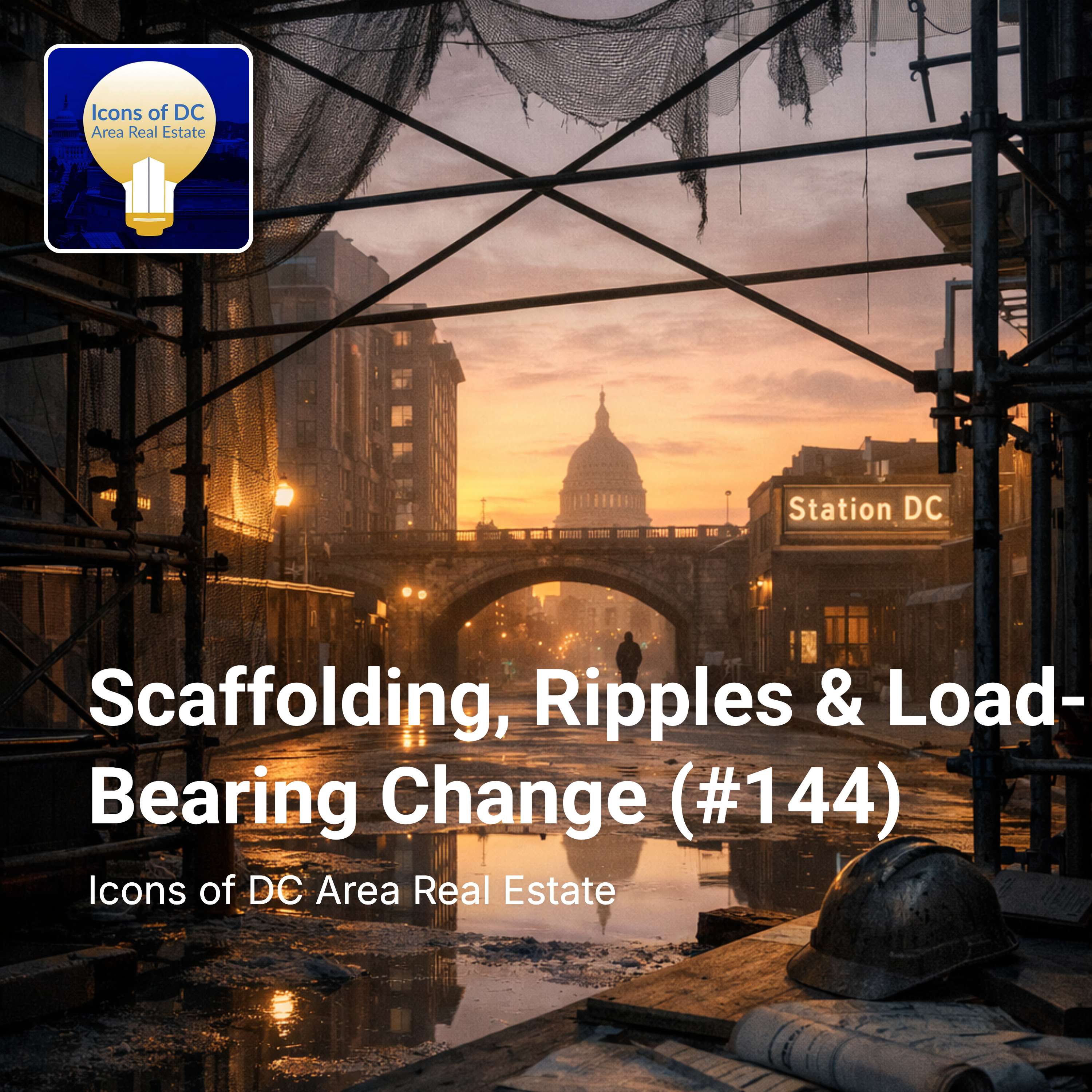
I want to begin with an image, one so ordinary we almost forget how profound it is.
An early morning city, street still quiet, the sun not fully up, buildings half wrapped in shadow.
And what caught my attention that morning wasn't the building.
It was the scaffolding, the steel, the planks, the netting, the temporary skeleton wrapped around something not yet ready to stand on its own.
And I found myself thinking most of the things that make the building possible are the things that are never meant to stay.
We take them down once the structure can carry its own weight.
And that thought stayed with me because the same thing seems to be true in real estate, in careers, in leadership, in community, and right now, very personally, in my own work.
So today I want to talk about scaffolding ripples, bridges, load bearing, change, repositioning and shoring, Jane Jacobs and the soul of our streets. And finally, the transition that ties all of it together.
The iconic journey in CRE transitioning to CO enterprises from my own ongoing activities and station DC for the community I built here in the DC area.
And underneath all of it, one quiet question.
What remains when the scaffolding finally comes down?
Scaffolding is honest.
It doesn't pretend to be the building. It doesn't ask for attention it doesn't expect permanence. It shows up, it carries weight, it stabilizes what's fragile, and then it disappears.
And yet without it, the building doesn't rise.
In commercial real estate, we celebrate the things that last.
But if you been around this business long enough, you know the truth.
Everything permanent stands on something temporary. First, early capital that took a risk before certainty.
The first tenant who signed before the amenities were finished.
A city planning staffer who believed in a vision still on paper.
A relationship that steadied something behind the scenes when no one was looking.
That's scaffolding.
One of our conversations, Gary Rapoport said something that sounded almost too simple to be profound.
He said, john, we don't build centers. We build Saturday morning memories.
He described watching a father and daughter walking toward a bagel shop at one of his shopping centers.
Not a grand opening, not a ribbon cutting, just a ritual, quiet, repeated, human.
And Gary's point was this.
The real success of a place is whether it becomes a container for life, whether people return without being prompted, whether a location becomes part of the story families tell themselves.
And that's why I'm starting it with scaffolding.
Because long before an asset is stabilized, a place becomes stable when it holds memory, and memory holds, like scaffolding is mostly invisible.
And when I look back on the iconic journey in cre, that's how I now understand it.
Not as the building, as the scaffolding.
It held early confidence, vulnerable questions, unpolished leadership, multi generational dialogue, relationships before they had names or outcomes.
Scaffolding is not an insult. It is a complement of the highest order.
Because when scaffolding works, the building stands without it. And that's where we are now.
Once you start noticing scaffolding, you begin to see the world differently.
You stop mistaking visibility for substance, noise for momentum, branding for structure. You begin to see that success grows quietly. First iconic journey in Sierra wasn't a megaphone.
It was a listening room.
It was a street where people felt safe enough to ask unsophisticated questions, expose uncertainty, learn in public, fail without being exiled.
That kind of environment isn't built with programming, it's built with restraint.
Hospitality, continuity, trust earned slowly over time.
And that's what scaffolding does.
It holds things steady long enough for something real to harden.
And once it does, the scaffolding must come down.
Not because it failed, because it succeeded.
A successful structure doesn't just stand. It begins to influence the space around it.
This movement, this spread of invisible influence from a single small action brings us to the next structural idea, the ripple.
Let me slow this down a minute. For a minute, because one of the most accurate things anyone has ever said to me about relationships, and by extension, about careers and communities came from my friend Brad Olson and podcast guest.
Brad said it almost casually, the way people sometimes offer the truest things about realizing how deep they travel.
He said, you don't really build networks. You toss pebbles and ripples. Do the rest.
I remember nodding at the time, but it took years for that idea to really settle into my bones, because most of us are taught, explicitly or implicitly, that neighbor networks are something you build, like walls.
One brick at a time, one contact at a time, one transaction stacked up on top of another.
Brad's view is completely different.
He's saying relationships don't behave like walls, they behave like water.
Think about what a single pebble and actually is.
It's not dramatic. It's a quick coffee, an unpublicized introduction, a note you didn't have to write, an invitation you didn't have to extend, a moment where you chose to take someone seriously before anyone else did.
At that moment, you toss it.
The surface barely moves.
No applause, no visible payoff. Sometimes not even acknowledgment.
But then the first ring spreads, and somewhere out beyond your line of sight, it touches another ring already in motion. And another, and another.
A personal ripple that took years ago.
I made a quiet eroduction between two people who at the time had absolutely no obvious reason to know one another.
Different stages of their careers, different lanes, different incentives.
It felt like a small courtesy, more than a strategic move.
And then nothing happened for years.
No update, no follow on, no. This led to something.
I assumed it went nowhere.
Then, almost five years later, I got a call that one introduction had turned into a capital partnership, which turned into a platform, which turned to a career inflection point, which turned into a leadership role that now shapes dozens of lives.
I had forgotten the pebble, the water end.
But here's the part we don't talk about enough.
Not every pebble a ripple lands. There are pebbles I tossed that sank straight down, never intersected with anything, never returned a visible result.
And if your sense of worth is tied to outcomes that can quietly distort you, you start choosing which pebbles to toss based on who's watching, what might come back, whether it makes sense strategically.
Brad doesn't operate that way. He tosses pebbles as an ethical posture, not a transaction.
That's the difference.
And that's where Brad's second metaphor Comes in because after you've tossed enough pebbles, after enough ripples overlap, sometimes something else forms a bridge.
Brad once said to me, the most valuable people in any ecosystem aren't the loudest ones.
They're the bridge builders.
What it means to be a bridge here's what people don't tell you about bridges. They're not neutral.
They don't just connect. They carry load.
They absorb tension.
Let me discuss two types of bridges. One kind sits between opposite pressures. In a transaction, they can get blamed by both sides when crossing feels uncomfortable. If you build bridges long enough as an intermediary in real estate, three things will happen.
One side will accuse you of disloyalty. The other side will accuse you of slowing things down. And neither side will fully understand what you're holding in the middle.
Bridges are not sentimental. They are engineered for stress.
Another kind of bridge is primarily a connection that facilitates a long term relationship. And Brad has spent decades quietly standing in that middle space. In both types of bridges, between generations, capital and community, ambition and restraint, urgency and patience.
A bridge that almost collapsed.
There was a season when two sides in our broader ecosystem, each fully convinced they were right, were hardening toward conflict.
Brad walked into that span carrying one. Neither am Genda. Weeks of listening, too quiet conversations, no performative gesture. Eventually the pressure equalized. Nobody won.
But dozens of downstream careers depended on the fact that the bridge didn't fall.
So now we have scaffolding ripples, bridges.
And that brings us to the next structural truth.
The work of the bridge is to hold load and the willingness to hold tension, to translate perspectives and to engineer. For stress is the very definition of the next structural truth. We need to discuss load bearing change.
When ripples accumulate and begin intersecting across people, generations and institutions, a new kind of structure starts to appear.
Not accidental, not orchestrated, but emergent.
This is where bridge builders step into view.
A bridge builder isn't simply someone who makes introductions or expands networks.
That is the pebble tossing work of the earlier chapter.
Important work, but preliminary bridge building is a far heavier discipline. It requires the willingness to hold tension rather than avoid it. To connect people or groups who don't naturally see each other.
And to take on load that others cannot or will not carry.
In one of my conversations with Tom Buzzuto, he told me about walking a community where someone stopped him. Not to ask for something, not to complain, but to say thank you.
The resident said, in essence, you gave us a place that treats us like we matter.
Tom paused when he told it because he understood what was really being said.
And then he offered a line I've never forgotten. People don't want luxury. They want dignity.
That is a bridge statement.
It connects investor expectations to resident experience.
It connects capital returns to human aspiration. It connects the world of pro formas to the world of lived life.
And it reminds you the strongest bands aren't always made of steel.
Sometimes they're made of values.
A bridge is not just a decorative structure.
It exists because two sides cannot meet on their own.
It must be engineered for stress.
Every connection point must handle compression, tension, vibration, and the unpredictable forces of what flows beneath.
Human bridges do the same.
They absorb conflict, translate perspectives, stabilize uncertainty, prevent fractures before anyone else knows a fracture was possible.
Years ago, two respected D.C. area leaders, each principled, each convinced of their view, were pushing toward an inflection point that could have split a partnership, affected teams downstream, and shaped a shared project.
What resolved the moment was not a master argument or dramatic negotiation.
It was the quiet presence of a bridge builder.
Someone with the steadiness, trust and emotional load bearing capacity to stand between them long enough for the tension to dissipate.
No spotlight, no announcement, no appearance of saving the day, just stability.
And stability in the right moment is the structural intervention.
[00:17:53] Speaker A: Bridge builders rarely receive public credit. Their work is invisible precisely because it prevents visible problems.
But when an ecosystem thrives, when collaboration deepens rather than fractures, when opportunity flows across boundaries, when generations stay in conversation instead of drifting apart, it is almost always because someone was willing to hold that middle span.
These are the structural leaders.
They think in load paths, not headlines.
And the healthiest communities stand on the quiet strength of their bridges.
To think in load paths is to understand the difference between necessary structural elements and purely decorative ones.
This distinction is what separates real, enduring progress from the high gloss of motions that fail under stress.
When I interviewed Bob Kettler, he told me something that stayed with me for years.
The downturn doesn't change you, it reveals you.
He talked about a moment early in his company's life, when pressures mounted, capital tightened, and the team suddenly saw which parts of their operation were actually carrying weight and which were nothing more than decorative assumptions dressed up as strategy.
Bob said the stress didn't create new truths, it simply stripped away the illusions.
You learn very quickly what you can lean on, he told me.
And that is the essence of structural clarity.
Understanding what holds what buckles, and what never mattered in the first place.
In buildings, some walls exist just to divide space.
They shape rooms. They guide movement. They look important, but structurally, they're not holding anything up.
And then there are Other walls, the ones you never see, the ones that quietly transfer the weight of the entire structure from the roof all the way down to the foundation.
You don't discover which is which when times are easy. You discover it when the pressure shows up.
Market supply pressure, interest rate, supply pressure, capital tightens, demand shifts, cycles turn.
Leadership transitions only apply pressure.
Health applies pressure, Age applies pressure.
Failure applies pressure. And suddenly the difference between what was decorative and what was structural becomes unmistakably clear.
Years ago, early enough in my career that I still equated momentum with growth, I watched a major platform undergo what everyone called a bold transformation.
New branding, new language, new leadership titles, new advisory councils.
Everything looked like forward motion until the first real stress hit.
What became clearer, quickly and painfully, was that decision authority hadn't actually changed.
Accountability was still fragmented.
Trust had never really been redistributed.
The structure looked new, but the load paths were exactly the same.
When pressure increased, the fractures reappeared.
Not because anyone was malicious, but because nothing structural had truly moved.
That was decorative change.
Now let me contrast that with far less glamorous story.
A leader I respect deeply realized after a difficult season that the organization didn't need new language. It needed clear decision gravity.
Without fanfare, two overlapping committees were dissolved.
One reporting line was simplified.
One hard personal responsibility was accepted at the top.
No rebrand, no newsletter, no ribbon cutting, just structural clarity.
When pressure returned, the organization held.
This distinction lives inside us too.
A new role can be decorative.
A new city can be decorative. A new identity can be decorative.
Sometimes what really needs to shift is where you source your validation, how you respond when uncertain, whether you still need to be in control, whether you can stay steady without being central.
Structural change, whether in a career or a building, is rarely glamorous.
It is the necessary, non visible process of shoring, a deeper, more fundamental action than the surface level work of repositioning.
Repositioning is the part everyone sees.
Shoring is the part almost no one does.
One changes the story, the other changes the structure.
In real estate, repositioning changes the use, the frontage, the narrative.
At the human level, it changes a new job title, a new platform, a new city.
Repositioning says, I'm not who I was last year, and that's important.
But repositioning cannot be mistaken for structural change.
Shoring happens when the soil shifts, the load increases, the assumptions no longer hold.
Personally, shoring looks like learning to listen more than speak, trusting others with roles you used to own, shifting from central to foundational, making peace with legacy as handoff, not monument.
There is a season. There was a season when I realized my instinct to lead from the front in every room was becoming structural strain.
I didn't need a new brand. I needed humility that changed everything that followed.
Organizations that last reinforce trust, alignment, responsibility, clarity of purpose.
Esthetics don't hold weight, foundations do.
The focus on foundations and structural integrity naturally draws us to a thinker who understood the difference between a city's appearance and its functional, load bearing soul. Jane Jacobs and her relentless attention to the human scale of our streets.
Jane Jacobs didn't talk like a developer, she talked like a watcher.
In her landmark book, the Death and Life of the Great American Cities, she gave us two images that quietly explain why cities live or die. Her core structural insight was that safety and vitality are not planned from above.
They emerge from the ground up out of continuous, informal human presence.
Cities don't stay safe because of informal enforcement alone.
They stay safe because people are present.
Jacobs argued that a mix of uses residential, retail and workplaces on short blocks is crucial because it ensures different people are on the street at different times of the day.
Shopkeepers notice patterns.
Neighbors recognize rhythms.
Parents observe what feels off.
Safety is emergent. It arises from presence.
Ground floor retail isn't just an amenity, it's social infrastructure.
When I interviewed Ray Ritchie, he said something that has the quiet certainty of a man who has watched decades unfold. He said, you can't rush a neighborhood.
Time reveals its character.
Ray has seen districts that were written off return.
He's seen sure bets stall.
He's seen the long arc of a city prove smarter than any single cycle.
And his point wasn't romantic, it was structural.
Place making has a time component you cannot buy.
You can finance buildings, but you can't finance the slow trust people develop with a place.
That's why Jacobs matters.
That's why patience is not passivity. It's a form of load bearing strength.
The sidewalk ballet is Jacob's beautiful term for the daily unchoreographed choreography of life that occurs on a thriving city street.
It's the continuous low stakes interaction that weaves a community together.
Dog walkers, strollers, shift workers, kids after school, late night employees.
You can't command this, you invite it by creating the physical conditions.
Like short blocks, varied old and new buildings and mixed use zoning that allow it to happen naturally.
You can finance buildings, you can't finance belongings.
The block didn't shift when facades changed, it shifted when people lingered.
Great leadership is witnessed, not announced.
The iconic journey in CRE was a temporary Streak Station DC becomes a new Sidewalk System the creation of a new enduring sidewalk system for a community necessitates a structural shift in leadership.
This brings us to the most personal and necessary transition.
Moving from the scaffolding of the iconic journey in CRE to the new to two new load bearing forms, CO Enterprises and Station dc.
Now we step into the most personal structural shift of all. For four years, the iconic journey in CRE wasn't a building.
It was a scaffolding. A temporary but vital stabilizing platform that created community, mutual learning, intergenerational trust, a safe street where people could appear when they were fully ready to acknowledge something. As scaffolding is not to diminish is to honor its purpose.
Scaffolding exists to disappear before the external transition could occur, before any announcement, before any handoff. You had to undergo the internal transition.
And internal transitions are always load bearing seasons.
You had to shift from leading from the center to supporting from the foundation, shift from directing rooms to shaping conversations, shift from carrying the weight to distributing it. Shift from owning the identity to to stewarding the legacy.
It is the work no one sees. It is shoring, not repositioning.
And shoring is deeper. It requires humility, detachment, perspective and the ability to reframe what is mine into what can I ensure outlives me.
Here comes There comes a moment in every long leadership arc when the center role becomes too constraining for the person and too limiting for the organization.
That moment arrived.
The iconic journey in CRE was no longer the structure.
It had become a chrysalis, beautiful, important and temporary.
The natural evolution was the Iconic Journey concludes its scaffolding purpose. CO Enterprises emerge as your refined core acting as the high leverage interstudio advisory platform and content generation engine for my personal intellectual capital and executive level strategic consulting. It is the intentional small load bearing entity focused on bespoke deep dive projects that require your my, I should say unique perspective. Distinct from broader community centric work, Station DC becomes the new flexible multi room framework capable of carrying broader load.
This isn't an ending, it is structural succession.
The success of of structural succession depends entirely on the capability and ethos of a new generation of bridge builders.
At the center of the rising Station DC real estate structure is Sam Glass and his commitment is driven by two powerful load bearing words.
If the iconic journey of CRE was Scaffolding and Co Enterprises is the inner studio, then Station DC is the next structural system.
A networked adaptive building capable of supporting a new generation.
Station DC is designed to take the principles and community related community generated by the iconic journey theory and scale them into a sustainable multi room framework for the intergenerational dialogue and talent development in the D.C. area. It is the new sidewalk system engineered for the sidewalk ballet of the next generation.
It is the structure built to hold the belonging that cannot be financed.
At the center of the rising structure stands Sam Glass. Sam does not lead from ego. He leads from ethos.
And his ethos is embodied in two words. Pro patria.
Not flag waving, not nationalism, not rhetoric. Pro patria is Sam's framing means for the good of the place, for the good of the profession, for the good of the community, for the good of the next generation. It is leadership as custodianship In a strategy meeting earlier this year, a debate emerged about whether Station DC should chase a high profile sponsorship opportunity that would bring visibility but compromise the mission. The room leaned toward opportunity. Sam leaned toward responsibility.
He said calmly, without moralizing, if we don't know who we're serving, the market will decide for us. And the market doesn't think about the next generation.
That was pro patria and it shifted the room and it clarified the load path for Station dc.
I'm not stepping aside. I'm stepping differently. I am becoming the advisor, the narrative keeper, the historian, the steward of the cultural DNA, the foundational beam beneath the emerging structure.
This isn't replacement. It's lineage, succession, transitions and the shift from central to foundational roles always raises the question of change.
But the most important discovery in this load bearing season is recognizing not what changes, but what, but what cannot be moved.
In the midst of transitions, people always ask what changes?
But the wiser question is what doesn't?
Because identity is not in the scaffolding.
It is in the commitments that endure after the scaffolding is gone.
No matter how the organizational forms shift, these pillars remain load bearing in leadership. 1.
Ethical grounding the refusal to use influence as leverage, the insistence on transparency, fairness and stewardship.
2. Relationship first thinking deals are temporary relationships compound.
3.
Intergenerational responsibility A constant will, Willingness to mentor, support and elevate the rising generation.
4. Long memory A historian's instinct recognizing patterns, cycles and the wisdom embedded in decades of watching the region change.
5. Service over supremacy.
Not dominance. Contribution.
These are not brand attributes. These are structural commitments.
The outer form changes. The internal architecture does not.
These enduring commitments define the individual as much as the organization.
If you are listening to this, you may be feeling the uncomfortable friction of your own next structural step, entering what I call the listener's load bearing season.
Now let's turn outward.
You're listening to this and you feel stretched, unsettled, unusually quiet, suspended between identities, aware that something in you is shifting. You may be entering your load bearing season.
A season where old stories stop fitting, new ones aren't already set.
Certainty decreases.
Awareness increases.
Internal excavation begins.
This is the part of the journey that no one applauds.
It doesn't look like momentum.
It doesn't feel like success.
But load bearing seasons are where futures are decided.
They develop foundational strength, clarity of purpose, emotional regulation, authentic leadership, the ability to act without needing attention.
If you're in this season, nothing is wrong.
You are being prepared for structural responsibility, not decorative accomplishment.
The season of quiet preparation inevitably gives way to the moment of revelation.
We turn one last time to the image that began this conversation.
Return now to that early morning street.
The workers arrive. The bolts loosen.
The platforms descend.
The steel frame comes down piece by piece.
And there, quietly revealed, is what the scaffolding made possible.
A building standing wholly on its own strength.
This is that moment.
The iconic journey. And CRE has completed its purpose.
CO Enterprises comes back into focus.
Station DC is rising. The scaffolding is gone. The structure remains.
And now, finally, we get to see what it can hold.
[00:39:13] Speaker B: If you're interested in learning more about coenterprises or the next chapter of community building taking shape at Station dc, you will find links and context in the show notes for this episode.
If this monologue resonated with you, if something here stirred a question, a memory, or a moment of recognition, I'd welcome your thoughts.
You can share them in the comments on LinkedIn or on the CoEnterprises website.
This work has always been a conversation, even when only one voice is speaking.
Looking ahead, beginning in 2026, I will resume icons of D.C. area real estate interviews.
The pace will slow to roughly 1:1 conversation per month, with the possibility of expanding beyond the D.C. region in sourcing guests. As I relocate to the Hudson Valley of New York in the middle of next year, the geography may widen, but the intent remains the same. Thoughtful conversations with leaders who have built things that last.
And finally, thank you.
Thank you for listening, for trusting me with your time, and for staying curious alongside me for more than six years. These conversations with real estate leaders in the D.C. region have truly been a labor of love, one I carry forward with deep gratitude.