Episode Transcript
[00:00:00] Speaker A: Foreign.
Hi, I'm John Coe and welcome to Icons of DC Area Real Estate, a one on one interview show featuring the backgrounds, career trajectories and insights of the top luminaries in the Washington, D.C. area Real estate market. The purpose of the show was to explore their journeys, how they got started, the pivotal moments that shaped their careers, and the lessons they've learned along the way. We also dive into their current work, industry trends, and some fascinating behind the scenes stories that bring unique perspective to our industry. Commercial Real Estate welcome to another episode of Icons of DCRA Real Estate.
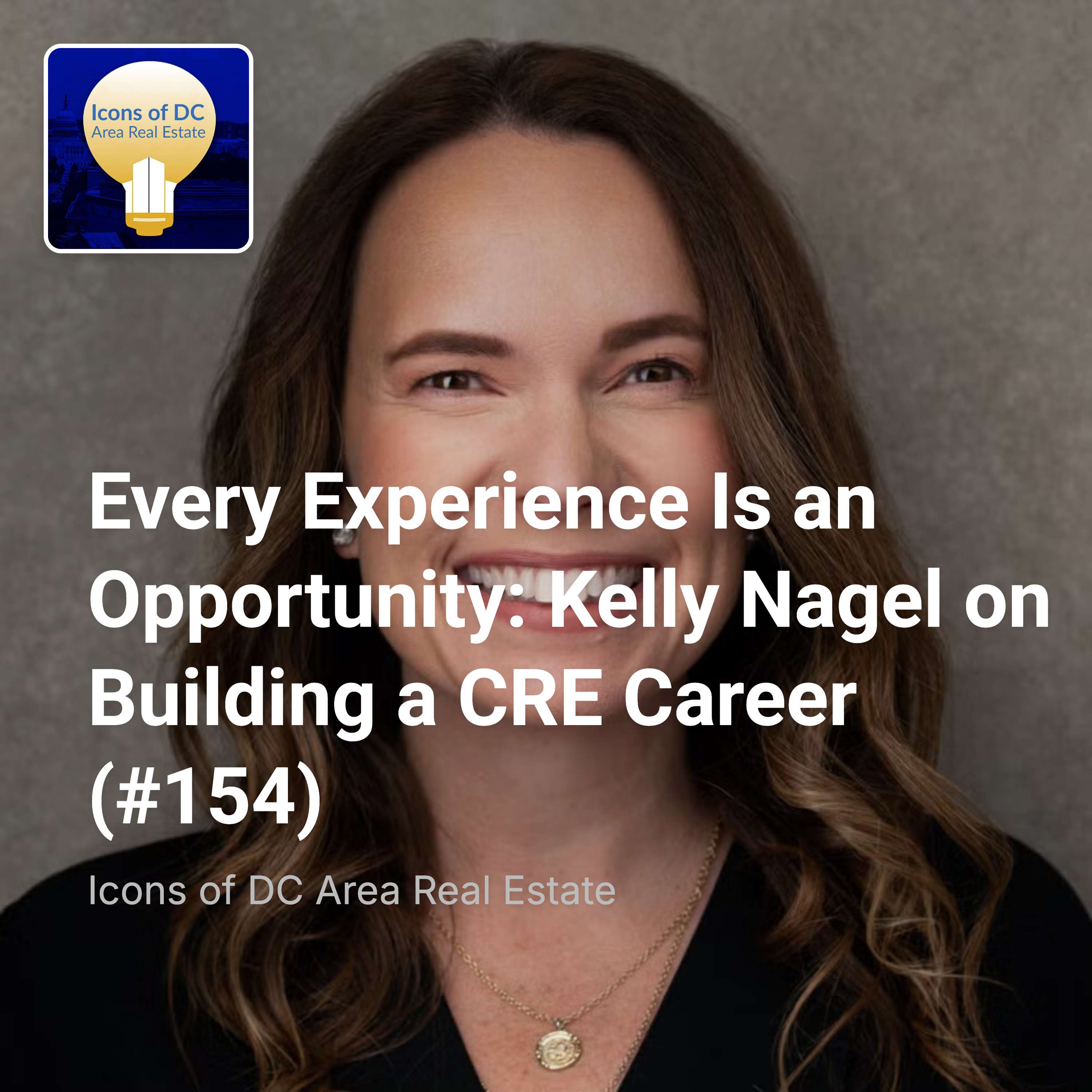
Today I'm joined by Kelly Nagle, whose career has crossed consulting, government, commercial real estate, entrepreneurship, and education.
Kelly studied business and accounting at Washington and Lee University and then earned her MBA at North Carolina's Kenan Flagler School.
Early in her career, she worked in consulting with Accenture and IBM and served as a civilian at the Defense Intelligence Agency eia.
Those experiences gave her a close look at how organizations make decisions and how budgets, schedules, relationships and institutional culture shape what actually gets done.
She later brought that perspective into commercial real estate, working across development, investment and business building, including founding reside her company.
Today, Kelly combines advisory work with teaching and curriculum development at Georgetown's Stier center as part of the McDonough School.
We'll start by talking about how a varied career can become coherent in hindsight, what she learned from making consequential decisions about complete information, and how a strength can sometimes become its own obstacle.
Kelly has been exploring that last idea through the concept of near enemies, behaviors that look like virtues but can become counterproductive when taken too far.
We'll also discuss how real estate education can build judgment in the age of AI and what it means to pass experience and capability on to others.
Without further ado, here's my interview with Kelly Nagle.
Before we discuss your professional journey, what did your family and early environment teach you about achievement, responsibility, and the meaning of worthwhile work?
[00:03:06] Speaker B: So I would say that achievement and responsibility always mattered and that was something that was definitely expected growing up, like in my household.
And I think I took it to an extreme growing up. And so there was a certain baseline that was expected of us in terms of working hard, having achievements, taking responsibility, being successful, things like that. But I think I took it to another level. And so growing up, I think back to high school when I was doing activities, it wasn't enough for me to be on the dance team. I wanted to be the captain of the dance team. It wasn't enough to get all A's I wanted to be valedictorian and so I think a lot of the pressure was probably self imposed more than anything else, but there was a high expectation kind of in the household regardless.
[00:03:58] Speaker A: Talk about your parents background a little bit.
[00:04:02] Speaker B: Yeah, so my mom grew up in San Antonio, Texas, which is where I consider home. My dad grew up in Kentucky and they met after he had joined the army after college. He had an ROTC scholarship and joined the army, ended up down in San Antonio and they met and got married, you know, and did all the things and they lived in Germany when they first got married and then moved back to the states. I was born in San Antonio, but because of my dad's army career, we moved around a lot. And so I went to four different elementary schools, three middle schools and two high schools.
And to be fair, like the high school that I graduated from, we moved in January of my freshman year. So most of high school was there and it was also in San Antonio, which is where I was born. Went to part of elementary school and then again most of high school. And so, so we moved around a lot. So I.
[00:04:58] Speaker A: Military culture.
[00:05:00] Speaker B: Absolutely. And so in middle school, you know, seventh, eighth, ninth grade, we moved in the middle of the year, you know, three years in a row. And those are tough years. Having kids that are, you know, have gone through it, are going through that now. And so being able to walk into a room and not know anybody and have to figure out, you know, where to fit in and how to fit in and, and everything else was something that I had to learn early, you know. And my little brother was, he was the only person who had kind of been through all of that with me. So he was my first friend, you know, like every place that, that we move.
[00:05:37] Speaker A: So that's really where you built your adaptability.
[00:05:40] Speaker B: 100%. 100%.
[00:05:42] Speaker A: Yeah.
[00:05:43] Speaker B: Yeah,
[00:05:43] Speaker A: that's what I'm gathering.
Okay.
Now that actually sets a backdrop pretty well for your career, which we'll get into.
You studied business administration, accounting at wl Washington Lee. What attracted you to the structure and precision of that training and how does it still influence how you think?
[00:06:04] Speaker B: It was sort of an accident how I ended up there. I thought I wanted to be pre med coming into wnl and I took a bunch of science classes and didn't love them. And I had taken all the AP sciences in high school and those were some of my favorite classes, honestly, because they were some of my favorite teachers looking back.
And then I got to WL and started taking those classes and I remember thinking, why Do I need to understand botany in biology to be able to go to med school? That just doesn't make sense to me.
And so I had a hard time seeing the.
The practical application of, of the things that I was learning. And so I took a couple of classes in what we call wl, the C school, the, the School of Williams School of Commerce, Economics and Politics.
And those business classes just made sense to me. I started doing that sophomore year. And so management classes and accounting and econ, like all of that was practical and logical to me. And so I really liked that. I also really liked a class that I took, a psychology class that I took freshman year called Brain and Behavior, which was awesome, was still one of my favorite classes. And I remember coming home and telling my parents, I was like, I think I want to be a psych major. And they promptly said, no, that's not a good plan. You're going to have to go to school forever. You need to get a job. So the C school offered the. The Promise of Employment. And so it kind of went through those courses. Like I said, they made sense. And I realized that I had already taken a bunch of accounting classes. And so it was really easy to do the double major in Business Administration and accounting. I will say I did an accounting internship. I tell my students this at the beginning of every semester. I did an accounting internship summer after my junior year. And I got about three hours into it and realized that I had made a grave error in terms of my potential career choice. And so came back to school after that summer, talked to my advisor, who happened to be my tax professor, and complained to him, not complain. But I was very worried, what am I going to do as an accounting major? And I don't want to be an accountant. My life is over at 21 and he was not over.
And that I would get a job in consulting. I would start recruiting for consulting roles my senior year, which I did. I would do consulting for a few years. Then if that wasn't it, I would go to business school and figure it out. And that's pretty much how it worked out.
[00:08:45] Speaker A: So your early experiences included Accenture, IBM and Diagram Intelligence Agency. What did those very different institutions teach you about how organizations make decisions?
[00:09:00] Speaker B: So different such different organizations. I will tell you the most important thing I learned that became important in my development career and in real estate was how to manage a budget and a schedule. And so at Accenture was doing management and strategy consulting. The Defense Intelligence Agency was actually one of my clients. My first client was the Postal Service and so we can save that for another day. The idea that we get our mail every day is nothing short of a miracle. And so learned all about how post offices work, and all the cool things in post offices happen before five in the morning, so lots of weird hours there. But ended up working at the Defense Intelligence Agency as a client after 9, 11.
And it was just. The DOD is a vast organization spread out around the world.
And I was within the dia, which is the intelligence arm of that, and so working in the. In the CFO's office.
And this was kind of at the beginning of the global war on terror, but understanding sort of the immense bureaucracy that, that is our federal government and the Department of Defense, but also, you know, just a group of very dedicated professionals who, their entire purpose is to make sure that the war fighter, you know, had the resources they needed to protect our country. And it was just. It was so interesting just learning how things worked. And I was. I was really young relative to a lot of the colleagues that I had at the dia.
And so bringing some of that was kind of my first experience, I would say, bringing some of, like, commercial best practices and things like that into, you know, another organization, in this case the dia, but figuring that out and sort of navigating that terrain and the traditions and not just the bureaucracy, but just like the way we've done things or the way we have to do things, the way it's different here and really listening to people and listening more than you're talking initially to try to learn and figure out context and where is the appropriate way to, you know, interject an idea or try to maybe change your way of thinking a little bit and adjust it and be agile and nimble, which was really important, you know, in kind of this changing environment that we were in kind of the early 2000s.
[00:11:24] Speaker A: Your parents must have been proud of you in that role.
[00:11:28] Speaker B: They were. I mean, my dad in particular, as, you know, an army veteran, they were like. It was really.
And it was really fulfilling for me, too, to be able to work within the DoD. I ended up actually working for the Department of Defense as a civilian. One of my references for business school, as I was following my professor's advice, was my client there at the dia. She was the chief executive, chief financial executive. And I asked her to write a recommendation for me, and she did.
She was great because she was one of the first very strong women that I had worked for and seen really in action and worked closely with. And she was. She was not like a very big one. She was Five, two, five, three. Like, just like very petite, but she could hold her own in these
[00:12:17] Speaker A: rooms with four
[00:12:18] Speaker B: star generals.
Yeah. And it's like four star generals that like, people don't say no to. Right.
And she would be like, no, like, this is, this is not going to work. And here's the reality of X, Y and Z. And she was just, she was so awesome and she was always prepared and. But she was, she could think on her feet.
She knew what she was talking about and she knew when she didn't know an answer either. And like, and that was really impactful. I think for me to learn is that humility to be like, look, I don't have that exact answer right now. Like, I know lots of things, but I don't know that detail. So I'm going to get back to you on that. Yeah. And we're going
[00:12:56] Speaker A: to your key mentors.
[00:12:58] Speaker B: 100%. And she was wonderful. And I asked her to write this recommendation for me for business school and she agreed to. She's like, but I have an idea. She was like, I would. And I was still a consultant at the time with Accenture and IBM. And she was like, I would love for you to come work for US as a DoD civilian, defer business school for a year and come work for us. And she's like, manage a couple of projects that you can't manage as a contractor, but you have to be a civilian.
And she's like, and then you can go to business school. And. And so that's what I did. And it was awesome. It was just.
[00:13:37] Speaker A: You still are in touch with her?
[00:13:38] Speaker B: We are, yes. For sure.
[00:13:40] Speaker A: I would imagine so. She's probably somebody that you call as one of your major people in your life.
[00:13:46] Speaker B: Absolutely. Yeah. She was, I mean, she was one of the first people, I think, that that saw potential and things in me that I didn't necessarily see myself.
[00:13:55] Speaker A: Everybody listening. Find someone like that to help you in your career.
Absolutely.
So how did you find your way into commercial real estate?
Was there a person, project or moment when you realized that the built environment could become a setting for
[00:14:14] Speaker B: your career? Yeah, I, you know, when I was in college, I had sort of accidentally stumbled into an internship with a family friend down in San Antonio who had gone to WL and whose kids I had gone to high school in WL with as well. And he was a hotel developer and I spent the summer with him. And honestly, like, my big project initially was this Will date me was to update his Rolodex.
And so he had three of Them because he knew so many people.
So I went through and updated his Rolodex and all that, but I got to follow him around and shadow him as he was developing hotels all over Texas. And so we did a lot of road trips and met with a lot of city officials and hotel flags and architects and bankers and all of the things.
And I didn't.
At the time, I wasn't like, oh, this is what I want to do. But it was interesting looking back. So I mentioned my stint at the DIA before I went to business school. I went down to Chapel Hill. And you started looking around, like, as I started my MBA and went to all the career clubs and all the things, and I was like, okay, well, what's interesting was interesting. And I really liked marketing. I was newly married at the time, and my husband was still in D.C.
there's not a lot of, like, school, you know, CPG jobs in DC. So I was like, well, that's not going to work. I didn't really want to do consulting anymore because that sort of defeated the purpose of going to business school for a career pivot. But I really liked real estate as I talked to those guys, and I liked it because it was tangible. And I know a lot of people say that, but, you know, it just. When I was doing consulting, I did a lot of PowerPoint decks, and, like, we would have conversations and make recommendations and. And ironically, I have a lot of conversations now as part of my job and what I do, but I didn't know what necessarily happened to my recommendations in my PowerPoint deck after I created it. It could go sit on a shelf. And especially being on the civilian side of DoD, that was sort of the mantra, right? It's like, well, we're going to outlast whoever this consultant is and go back to the way we've always been doing things.
And so I didn't want to do consulting if I could help it, but real estate was pretty cool. And I learned when I was doing consulting and when I was working at the DIA again about budgets and schedules and a lot of development is project management.
Now, it's very difficult project management because it's a very expensive and complicated game of Whack a Molecule, you know, meets Tetris meets Jenga. But that's a big part of it is, you know, kind of time and money and figuring that out. So I was like, well, I can. I think I can solve this. This puzzle, right? I think this puzzle would be really interesting to solve. And I was so lucky that I had Ended up in an MBA program that had a really amazing real estate legacy.
[00:17:20] Speaker A: Like Kenan Flagler.
[00:17:22] Speaker B: Yeah, the Wood Center. Kenan Flagler is fantastic. And, you know, I've been super involved with them since I graduated as well. And it really created this lifetime sort of relationship with that institution now. I was there 2006 to 2008, which was a really fascinating time to transition into commercial real estate, but I think that was positive, too. But getting to Keenan Flagler and the Wood center and all the club activities and just like the mentoring that takes place and just the really amazing people that have come through that program and our friends of that program was really fantastic. And I went to WL Undergrad that has an amazing alumni network. And I would say that the Wood center rivals that for sure.
[00:18:08] Speaker A: Was David Flanagan involved? Yes,
[00:18:11] Speaker B: he's my neighbor, actually, and my neighbor now. But yes, he was involved.
[00:18:15] Speaker A: I knew he was very involved.
[00:18:17] Speaker B: He was. Yeah. I interviewed with him for an internship when I was in school.
[00:18:23] Speaker A: I don't know if you heard my podcast with him, but
[00:18:25] Speaker B: I didn't. I'll have to listen to it.
[00:18:29] Speaker A: He's probably the most high risk reward guest I've had. I
[00:18:33] Speaker B: believe that. I work with him on the ULI Awards jury, and it's always really interesting to hear his perspective on the various projects that we
[00:18:41] Speaker A: have. He looks at risk differently than almost any other guest I've had.
[00:18:45] Speaker B: He definitely does.
That's awesome.
[00:18:48] Speaker A: So your resume can appear unusually varied.
Consulting, government, retail, multifamily development, investment, leadership, entrepreneurship, and education.
What did that journey feel like from the inside?
[00:19:07] Speaker B: So interesting question. For me, it feels cumulative and not really disconnected. And I could see where it could appear disconnected. But I would say that the through line for me, I think the beginning of my career and we talked a little bit about my childhood in high school and things. The beginning of my career was a lot about proving my capability and proving that I was a hard worker and I could do things and I could just get things done and solve problems. Right.
Being able to do that, I think is obviously very important.
And so understanding, too, how organizations work and how people make decisions is really important as well. And I can tell you now, and having worked for private companies and public companies and different industries and things like that, there's a
[00:20:08] Speaker A: lot of.
[00:20:10] Speaker B: Right. And how people work and how decisions are made or, like, where bottlenecks are and things like that. And I think for me, being able to have that perspective and see those things has been really important for me to discern the patterns which is a lot of what I do now. Right. And so it's been really cool. Looking back, I don't know that it, you know, certainly my career has not been linear. I don't think many people have a super linear career, which is something that, you know, I feel questions from my students about all the time. It's like, it's okay that if you don't have the next 10 years planned out, right? Or it's okay if you think you do and you get into it, you're like, this is not for me. Like, you're, you know, you can pivot.
But being able to, you know, kind of look back and understand, you know, kind of the common denominators and things like that. And one thing about me, too, is like, I'm just.
I'm a lifelong learner, and I'm curious, and I want to understand how things work, and I want to understand context.
And I like to see how things could maybe be better or shift or adjust. And so being just constantly curious like that and wanting to learn, I think is something that has been consistent for me throughout my entire life, honestly. And. And so the way, looking back now, with hindsight, it's a lot easier for me to say. It's like, okay, well, this is what I learned and picked up along the way. These are the relationships that I made. This is what I learned about working in a big organization. This is what I learned about trying to push on rope when you're trying to get something done and there's cultural obstacles, and how do you kind of take that.
That kit of parts and rearrange it in. In different ways? And. And it's also. It's been. What's been super cool for me is realizing, you know, first I was kind of proving my capability, and then it was like, okay, how can I make something better or build something, you know, that doesn't exist using the experience I have? And now I feel like this phase of my career is much more about like, okay, how can. How can we take that? And then how can I not be the capability myself? How can I teach that capability to others so that they can go make better decisions or think about things differently or what have you? So I'm not the bottleneck.
[00:22:41] Speaker A: I'm just astounded because it's very similar to my career.
That's why it's fascinating to me what you're doing and what you're saying. Saying. So you have described much of your work as the same move, stripping away the framing to reveal the actual concept Underneath.
When did you first recognize that pattern in yourself?
[00:23:06] Speaker B: I think I first articulated it relatively recently, but I think I first recognized it pretty early on. Like, I mean, I can remember at Accenture, you know, like working on proposals and are working through client problems and things like that, and being like, okay, it's like, well, they say that this is what they need, but it's really clear once we dig into it and do some client interviews and things like that, that the real problem is this. Right.
But the difference is recognizing something and having, I would say, the jurisdiction to do something about it or for the person that you can report the problem to, for them to listen are two very different things. And so it's one that like you can see things, but is it your place or you know, to say something and. Or like whoever needs to hear it? Like, are they in a place where they're really willing or able to hear it? And what I recognized, whether it was kind of my pre business school career or kind of post business school, coming into real estate in the gfc, which was just a wild time, and then doing development and then getting kind of into the operations and asset and portfolio management side to running my own business, there's a lot of similarities in terms of the business business problems. And so that's kind of where I started. It's like, okay, it's like, well, this is just packaged a little bit differently or what have you. You have the same kind of core issues no matter what what's happening. And that's honestly, that's not just business. That can be true for relationships and, you know, anything else as well, or nonprofit organizations or whatever.
[00:24:57] Speaker A: That's great.
Looking across all the different roles, what qualities, interests or values remain constant, your own career and variance.
[00:25:09] Speaker B: So the curiosity, I think, is a big part of it.
I am endlessly curious. And I always want to understand more, whether that is context or how we got here or where it is we think we want to go and who the players are and what's the relevant history and. And where might the obstacles be? And so it's like, I'm a problem solver. I love puzzles and I love trying to figure out a new way of looking at things when something is particularly challenging or difficult or hairy. And so I think that has been a through line through everything that I've done is just that curiosity and wanting to understand.
And then I think there's just some basic things to too. And it's just one is being a good listener. Right. And so being able to, especially if you're walking into a new situation with a client or a partner or something like that, like you need to know what you're walking into and like, and what's happening before you start, you know, kind of spouting off your wisdom. Because it could change, right? Or like the context might change something or again like someone's receptivity to what you have to say might not be there yet. And so you've got to earn trust and, and everything else. And so being really curious has been a through line for me. Being able to listen has been a through line. And then you mentioned it earlier, just the ability to adjust and be agile and be nimble and kind of roll with the punches becomes really important too. Because if you're able to do that and kind of keep your North Star in mind, then it's a lot easier to kind of of withstand anything that might happen.
[00:26:54] Speaker A: Resilience,
[00:26:55] Speaker B: Resilience is so important.
[00:26:58] Speaker A: But how do you distinguish between a true career invariant that should be pursued and a professional identity that was once too, once useful but has become too limiting?
[00:27:11] Speaker B: Good question.
I think part of it is being able to ask the question and check in with yourself, right? And so, and there's, and you know, this is the premise around a lot of the work I'm doing is this idea that we have a lot of strengths and at some point the strengths might get over indexed, you know, and you might have to recalibrate because all of a sudden that strength or like what has been a strength like up until now might be holding you back in some way and so understanding that about yourself. And like, and I'm, I'm still growing and learning myself and so like I'm, I'm getting better I think at being able to articulate what's important to me and what I want and what are what are kind of non starters and non negotiables. That's very different from maybe 25 years ago or even 10 years ago. Right. And so knowing yourself and being able to have honest conversations with yourself and kind of not staying someplace because you're scared and maybe that's it too. It's like being able to ask yourself the question, what's the worst thing that's going to happen if this doesn't go right and what am I scared of that might happen and how might I mitigate that? And having those honest conversations with yourself, which is I think harder than it sounds
[00:28:38] Speaker A: here you're there, but as you move among Regency, Archstone, Avalon Bay, Skanska, Aimco and Edens what did you learn about recognizing when it was time to stay, adapt or leave?
[00:28:55] Speaker B: So I would say my path in particular.
You know, sometimes things happen that are not in your control, you know, such as companies getting acquired or things like that. Sometimes, you know, things happen in your life, circumstances that you know are not fully in your control and something has to change.
But sometimes it was like I chose a new challenge. And something I've learned about myself, I would say over the years is that I really like having room to build something and I'm not as fulfilled long term with just the care and feeding of something that already exists and is status quo. Right. And that's fine, you know, it's great because that things need to be maintained as well. But I don't think that's my highest and best use, to use a real estate term. And so I really enjoy the challenge of kind of building something, seeing the potential, being given a charge. It's like we're trying to build this and this is what we want it to look like go. You know, here are the constraints, here are the resources and, and that's really fulfilling to me. And again, sometimes things happen that aren't in your control.
So like when I launched my company Back in 2021, 2022, I raised money, I raised capital to buy multifamily assets with. And my entire thesis was I'm going to buy things at a reasonable basis and I'm going to take my institutional expertise from places like aimco and Avalon Bay and things like that and I'm going to do the targeted capex where I know I can get returns and I'm going to take things that are under managed or mismanaged and I'm going to wring out the operational inefficiencies and I'm going to grow noi that way. And if I'm buying it at a decent basis, then hopefully I can benefit from some cap rate compression or. But at the minimum I'm growing noi and I can create returns for my investors. And that was the thesis and I was able to raise money on that. I raised capital on it. Well, I recall what happened in the spring of 2022 with interest rates, they went up a whole lot after Covid and historic lows. And you might also recall that there was a tremendous bid ask spread. And the way I explained that to my students, it was like the bid is what someone's willing to pay and the ask is where someone's willing to sell.
And it was so wide at one point that there was no deal to be had. There was no room for negotiation. And right there at the beginning, even the brokers were just like, no interest rates going up. Don't affect the valuation. I was like, that's not how math works.
So I underwrote lots and lots of deals. Lots of deals. And I needed to buy some honestly, for the fees. And. And I didn't. And. And I ended up pivoting at that point. And there was a choice I made to pivot, but I felt like it was the right choice.
And. But looking back and starting a business was far and away the hardest and most rewarding thing I've ever done. And, you know, just having the courage to do that and put yourself out there. And, you know, I was wearing every single hat. I was. I was raising money. I was writing website copy. I was meeting with, you know, investors and sellers and brokers. I was underwriting deals. You know, I was talking to insurance brokers. I mean, I was doing all of it, and it was awesome, you know, and I loved it. And. And it was hard, and it was lonely, too. And so finding kind of your tribe, like, the other people that are crazy enough to do that was really fun. But it was also, I'm so grateful that I had the opportunity, A, but B, that I understood when it was time to say, this is not working as is.
[00:33:03] Speaker A: But you do have conversations with yourself frequently during.
[00:33:06] Speaker B: So many. So many.
And. And it's hard. It was really hard. And. But looking back, I mean, I'm so glad that I stuck to my guns. And now when I teach negative leverage to my undergrads, I was like, here's what happened, you know, and here's, you know, my thesis was that negative leverage was not good and it was not going to work. And, you know, and every time a broker told me, oh, it's only temporary. It'll be fine, I was like, I got a pit in my stomach, you know, and, like, I'm glad that I trusted my gut. And like, this. This iteration is not. It's not the right time. It's not for me. And so I pivoted. But
[00:33:47] Speaker A: let me dig a little further. My next question kind of fits into that process and decision making. Was there a particular consequential career decision you made before you could know whether it would work?
What.
What made you willing to act without complete information?
[00:34:06] Speaker B: I think starting residue was. Is probably the best example of that. It's interesting because I was trying to figure out the right time to launch, and there's not a right time it's kind of like. Like when people like, oh, I got to figure out the right time to have a. Have a baby, you know, and I have three kids, 16, 14, and 12. Like, there is no right time. You just do it and you figure it out. Right? And starting a business is very much the same way. But I was still terrified because I was just like, I have this plan. I have the relationships. I know it makes sense, but I'm not quite ready yet. I need a couple more months. I need a couple more months. And then finally just did.
Was the right thing to do. Could I have done it six months earlier? Probably. Could I have waited six months later? Probably.
But it happened when it was supposed to happen, and it was absolutely incomplete information. And I built a thesis and built the plan, raised the capital, did all the things, and then circumstances changed, the market fundamentally changed, and my thesis didn't work anymore.
And that's kind of the epitome of imperfect information, because you just don't know.
Again, I teach this. And so it's funny to be like, all right, we talked about cap rates and compression and expansion and everything else, and how you have a smaller spread, typically when you have a shorter hold period, because it's less likely for something crazy to happen in the market. I was like, but there are notable exceptions. 2008, 2020. There are absolutely exceptions.
But being able to, I think, trust yourself and trust that you have the right kind of fundamentals, first of all, but also, just like, just knowledge and agility and just resilience, like all of those things that we've talked about, being able to trust. And I will bet on myself all day long, right? And so having that trust, I think, is super important, too. And so it makes it a lot easier when you have. And we're always making decisions with imperfect information.
And so. But trusting yourself to kind of be able to tell what's really important here, right? And what do I do if that goes wrong somehow or if that doesn't line up? I mean, it's kind of the same way you look at real estate deals. And so, like, if you're an investment committee and you're having to say, like, okay, these 14 things have to align perfectly for this deal to work.
That's probably not a great investment to make. And, you know, but it's like, okay, it's like, here. Here are reasonable assumptions. They're like, we can defend these assumptions.
Here are the couple of things that we think could go wrong. If any one of them go wrong, we can recover. You Know, if all of them go wrong, we probably have something bigger that we have to manage. But. But it becomes important kind of understanding that that scale and sort of breadth of what are the variables,
[00:37:19] Speaker A: what you've built for yourself based on your career. It's resilience through adaptability and going through all these issues before.
So you built up this, I don't know, thick skin to be able to handle things. And I look at that as Nassim Taleb, as a book that you may have read called Antifragile. Antifragility.
[00:37:42] Speaker B: I've heard of it, but I've not read it. I will add
[00:37:44] Speaker A: it
[00:37:44] Speaker B: to my list.
[00:37:45] Speaker A: The exact thing. So with more stress and pain and problem, the stronger you get.
So basically, you're building up this resilience, and it's beyond resilience.
It's actually desiring to get into something more challenging and difficult as opposed to avoiding it or trying to stay away from it. It's, you know, the thirst for aim.
And that's in essence what you're. You're saying to yourself, I've got this, and I wouldn't feel alive unless I was doing this.
And the flow that comes out of that.
And so the definition of flow you may be familiar with, but it's just, there's a point where you're pushing yourself just about to the edge. Maybe not over the edge, but to the edge.
And your mind just, everything just time just kind of stands still and just keep going because you just, you know, you're on the right path.
[00:38:48] Speaker B: Yeah, yeah, yeah. And I think it's also, it's developing, you know, kind of your gut instinct too. Right. And so, like, okay, it's like, well, it's like I've got a. I got a strong core. Like, I know. I understand the fundamentals. I understand, like, lots of things can go wrong. And, like, things will. And you know, what we always say about a pro forma is that we know that it's not right, it's going to be wrong. But if you understand kind of what the drivers are. And this is not just real estate, it's business, it's life. You know, if you understand the fundamental drivers and you know what, what could happen.
[00:39:27] Speaker A: Stay away from the hazards.
Going to the good things.
[00:39:31] Speaker B: Yeah, it just. It becomes.
It becomes less scary, I think, because you're like, well, and I used to ask myself this all the time, like, what's the worst thing that could happen? And I remember, go back to when I was a kid, you know, like when I was a High school student.
I ended up applying. I'm going to date myself again. Like it was before the Common app. And I was on a typewriter, like, doing my college applications. And I ended up applying to WL early.
I really liked it and I visited and it was great, but it was half a country away from San Antonio.
And, you know, like, I was like, I think I like it. And so I applied early. And then I got really nervous. I got in, I got really nervous in April when everyone was getting their acceptance letters back and deciding where they were going to go. And I was like, I already made this decision. Like, oh my God, what if it was the wrong one? And I remember my parents sitting me down and saying, you're going to be fine, you're going to go. And if for some reason you hate it, which we don't think you will, you'll transfer. Like, that's the worst thing that could happen, which is a completely manageable situation. And I got there and loved it and it was great. And I still love Debbie now and going to Lexington and, you know, but if you think about, like, what are you actually scared of, you know, like, and how would you manage it? It's not as scary a lot of times.
[00:40:51] Speaker A: Well, the earliest, the earlier you learn that, the better for your life, I think long term.
So tell us about a project or investment where the accepted narrative said one thing, but the underlying facts told you something different.
What did you do?
[00:41:10] Speaker B: Oh, so many, I think going back to like, when, when market conditions change and you know, in multi, this will be an amalgamation of several different companies, several different projects. But, you know, market conditions change.
Perhaps you've owned a piece of land for a long time, you know, like, owned it. Not just like, have it under control. Maybe you have it under control, you know, instead of owning it, but.
But you've held onto it for a long time and the conditions have not been right for, for you to develop. You know,
[00:41:44] Speaker A: how do you determine a long time?
[00:41:47] Speaker B: Years, months? I mean, like, ideally what we're doing is like, if we underwrite a deal and, you know, we have the dirt under control, you know, we are making sure, like in a perfect world that you, when you close, you can put a shovel in the ground the next day. It doesn't always work out that way.
[00:42:03] Speaker A: Very rarely.
[00:42:05] Speaker B: Perfect world, because that's how IRRs work. Right.
And so, but like, let's say for whatever reason, market conditions change and that happened honestly, like in 2008, like, there were, you know, companies had bought land that they were ready to develop. And then the market took a wild turn and you know, all of a sudden it didn't work. And so there was a lot of land held for future development, right? And so, but things change. And so the assumptions that you had made going into it, whether it was about construction costs or rents or absorption or operating expenses, whatever those levers are in your pro forma, it can change over time. And, and we saw this a few years ago, you know, like coming out of COVID It's like everything, particularly in D.C. everything was moving in the wrong direction, right? Like operating expenses were up, like just across the board, there was a lot of supply. So rents were down, absorption was down, you know, concessions were up. And so effective rents were really down. And so the, what was happening actually like in the market was not great. And especially if you were trying to build something new, like in a particular market, and all of a sudden, you know, the, the rents that you were putting in your pro forma for your new development were 30% higher than what the effective rents were today.
Like, we couldn't get away with that. You know, like, and, and real estate, cyclical, you know, but like underwriting standards get tighter and tighter when, when things are tough. And you know, so it's just, it all of a sudden, if all of those inputs are kind of moving in the wrong direction, it become, not only does it become hard to justify to your investment committee, then you have issues like if you're actually trying to fill the capital stack, right? Like if you can't get equity and just, it, everything just kind of falls apart. And it, Those are tough conversations to have, particularly if the narrative, you know, has like, and there's a narrative with every investment. And so like first, you know, put, put land under contract and put down a deposit. It's like this is what we want to do and this is the story and this is what, why we believe in it. Because you're trying to mitigate risk for that investment committee. It's like, why, why do we feel like this is a good investment? How are we going to get the right risk adjusted return?
And then if those conditions change, it's like you got to adjust. But there's only so many things you can adjust, right? And
[00:44:38] Speaker A: the big question I've always wondered is, I've always heard the term good real estate.
So the question is, you know, in 1985, good real estate was downtown Washington office buildings or maybe a Tyson's Corner shopping center regional or something like that.
But over time, things change.
And a parcel of land in Gainesville, Virginia that is now a data center park has more land value per square foot than any piece of property in downtown Washington.
[00:45:16] Speaker B: Right.
[00:45:17] Speaker A: Does that make any sense at all? Is that what is good real estate? So time changes things.
[00:45:24] Speaker B: Yeah.
[00:45:25] Speaker A: And you know, when you're making a decision on an investment, it's very time framed
[00:45:33] Speaker B: for sure.
[00:45:33] Speaker A: No clue five years hence what that land value is going to be. You can look back five years and say what. How has it evolved?
[00:45:40] Speaker B: What's happened? Yeah.
[00:45:42] Speaker A: What had happened to now and what makes sense? So the question is, how do you look forward? And you have to build enough variables in to make a deal, otherwise you never make a deal or, or take risk that you hope is, is, is, is bounded in a way that you're not going to get killed.
[00:46:05] Speaker B: Absolutely. Well, and honestly, it, everyone's crystal ball has a crack in it. Right. So you can't. And, and good for, you know, because there's
[00:46:15] Speaker A: even the best developers, the best investors of all time,
[00:46:19] Speaker B: and there's, there's some luck in it. I think anyone will tell you. Right. I mean, and certainly in terms of timing and so it, I think I talk about this a lot in class too. It's like it comes down usually to just those basic economic principles of supply and demand and risk and return. Right. And whatever your particular investment strategy is depends on your appetite for risk. Right. And whatever it is you're going to do, it depends on what's happening with supply and demand. And understanding kind of how all of those variables and levers sort of move together becomes really important to start developing that intuition of what's going to happen. And I
[00:47:06] Speaker A: don't
[00:47:06] Speaker B: know that anyone could have predicted that, you know, land in Loudoun county for data centers was going to be where it's at. And who knows what's going to happen in five years. Right.
[00:47:16] Speaker A: If I was raising a child today, I would think that even in elementary school I would teach them statistics from the get go. To me, understanding probabilities in life and that's way beyond just economics.
[00:47:31] Speaker B: Yeah.
[00:47:32] Speaker A: It's decision making.
It's even your personal life. Understanding probabilities is really an important thing.
[00:47:41] Speaker B: Totally. Well, and going back to what's the worst that could happen, then what's the likelihood of that happening?
Right.
[00:47:48] Speaker A: Yeah, exactly.
So have your best transitions generally been driven by attraction to the next opportunity, discomfort with the existing situation, or there's some combination of the two?
[00:48:01] Speaker B: I would say all of the above, plus external circumstances. Right. I mean, just like whether it was like a Market shift or like a life event or, you know, a merger and acquisition, like, what have you. It's like all of those things sort of factor into it. What I will say though is like, I really do believe that, like, every stop that I've made has been an opportunity to learn. And like, my kids joke that I collect people because I'm just like, oh, my friend from there, like, oh, my God. They're like, you know, everyone, like, you know this person from what you know, and it's like from childhood, like, all the way on up and. But it's like I, I, I try really hard to collect experiences and relationships and, you know, build perspective and, and I, I think that everything I've done has given me an opportunity to, to build perspectives, point of view or data point or what have you. And I feel like the more data points you have, like, with imperfect information, the richer your perspective could potentially be.
And so I think that's been the, I would say the overriding thing is like, being able to see change as an opportunity.
[00:49:25] Speaker A: Let's pivot to one of your theseus today.
Where did the concept of near enemies originate?
Was there a particular lived experience that gave you the first glimpse of this pattern and maybe give backdrop on what near enemies means as well?
[00:49:45] Speaker B: Yeah, so near enemies is, it's a lot of the work I'm doing right now in kind of leadership and advisory. And honestly, it's applicable to business and your personal life and kind of everything else. And. But the idea of a near enemy comes from a Buddhist idea that I actually, I think I first heard about, like, through Brene Brown. Whether it was a podcast or a book or something like that, I don't actually remember. But the idea is in Buddhism, there are these, there are these virtues.
And so we're striving to be virtuous and embody these virtues, but we might not always achieve that virtue.
We might hit the near enemy of it instead. And so the example that resonated most with me was like, empathy is the virtue. Sympathy is the near enemy. And so if we're being empathic, we are walking beside someone in their pain and their grief and not necessarily trying to solve it or anything else, but literally like being beside that person. And that's the virtue. If we're being sympathetic, that's not a bad thing. Sympathy is not a bad thing at all. But it's not really the same thing as empathy, because with sympathy, there is this idea of hierarchy almost right, where you feel sorry for someone and it's not bad. I'm not saying it's bad at all, but it's just, it's not quite that, that virtue, you know, that, that maybe you were striving for. And so thinking about this, I was just like, I was like, I want to read more about this. And so I, I read a little bit more about near enemies and I was thinking, and again, I told you I'm a voracious reader. So I go down rabbit holes.
And I was like, oh my gosh, there's so many business applications to this and leadership applications where we think this is great, but then we over index into it and it's not as great as we thought it was.
And so just kind of figure that. So I started making notes on the pairs that I was coming up with and thinking about what happens, you know, like when you over index into something. And so the example that is applicable in my, I mean lots of them, but like one that's very applicable in my life is the idea of competence versus over functioning. And so we've talked about my childhood and everything else and like my career, it's like, you know, I was proving worth in a lot of ways through being competent. And think about earlier in your career. It's like I get things done and I solve problems and I get the deliverable and whatever, I meet the deadline. And so that's being competent. And you get more and more responsibility as you do that, which is great. But at some point, you know, being competent like could backfire and work against you a little bit where you start over functioning for others. Right? So then that's, that idea of jurisdiction is like, is this mine to carry? You know, is it still mine to carry? And so what served me and what might have served you earlier in your career might be holding you back as you're in a position of increased leadership or have a different purview or scope or what have you. And so I've been researching this and thinking about my experiences through my career and people I've talked to and things I've learned and clients and everything else and kind of putting that together. And so I have this database of all of these pairs as I think as things happen in life or in work or whatever, you know, it's like I'll voice note it and be like, all right, like this one belongs here, I think. And then seeing where the patterns are and where are their discrete buckets versus, you know, like these are thematically together or this is a separate one. And so I've been working through that and kind of creating this framework and thinking about near enemies is. And none of it's bad, but it's more of a diagnostic tool, I would say, you know, to, to know yourself and understand. It's like, okay, it's like, well, now I'm kind of like back to competence and over functioning. Now I'm kind of veering into this over functioning in parenting. Like, am I serving my children by doing all of their executive function for them? I'm. I'm not. Right. And so like, I've got to be able to step back. I'm. I'm capable of doing lots of things right. But as like, I told my daughter last year was like, I've already done eighth grade. You know, like, you need to do eighth grade now. Like, it's your turn.
[00:54:08] Speaker A: The hardest part of that is letting them fall and fail
[00:54:12] Speaker B: totally.
[00:54:13] Speaker A: And watching it happen and knowing in your mind you could help them, but you need them to learn how to fail.
[00:54:20] Speaker B: Absolutely.
[00:54:20] Speaker A: How do you, how do you do that as a parent? Because you love them, you don't want them to get hurt, but you also want them to learn because inevitably you're not going to be there.
[00:54:31] Speaker B: 100.
Yeah, it's hard. I mean, I think that's one of the hardest things about parenting for sure.
What seems to be working in like, again, work in progress. And like, I deal with this every day. And I'm a, I'm a solo parent of three, you know, two, two teenagers and a tween. And you know, for them, it's like I've tried to create an environment where they feel safe talking to me and, and that's hard. And like, and you might think you're doing it great, but like, I had a conversation recently with my 16 year old where, you know, it's like, we're. He's making a change. He's a junior. And so like, we're deep into kind of figuring out like, college and everything else. And he wants to make a pretty big pivot and in one of his activities and, you know, I was like, I wish. And we're having the conversation now and it's fine, but it's just like, gosh, I was like, you know, why, why didn't you tell me this, like six months ago or a year ago or whatever? And he was like, I was kind of afraid to, like, I didn't want to. I didn't want you to be disappointed in me. I'm like, oh, I wouldn't be disappointed. I'm so proud of you for advocating for yourself and Your, your mental health and like your time management and like, and all of these things. I was like, I'm super proud of that. You know, I was like, I'm not, I'm not disappointed. And it's just being able to create that environment where, where there's psychological safety and you feel like you can actually talk about it, I think becomes really important. But then also like kind of just being vigilant and kind of keeping your eye on things even if you're not saying anything. Because I think a lot of times, at least my kids like what they. And what I need too, sometimes. I don't need anyone necessarily to solve my problem. I just need someone to be beside me or behind me and be like, I've got you if, if anything goes crazy. Right,
[00:56:26] Speaker A: sure.
But the, you know, taking. The strength that you talk about is curiosity, teaching that to your children and opening them their eyes to wonder and new things just keep that flowing. To me, that overcomes a lot of things because
[00:56:42] Speaker B: I think
[00:56:42] Speaker A: it's outgoing,
[00:56:43] Speaker B: it seems to. And I think it, it helps build.
I think the psychological safety is really important too because it helps build that resilience that we were talking about. Like, you know, you can't, you can't be resilient if you're afraid to do anything. Right.
[00:57:01] Speaker A: So how would you explain a near enemy to someone hearing the phrase for the first time?
[00:57:07] Speaker B: I think, to put it simply, I think it's thinking about a genuine strength that can quietly become an obstacle if, if you over index into it. Right. And so, you know, think about like, capability.
This is one that I work with all the time too. Capability becoming obligation. I am capable of doing lots of things. I have had to learn that. That does not mean I am obligated to take that on and do it. That's hard. That's really hard.
But my capability can hold.
[00:57:45] Speaker A: That's where leadership comes in.
[00:57:47] Speaker B: Totally.
[00:57:48] Speaker A: So the question is, where do you become a leader?
When you're able to give other people the ability and the flexibility to accomplish things and watch and help and counsel and guide and be there when they need you, but not do their job.
[00:58:09] Speaker B: Right. Well, and that's, that's probably.
That's such a hard transition that people have to make when you go from being an individual contributor in your career to being a team leader. Right. Because all of a sudden there's not enough hours in the day for you to do all the work because you've got other responsibilities and you've got to start developing the people beneath you. And like and that was honestly, I love leading teams. I led a really big team at AIMCO for the first time and I loved it because I love seeing people's potential and understanding what makes them tick and what are they good at and what do they need to work on and what do they want their path to be and things like that.
To the puzzle, figuring out, okay, well, how do we get these opportunities for you?
Or if like, if something's in the way with like your style or like whatever, like how do we, how do we have those conversations in a respectful and useful way? And a lot of it's listening, honestly. But that's, that part's really fun. And now I get to do that, you know, with clients, but like, but with students, you know, and I can help them. It's like I could tell them the answer, but it's a lot more impactful for them to kind of struggle through it and figure it out themselves.
[00:59:25] Speaker A: Well, sometimes it's answering a question with another question
[00:59:28] Speaker B: for sure.
[00:59:31] Speaker A: So what do you think?
[00:59:35] Speaker B: Great question. It depends. Why do you think it would depend?
[00:59:40] Speaker A: You identify patterns such as strength becoming armor, preparation becoming postponement, accountability becoming self blame, loyalty becoming silence and clarity becoming certainty.
Which of you had to confront most directly in yourself?
[00:59:59] Speaker B: Gosh, all of them.
I think they've all happened like sometimes at different times. So the problem isn't always a weakness.
It might just be a strength doing the wrong job. Right. And so let's take preparation versus pull postponement. And that's analysis paralysis that we've all heard. And so it's like, okay, it's like, I'm going to prepare, I'm going to be super prepared and I'm going to keep preparing and you know, and then being able to move forward like that becomes really hard. And so like you just keep postponing it forever because it's like, no, it's like it's not quite ready yet. Kind of back to the idea of like starting a business or having a baby. It's just like you just got to do it at some point.
You can be prepared. But it's interesting because it's like they'll appear at different times. And again it's like being prepared is not a bad thing, it's a great thing.
But you've got to know when you're getting to diminishing returns and when it's just time to make a decision and let's go. I think for sure, accountability and self blame is.
That's one that I definitely see a lot. And that kind of goes back to that idea of like, you know, kind of the, the capability and like, obligation and what have you. So it's like, I could, you know, you might be able to see what needs to be done and, and you might even have, you know, responsibility for it. Right? But there might be circumstances that are outside. Look at me starting my business, you know, it's like I was accountable for that capital that I raised and the business that I created and everything else. And at the end of the day, I ended up saying, like, okay, it's like, you know, you need to take your capital back. Like, this is not like what we, what any of us signed up for, what have you. And I can.
[01:01:42] Speaker A: Every investor, if they're smart, knows there are out risks that are beyond the control of the investor.
[01:01:48] Speaker B: Right? And it's not my fault, you know, like, and you could say I failed, sure. But at the same time, it's like, I think it would have been a much bigger failure if I had deployed that capital and then lost it. Right.
[01:02:02] Speaker A: Or be in workouts for years. 100% in your time is just buried.
[01:02:08] Speaker B: We were having a much different conversation right now.
[01:02:14] Speaker A: Virtual real estate rewards conviction, resilience, expertise, relationships, and the willingness to assume responsibility.
What are the near enemies of those otherwise end up?
[01:02:30] Speaker B: One that I've seen a lot in a lot of different contexts, particularly in real estate, is the idea of your kind of conviction and like, rigidity. And it's like, okay, it's like, well, because you have to, like, it's storytelling, right? You have to sell, you know, like, whatever your investment thesis is. And like, and this is why I believe in it. I have, you know, here are the great attributes. I have outlined the risks, I have mitigated them. Like, go, go, go. Like, I believe in this. Let's do it. And you want to bring everyone with you.
And if you stay rigid in that, in the face of changing conditions, you know, that that can hurt you. And like, and that can hurt a company. Like, I think of like a pipeline like we were talking about earlier.
And this happens cyclically. You know, it's like you have a pipeline that you've built and that, you know, you have spent money on and you have capital invested and time and all the things and the market changes and, and you don't know when it's going to change back necessarily. And so, you know, it's like, okay, just because this is what you believed a few years ago when. And it was valid. It was perfectly valid and made sense, but now conditions all around us have changed. We need to relook at this and see what's happening. Or the idea of, like, you see this a lot too. It's like the idea of, like, having expertise, and it's like, okay, it's like, I've done this for however long, whatever. It can give you blind spots, too. And so being able to have like a different perspective or someone asking a question or what have you, that becomes just as important.
[01:04:07] Speaker A: Well, getting to that, you haven't mentioned it before, but I'm curious if you've ever had partners in any investments that you've made and how you used your partners. Partner is to help you find your blind spots.
[01:04:21] Speaker B: I. I think that is probably the most important role a partner can play. Right. Because hopefully you are both bringing complementary strengths to the table. If you bring someone, if you have a partner that's just like you, I don't know that that's necessarily helpful or additive, but if you've got. If you've got a Venn diagram, you know, where you've got overlap in the important places, but someone who maybe has slightly different expertise or experience, they can help you think about things a little bit differently. And I think it becomes so important, especially if you have a company where everyone has been there for 20 years. That's not bad. Loyalty is great. But it's like, we've always done it this way. This is the way we've always done it. I grew up doing it this way. I've never done it any other way.
That's part of what I loved about varied experiences I've had with private companies, public companies, family offices, you know, my own business, whatever. It's like, I've. I've seen a lot of perspectives, and, you know, that that helps, like, to maybe think about things a little bit different or at least like. Like be willing to, you know, throw out different ideas.
[01:05:26] Speaker A: Well, sometimes you say you have conversations yourself. You have to be a devil's advocate to yourself.
[01:05:31] Speaker B: Sure, yeah.
[01:05:33] Speaker A: You know, what if it wasn't this way? Or what if it's happening that doesn't happen? Or how do we deal with what are the mitigating circumstances of things that don't work?
[01:05:44] Speaker B: Right, right.
[01:05:46] Speaker A: And sometimes you don't have the courage to do that, I think
[01:05:50] Speaker B: for sure.
[01:05:51] Speaker A: When the momentum is strong and you're trying to make something happen and you're throwing roadblocks in your own way, you say, now wait a minute. Does that make any sense or does it. Right.
I think it's time
[01:06:06] Speaker B: for sure. Yeah. I think awareness is a big part of it. Right. So being able to question yourself and know that you don't have. I know enough to know I do not have all the answers in pretty much anything. Right. And so being able to question it is one thing, and then being able to take the action to, like, recalibrate and adjust is the other part of it.
[01:06:27] Speaker A: So when a capable person feels stuck, how do you determine whether the parent problem is the actual problem or merely the most visible symptom?
[01:06:38] Speaker B: So the way I try to deal with that is have the person kind of tell me in their own words what they think is happening.
And then it's just. It's like the five whys. It's like, well, why do you say this? You know, like. And tell me more about that.
And like, in a perfect world, I'm. I am not, you know, kind of telling you. It's like, okay, well, you're wrong. It's this. It's. It. You're getting there yourself. Right. And like. And I'm. I'm a thought partner with you to start, you know, dissecting what it is you're going through. And. And honestly, more often than not, like, my favorite clients are the ones who are just like, oh, it's not actually this. This person. It's this culture that we've created where we're allowing the actions of this person to, you know, kind of infiltrate the entire organization and it's affecting how we're making investment decisions or whatever. Right. And so it's not me saying, like, it's whoever is living it kind of figuring it
[01:07:43] Speaker A: out. You're basically lifting the shades from there.
[01:07:46] Speaker B: It's exactly that. It's like, it's kind of lifting the veil and being like, okay, it's like, well, well, let's really examine all of these different pieces.
And it becomes relatively obvious in a lot of
[01:07:58] Speaker A: times. You said right up front at the first part of the conversation that you love psychology. Well, it's now showing through.
[01:08:08] Speaker B: Oh, my God. That I could get a job.
[01:08:14] Speaker A: Yes. Because that. What you were just explaining is psychology understanding or, you know, what's holding people back mentally or emotionally.
[01:08:24] Speaker B: Right.
[01:08:25] Speaker A: So how do you test a near enemy's diagnosis? What evidence might persuade you that the individual's original explanation was correct?
[01:08:37] Speaker B: Yeah. So, you know, staying curious, I think, is a big part of it and willing to, like, a willingness, I think, to be wrong. It's like, okay, it's like, well, this is kind of what I suspect, but. But tell me more. And. And like, I'M I'm happy to be wrong. You know, it's like, but that means I have more information.
And so if I have more information, then we can come up with a better, you know, conclusion. And so figuring out, like, what's. What's the evidence that's supporting, like, whatever, you know, the person is saying, it's like, okay, it's like, well, you're saying that, like, this person you work with is X. Like, tell me why. Like, what. What evidence do we have? Give me three examples of that. And so kind of figuring that out. And then. And then, like, what would, you know, what evidence would disprove, like, my hypothesis. Right. And so, you know, just being curious around that and. Because what happens is like, pattern recognition can become confirmation bias. And I love patterns. I love them. I love puzzles. I love all of it. But.
But you've got to make sure that you don't kind of fall into, like. Well, I've seen it this way, you know, 10 times. So it's definitely this. Because it might not. It backs probabilities. It might likely be that, you know, but. But you've got to. You've got to merit that with. With the evidence. And so. So the way I look at this is I see near enemies as. As a framework, right? And just in itself, infrastructure and guardrails, like, to kind of think about and like to put words around things that we experience in different ways. And it's not. It's. It's not to impose. It's not to, you know, be rigid or black and white or like, you're right, you're wrong, or anything like that. It's just like, here are words, I think, that. That fit what you're talking about. And you've kind of given, like, our common meaning of. Of whatever this is.
We can adjust or recalibrate, you know. Cause it's like. Cause what you're doing is not bad. It has served you, and it doesn't. You're not wrong or right or bad or good or anything else. But in this situation, with the jurisdiction that you have and the obstacles that you're facing, like, it might help to be a little less rigid or, you know, a little more willing to make a decision more quickly or whatever the case may be.
[01:10:54] Speaker A: Your clients get a fresh outlook,
[01:10:56] Speaker B: for sure.
Yeah.
Yeah. Because, like, they've been living it, right? And like, I. I don't usually get the client until they're at their wit's end, you know, Like, I don't know what to do here. This is hard. And so being able to. You kind of look at it with fresh eyes, you know, and, like, and it's interesting too. And like, I've seen this, like, in my own life, you know, it's like working through problems. It's like, you tell it to someone else. You're just like, God, this really is screwed up.
I've been managing this for a long time this way.
[01:11:29] Speaker A: Raising three teenagers.
[01:11:32] Speaker B: Yeah. Not for the faint of heart, for sure.
[01:11:37] Speaker A: One of your examples is loyalty becoming silence.
How should a professional decide when preserving a relationship requires is speaking a difficult truth?
[01:11:50] Speaker B: Good one.
Go back to something I said before about jurisdiction.
Seeing something doesn't always mean that it's mine to point out.
And I, I, I am, again, a work in progress. I am still, you know, perfecting this, but knowing where my role kind of starts and stops and knowing that I can offer honesty without controlling someone else's willingness to hear it.
And, and that's hard, right? And in recognizing, and a lot of it is, like, just kind of recognizing what's in my control and what's, what's not, and, and being able to see a pattern and, and, you know, maybe come into an organization and be like, wow, you know, you guys have been going down this path for a long time, and I see where it served you. I can see where it's not serving you. Now, can we revisit some of these assumptions or kind of our common way of doing things? And if the other party is not willing to listen or concede that, oh, no, the way we've done it, it's always right. It must be you that's wrong.
Okay, I can't control that. I wish you the best.
And so understanding that jurisdiction becomes really important at the same time, you know, like, well, I guess we'll go back to, like, loyalty versus truth telling. You can kind of get yourself into a sticky situation within an organization where it's like, okay, well, the, the person at the top makes, makes all the calls, calls all the shots, you know, like, they, they set the culture, everything else. And, you know, I, I have to agree with them because I'm loyal, right? Or like, I'm loyal to the organization and this is the way that we do things.
And so even though, like, I might have questions or see things a little bit differently or want to understand, like, well, things have changed, like, should we adjust? I feel like I'm being disloyal if I say something and, you know, and that that's a tough place to be.
[01:13:52] Speaker A: And if you, if you find the source of what it is. It seems to me if the person is a reasonable, open minded person, they're going to listen and say, you know, have you thought about it the. This way?
[01:14:03] Speaker B: Right.
[01:14:03] Speaker A: You look at things that way maybe.
[01:14:06] Speaker B: Yeah.
[01:14:07] Speaker A: If they're not open minded or if they're rigid, you know, it may not be the right organization.
[01:14:14] Speaker B: Well, I think you just said it right and, and hopefully. And I think everyone wants to say, like, we have a healthy culture and like, we love, you know, being questioned and we love, you know, doing things differently and thinking outside the box or like, whatever. We want to be the best, but saying that and practicing it aren't always the same thing.
But I think you're absolutely right. I think in a healthy organization with psychological safety and a clear mandate and culture, questions can be asked. But you get in trouble when you start kind of ignoring facts and changing situations because you're afraid of being perceived as disloyal to the.
[01:14:58] Speaker A: So who have been the truth tellers, mentors, or sponsors in your own.
You mentioned your. I
[01:15:04] Speaker B: mentioned one, I mentioned Michelle. She's great. I, I would say in, in real estate, the first person that comes to mind is Ron Silverman. He is a land use attorney in la and I refer to him as my Uli fairy godfather.
And he has forgotten more about land use and ULI and real estate and the built environment than like, I will ever know, first of all. But what I love about him so much is he's, he is the most active listener I have ever encountered in my entire life. And, and I've known him for, I don't even know how. I don't remember not knowing him. Like, but, but since the advent of Zoom a few years ago, it's been really funny because he and I will like, we'll text but like, we, he does like doing phone calls, he likes doing Zoom so like, we can see each other's face, which is very fun. And, but he will sometimes like, put his, you know, head in his hands and like, close his eyes and you're like, is he listening to me? Is he falling asleep? Like, what's happening? And what you, what I've come to realize is like, he is deeply listening to what I have to say and contemplating it. And he's about to say something really, really profound back to me and I just, I, I love being the beneficiary of that and it's such a gift, but it's, it's such a great example of, of being able to. And he's like my, my friend, my Mentor my colleague, like, all of these things.
But he knows exactly when I just need someone to, like, listen and, like, hear me vent. But he also knows when to push me or when to just ask a question. And again, it gets me to kind of stop myself. And it's great.
I am so lucky to have him in my
[01:16:52] Speaker A: life.
[01:16:53] Speaker B: I met him through ULI years ago, and I've kind of dragged him with me to all these things I do in uli. And so I asked him to be on the Women's Leadership Initiative for the Americas, to be on the steering committee.
And like, it was very controversial because I had, I asked a few men to, to be on that, that committee.
And he's just, he's a gem, you know, everyone should have a Ron Silverman. And like, and I hope that I can be that for others. Like, he's just, he's fantastic. It's because he listens and he listens intently and he knows somehow he knows when to push, he knows when to, like, lay back a little bit and he knows when just to sit there.
[01:17:38] Speaker A: So. But he's an attorney. He's a land use attorney. Land centers.
I think he could have gone and done something for himself. He
[01:17:47] Speaker B: could have done any number of things. Yeah, he has these great tidbits and quotes and things like that. And so often at ULI meetings, I know he does this for ULI, LA, but he's done it for WLI too. Like, he'll end the meeting with a, with a quote, you know, or like some sort of, you know, deep thought. And, and so people have been telling him for years he needs to write a book. And so I'm working with him. I want to do, I would love to do a
[01:18:12] Speaker A: book
[01:18:13] Speaker B: on, like, his words of wisdom.
[01:18:17] Speaker A: So he's a counselor in more ways than one.
[01:18:20] Speaker B: For sure. For sure. In life. I mean, like, he, we're very good friends. Like, he knows me really well and like, when I have life issues, he's one of the people that I call and he's really good about saying, again, what's the worst that could happen? Or is it possible that you're overthinking this a little bit?
You don't have to have this figured out by six o' clock tonight.
Yeah, I guess you're right. Ron,
[01:18:47] Speaker A: how has your definition of leadership changed as you move from producing answers yourself to developing judgment and capability in other people?
[01:18:58] Speaker B: It's a great question. And it's definitely like, that's been the evolution of my career, I think, as a natural problem Solver. I've had to develop the ability to resist giving the answer, right? And I love efficiency, too. And so I'm just like, I know what you need to do. Like, do it. And. But that doesn't, that doesn't help anyone else learn, right? And because one of the other things that, that I've learned is, you know, like, I'm capable of lots of things. I can get lots of things done. I don't want to do lots of things, you know, like, that is not necessarily the highest and best use of my time, nor is it fulfilling or anything like that. And so being able to, you know, kind of let that, let it go is really important. But it's. But I'll say the same thing with, like, my students, especially kind of in this, this age that we're in, my clients are the same way. It's like, you've got to struggle enough to develop your own thinking, right? And so with, with my students, it's like you've got to understand, you know, kind of the fundamentals of real estate. You've got to, you've got to build the pro forma yourself before you can feed it into clot or chatter, whatever, you know, and, and get it back and know whether it's any good.
And so you've got to be able to develop your own thinking. And for me, I think that the best governor for that has been like, okay, it's like I'm not capable of doing everything myself. It's like I want to teach the man to fish instead of providing the fish on a platter, right? And so because helpfulness becomes interference too, it ceases being helpful. And so being able to build the capability rather than the dependency becomes really important. Like, I don't want everyone to be dependent on, like, I don't want my kids to be dependent on me for everything. I need them to figure stuff out on their own because they need to adult in a few years. So
[01:20:57] Speaker A: I think the heart, the best thing to do for that. I'm just speaking out loud in my own experience. Ask yourself questions. Keep asking yourself questions and teach people how to ask themselves questions,
[01:21:07] Speaker B: for sure.
[01:21:10] Speaker A: So if you're teaching the classroom and they say they're stumped, keep say, now just come up with 10 questions for yourself and answer those questions as best you can.
[01:21:22] Speaker B: Yeah, hugely valuable.
[01:21:26] Speaker A: Start with yourself before you go to somebody else
[01:21:29] Speaker B: 100%.
[01:21:30] Speaker A: And then, you know, maybe then once you've got a framework for yourself, then go and say, you know, am I wrong here with somebody else or Even with. Even with AI, you know, you go to AI and bounce ideas off of it and say, am I off base here? Be a devil's advocate for this. Am I wrong?
[01:21:52] Speaker B: For sure.
[01:21:54] Speaker A: Just a way to teach. I think that it's a good way to teach.
Let's see. So what have you learned about exercising influence when you're responsible for an outcome but do not possess complete authority?
[01:22:11] Speaker B: Too much. Too much. I would say pretty much any volunteer position I've ever done with, like, an advisory board or anything else, or uli, you know, like, you. You have a lot of leadership responsibilities without reporting much. Right. Especially if it's a volunteer organization, people are generally paying for the opportunity to join you in that endeavor. Right.
And so what I found is most successful when I'm in a leadership position. There is being able to articulate a clear vision and then create urgency and then be able to have demonstrable value and kind of go from there. And so giving others, like, ownership of that, but, like, getting people bought in. Right. And that's a lot easier to do when you're like, okay, here's the. Here's the clear vision of where we're headed. And, you know, this is why it's important that we do it now instead of, you know, going into the vortex of nothingness. And then here's why it's important. And. And hopefully you have, like, if you've got people that are engaged on your board or in your organization, you know, it's like that, hopefully, like, that's a good start. Right. You're not starting from a place of negativity, but being able to, like, articulate the vision, I think, is where a lot of people maybe fall down, you know, and creating the urgency around it.
[01:23:34] Speaker A: Why did you join uli?
[01:23:39] Speaker B: Great question. I just had to answer this one yesterday, actually. I joined ULI 20 years ago when I was a student at UNC and I was a career switcher. And I didn't know much about the built environment or what ULI did, but I had heard good things. And so I joined as a student because it was cheap and. And it was awesome to be able to go to, like, some of the local events. Like, I. So I was doing ULI Triangle initially when I was down in Chapel Hill, and like, the tours, the Young Leaders group is exceptional, you know, kind of across the country. And then moving up here to D.C. after business school. School, you know, really kind of being able to jump into an industry that I didn't know super well. It was 2008, which was a scary, uncertain time for. For all the reasons, but being able to, like, get a mentor, you know, like, through the Young leaders group with uli, and so, like, really kind of.
Absolutely, yes.
[01:24:41] Speaker A: I was a founding
[01:24:41] Speaker B: member all.
[01:24:44] Speaker A: Oh, yeah.
[01:24:47] Speaker B: Oh, I love that. That's such a great legacy. Like, it's such a great program. Like, I.
I've been a mentor for a long time, but I was a mentee for a long time, and, like, I direct all of my students to go join and be part of it, because in some of the people that were in my first, like, mentoring group, you know, it's like, we've all grown up. I mean, that's the importance of networking, too. You know, it's like, you. You have people above you. You know, you have your peers, and eventually you have people that kind of come in after you and you get this intricate web of networks and relationships. But the people that were in my first mentoring group, like, we've all, like, we've all grown up in the industry together, you know, and we're all doing slightly different things now, but those are important relationships, and it's great.
[01:25:33] Speaker A: My last 15 podcasts, probably half of them were mentors. Mentees of mine, actually. I love that. Very successful industry participants.
[01:25:42] Speaker B: Oh, that's awesome. I love it.
[01:25:44] Speaker A: So fun. Sixteen years I mentored at ULI Washington.
[01:25:48] Speaker B: Okay, that's a great one. Yeah. And we've used that program, the ULI Washington program, like, across the country, like, and emulated it. And then I was able to get involved nationally with uli, which was. Has been super valuable and given me so many more relationships. That's how I met Ron Silverman. And, you know, it's just. It's been great. And, like, in being able to see, like, the best practices that different district councils use, I was very involved with the Women's Leadership Initiative and nationally. And so being able to, you know, come up with, see where there were holes and, you know, kind of programming and things like that. So we have a very successful entrepreneurship cohort now through wli, and that became a passion that was near and dear to my heart. You know, like, as. As I had launched a business, and I was like, I wish I had had support from other peers because it was really lonely, you know, and so now we've created that and paired them with. With their own mentors and everything else. It's just. It's. It's been really fun. So, like, I've. I've really gotten a lot out of uli, and I feel like kind of expands and contracts based on where I am, you know, kind of in my life and, you know, like, how much time I have to give and what have you. And it's just. It's been really valuable. And, like, I have a lot of people that I met who, like, started as colleagues and have become, like, really close friends, and I think that's been really valuable as well.
[01:27:06] Speaker A: So we're going to pivot now to your current job.
[01:27:08] Speaker B: Okay.
[01:27:09] Speaker A: And so tell me, why is Georgetown the right next chapter for you?
And what do you hope to build at the Stier center that does not yet exist?
[01:27:18] Speaker B: Yeah, so, so interesting, like, how, you know, again, like, my path makes a lot of. Lot of sense in hindsight, but didn't necessarily at the time.
So when I was launching reside and kind of working through all the things that we've talked about with raising money and launching the business and looking at investments, I was introduced to Matt Seifer, who runs the program here, and he was.
He was growing the platform, and he was looking for someone to take over teaching these undergraduate, really state finance classes. And he wasn't. They were his baby, you know, and he wasn't going to hand them over to just anyone. And he was looking for the right person. And. And a couple people told him that we should meet, and so we had breakfast and chatted. He's like, I think you'd be great in the classroom. I'm like, okay. You know, And I was like, well, I've got. I've got some flexibility right now. Like, let's try it and see what happens. And I always thought that I wanted to teach at some point, but, like, I just. I figured it would be, like, at the end of my career and whatever. Georgetown's 10 minutes from my house, so the commute was really easy. And. But it was interesting because I got the slides and the syllabus and, like, kind of all of his materials, and they're great, but I was like, I can't teach these, you know, like, they're not mine, you know, and it's like, it's not my.
Like, he's a marathon runner, right? So, like, one of his first slides was like. Like this analogy with, like, the Boston Marathon. It was like, this is not me, you know, I can't do this.
And so I spent that first semester kind of, like, breaking everything down and redoing it, like, in my voice, with my context, what have you. And so the joke was, it's like, I need to do this more than once so I can get some return on my Investment. Right. Because adjuncts are basically volunteers, for what it's worth. It's very fun, very rewarding, but it's not particularly lucrative for the time that you put in. But I loved it. I loved teaching. And I had these amazing undergrads who are mostly finance majors. I usually get them as juniors or seniors. I'll have a few wayward sophomores in the spring.
And figuring out. Teaching and public speaking are two very different skill sets, because teaching forces you to take complex ideas, simplify them in a way that makes sense without dumbing it down, holding attention, reading the room. And I've got 45 students in each of these sections I teach. And so that's a lot of, you know, faces to figure out what's going on. You've got to foster the learning in it, you know, and then. And undergraduate real estate finance, it's like you're teaching the fundamentals. And so, like, you've got to. It's my responsibility to kind of give them the baseline. And so the very first class, we talk about asset classes because not everyone knows what the difference is between, you know, like, real retail and multifamily and mixed use and industrial and whatever. And so, like, we talk about. That's where we start. And it's the class that I wish I could have taken.
Honestly, either time I was in school, like, as an undergrad or, you know, like in my mba.
[01:30:22] Speaker A: Your idea to think the first class being the asset classes, or was that Matt's idea?
[01:30:26] Speaker B: I think Matt, like, did a version of it. I made it my own, you know, because I talk about, like, my. I talk about my background. You know, it's like, okay, it's like, well, here's. Here's why I'm standing in front of you, right? Here's why I'm qualified to stand in front of you and teach you this. And this is what we're going to do. And we start with asset classes, and then over the course of the semester, we move into.
We talk about kind of like the system where we're talking about the asset market and the space market and talk about supply and demand and capital markets and risk and return and all of those things. And then we get into the pro forma. We get into leases. Like, why are leases so important? Because it's the legally binding way that we collect rents. And, like, that's the top of our statement of cash flows. And then we go through the statement of cash flows and how we apply expenses and
[01:31:16] Speaker A: how
[01:31:16] Speaker B: we
[01:31:16] Speaker A: get the most important document in commercial real estate.
[01:31:19] Speaker B: 100%.
[01:31:21] Speaker A: It's the most important document.
[01:31:22] Speaker B: Yes.
And like we talk about various clauses and why they might be important and you know, how everything's negotiable, like in a lease, but like that is like the bible for what you do going forward. And, and then we get to, you know, get through the statement of cash flows and how you get to net operating income. And then we talk about cap rates and that blows everyone's mind because cap rates, you have a lot of things wrapped up into them, but effectively they're a proxy for risk. Right. And so like, how risky is a particular investment? And like, and what are the different ways that we can quantify that? And the
[01:31:59] Speaker A: other side is the capital market side of the public app, right?
[01:32:02] Speaker B: Yep.
[01:32:03] Speaker A: And you have to explain that you're comparing real estate investments with other investments. Exactly. Another index
[01:32:09] Speaker B: that's a whole nother.
[01:32:10] Speaker A: So that's something you have to bring in. Otherwise.
[01:32:13] Speaker B: Yep.
[01:32:14] Speaker A: You know, and it's hard to do that at the undergraduate level.
[01:32:17] Speaker B: It is. And, and so understanding, like the math is not that hard, but there are a lot of complexities around it. And so we get through that and then we start looking at deals and we start looking at actual deals and underwriting them and then creating investment committee screen memos. And so by the end of the semester they have built their own model and they have created an investment committee screen memo and laid out an investment thesis, laid out the key attributes, the key risks, they've run sensitivities and like, this is what's most impactful to the model and this is what we need to understand and made a recommendation. And so I love it because every semester, you know, like they're, I, I'll do like a pre class survey about like, okay, what's your relative comfort with Excel? Or like, what are you nervous about? Like, what are you excited about learning? Whatever. And there's lots of people who are like, oh my God, it's like, I'm really nervous about the modeling, whatever. But by the end it's like, I'm so proud of myself because I didn't know what mixed use meant seven weeks
[01:33:22] Speaker A: ago, what I felt maybe the next semester you say, okay, I did this five years from now, let's see what happens.
And then say, oh, it didn't happen the way I thought it was going to happen. Why did that not happen?
[01:33:39] Speaker B: Absolutely.
[01:33:40] Speaker A: Then you ask those questions, but you're looking back as to why did I think that way then and what happened?
[01:33:47] Speaker B: Well, it's funny you say that because One of the other classes that I teach is a multifamily clinic and that's really just like a very hands on the equivalent of a lab that you would have in a science class. And we look at, we kind of do a deep dive in how to underwrite a multifamily acquisition on an example project. And then we have three other deals where we do mock investment committees on them.
And last semester when I taught it, one of the cases that I had did not trade and came back on the market during the semester. So we did a redux. Our third case was actually redoing that investment committee thesis and model based on the new information.
And it was completely accidental, but it was such a great learning exercise to deals. We back all the time.
[01:34:39] Speaker A: Yeah. It's like just looking at something that didn't work. Why? And then
[01:34:46] Speaker B: totally,
[01:34:46] Speaker A: if I thought about it a little differently, it would do this, you know. Yeah.
[01:34:50] Speaker B: Well, it's been fun and like. And so I'm looking at it now.
So why Georgetown? Why now? I love teaching. I would, I wanted to do more of it, but I. But not just more teaching. I wanted to be back to like, I need room for like grow and build and things like that. I just, I saw so much potential for where the Stier center wanted to go. And the Steer center has a very clear mandate and they have resources and I really wanted to think deeply about curriculum design and strategy and what is it we're teaching our students. And so we have three programs. We have our undergraduate program where we have a real assets minor that we're launching right now. And then we have a certificate within the MBA program and then we have a one year master's of science in global real assets, which is kind of just a compressed graduate program.
[01:35:44] Speaker A: Talk to me about real assets.
[01:35:46] Speaker B: Yeah.
[01:35:47] Speaker A: As opposed to real estate.
[01:35:50] Speaker B: Sure.
So the idea is that real estate is how we've always thought about it. Right. It's the, the buildings, the built environment, everything else. Increasingly there is this connection to everything like infrastructure and energy and everything else. And you can't think about one without the other. Right. And so the idea is we are trying to think about real assets in a holistic sense and real estate is a very important part of that. But think about a data center. We, we can't have a conversation about a data center without talking about the grid or what's happening in the community and what's happening with the infrastructure around that.
I feel like the lines are getting blurred and so being able. This all goes back to what I want to teach students as they come out of here is the idea of judgment and discernment. We live in an environment.
We live in a world where information is plentiful and cheap, right? And so in a world like that, I think that judgment and discernment are going to become that much more valuable. And so what is it we are doing in the classroom to make sure that we are teaching our students how to think and be able to communicate well and to write? Because if you write clearly, that means you can think, think clearly. And how do you communicate succinctly and effectively to whoever your constituents are about what you're investing in? And I just, I think that is going to be the most important thing that we do. And we still have to teach the fundamentals, and you still have to struggle through that, you know, but then let's figure out, like, okay, what are the tools? I wrote about it today, actually, you know, it's like there are tools now that take, you know, deals that took two to three days to underwrite. You can do it in a matter of, like, hours or minutes even. And so, but if you get that, if you feed that in and get something back in two minutes and you've never done it and you don't know if it's right or not, you're not adding value, right?
So
[01:38:00] Speaker A: I'm going to get now into AI
[01:38:02] Speaker B: totally,
[01:38:03] Speaker A: and I want to talk to you about that. So as a is artificial intelligence makes information analysis and technical, technically plausible answers increasingly acceptable information.
How should real estate education develop judgment?
The ability to recognize when an answer is substantively wrong or incomplete.
[01:38:28] Speaker B: So I think kind of like what I was just saying, AI can't replace that kind of substantive discernment. Right? And so you've got to be able to understand and like, kind of develop that gut of, okay, it's like, well, this. This traditionally works. And you know, or something. Or I know that if cap rates are compressing and go down, my valuation naturally needs to go up. And if that's not happening in my model, something's wrong, something's broken, right? Or if rents are going up, like, a lot of your value is created in rent growth, right? Whether it's through literal. The literal growth of NOI or the fact that rent growth makes it a less risky asset. So therefore you can have a lower cap rate. All of that's important. And so being able, you have to struggle through some of that. I think the struggle is going to become more compressed and efficient, I think, because once you understand those fundamentals, Then you have a better kind of domain expertise and baseline knowledge so that you can question assumptions and everything else. But it's just, it's the same. I mean, this is in every industry. You know, like the legal profession is dealing with this, like, consulting's dealing with this. Everyone's dealing with this.
If entry level jobs are becoming fewer and farther between, you know, like they still exist, but not maybe to the extent that they did before, how is it you can still teach those? Because I learned by like building models and building PowerPoint decks. Right. And so if that's not the skill set anymore, it's kind of like everything that was done by hand before you had Excel. It's like it's a paradigm shift. And so figuring out. And I think it becomes that much more important to be able to explain and teach the fundamentals and what should happen. And then hopefully, you know, like, it is then incumbent on the students and the people learning to not cognitively offload everything to AI. Right. And to be willing to go through that struggle because that's where the learning is going to take place and that's where you're going to remember it. And if you're paying a boatload of money for your tuition, hopefully you have a vested interest in that. But that's the tough part.
We can provide the environment, I think, in the curriculum that feels appropriate and teaches the fundamentals and overlays technology and connects you with practitioners. And we'll have the conversations of, like, what's happening and how are things evolving, you know, like in industry.
But the students have to be willing to do some of the hard work too, in order to get there. And they'll be so much more valuable at the end of the day, you know, with being able to kind of bridge that and understand.
My best students, I just created midterms. My best students, like in the last case they just did, were the ones that were able to connect what was happening with the lease renewals and the vacancies with rent growth, with the perceived risk of the investment, and then what was happening in the macro economy. And kind of put that all together and be like, I think this is the, the biggest risk, but I'm given this risk, I think the probability of this happening is relatively low. And so I am comfortable recommending a purchase price of X. But being able to take that story all the way through is really important.
And not everyone can do it.
I can tell the ones that cognitively offloaded their analysis to Claude,
[01:42:04] Speaker A: the key word you just said is storage.
[01:42:06] Speaker B: Yeah.
[01:42:07] Speaker A: And so if I were teaching the course of your teaching, the first data I would show is a three legged stool.
In a picture at the end of each leg would be. First would be communications, the second would be analytics.
[01:42:26] Speaker B: And
[01:42:26] Speaker A: in real estate, the third is design.
[01:42:29] Speaker B: Yeah.
[01:42:30] Speaker A: So that three legged stool asked to stand in real estate.
So you have to be very good communicator.
You have to be very strong analytically and understand how all the numbers pencil together.
[01:42:47] Speaker B: Yep.
[01:42:47] Speaker A: You've got to come up with a design that makes sense not only for you as the owner sponsor, but for the users of the property and the real estate. For
[01:42:57] Speaker B: sure. Yeah. Yeah.
[01:42:58] Speaker A: And that changes, of course, almost every day in some respects, depending on how you know, in a hotel where you started the first real estate experience you had. Every day is a new day. Every single day is a new day
[01:43:14] Speaker B: for sure.
[01:43:16] Speaker A: And the other side of the thing people don't talk about is the hospitality side of real estate.
[01:43:23] Speaker B: Yeah.
[01:43:24] Speaker A: And that should be taught at the very early stages as well, in my view.
[01:43:29] Speaker B: Agreed.
[01:43:31] Speaker A: Being kind to your tenants, to your and to your fellow people in the industry, but well, to people you serve because real estate is a service industry.
[01:43:42] Speaker B: I totally agree with that.
[01:43:44] Speaker A: So, you know, those are philosophical things that I would probably set the tone on early on if I were teaching a course like that. Just those were my thoughts. I thought I'd
[01:43:54] Speaker B: bring you in for a guest spot.
[01:43:58] Speaker A: Well, I'm living in upstate New York now, so it's going to be hard for me to get down to Georgetown without some effort. Fair
[01:44:04] Speaker B: enough.
[01:44:06] Speaker A: So I've got one more question for you and then I also have a side question I'll get to as well.
When you consider your work as an educator, advisor, framework builder and industry leader, what do you now feel responsible for passing forward? And what message would you place on a billboard for someone intentionally building a career in commercial real estate?
[01:44:31] Speaker B: So I think you're going to obviously notice a theme here. But the idea is I want to be able to take the capability that I have, that I create, that I work with and I want to be able to pass that on to others so that I'm not the only keeper of that. And so for me, that is creating this curriculum at steers that is going to outlive me and continue to be updated and stay relevant and everything else, but I'm helping create it and I'll continue to do the care and feeding. But if I'm the person teaching, teaching every class, it's going to fail. Right. And so how do I make sure. That it's a living, breathing thing that is going to adapt over time as it needs to. And so like that's part of it. And I have, I have hundreds of students that come through just my classroom, you know, like every year. And so if I can influence them, shape them, help them think about something in a different way as they go off, whether it's in real estate, state or not, like if I can be influential to them and how they're thinking, that's helping pass that capability along.
I think with the advisory work I do, it's helping leaders be able to think more deeply and solve harder problems and kind of recognize their own near enemies.
And again, a lot of that I've realized it's not me being like, okay, here's the answer.
It's asking the questions and it's listening and it's helping lift the veil, like you said, so that they can kind of see it themselves. And then like that helps them grow and then they can teach someone else that and everything else. And so being able to scale the insight, like whether it's in the classroom or not, without being the bottleneck myself. And then I would say for a billboard, I think every experience is an opportunity, like whether it's good, whether it's bad, whether it turns out the way you planned or not.
Yeah,
[01:46:34] Speaker A: that's your billboard statement. That's
[01:46:35] Speaker B: my billboard.
[01:46:37] Speaker A: That's awesome. How about that?
So, Kelly, we've had a pretty wide ranging conversation today.
[01:46:44] Speaker B: We have.
[01:46:46] Speaker A: Is there anything that I didn't ask you that you would like to share with the audience? Some insights and thoughts?
Anything else you'd like to share as a leave behind?
[01:46:58] Speaker B: I mean, I think we covered a lot.
I would say, just like what I'm most excited about, like in this chapter of what I'm doing is how nicely I feel like everything is coming together. Because there was for a while I was like, oh, I have all these different threads that I'm doing. I'm doing this advisory work with organizations and I'm doing this advisory work with leaders and I'm thinking about near enemies in the book and I'm teaching and like those are ish related, but not really. And what I've realized is that they're all kind of different manifestations of the same principle. And so I will say that I love making connections, I love seeing patterns, I love being able to teach. And so I guess I would just say it's an invitation to connect or if you see something interesting or want to talk about something interesting or have an idea that you think I should share with my Georgetown students. I would love to hear from anyone, whether it's on LinkedIn or wherever, just because I think, again, every experience is an opportunity. And it's really fun to be able to make seemingly oddball connections and realize a few months or a few years from now, it's like, oh, I know someone who does that. I should call them and see what's going on. My kids make fun of me for it, but I really like it.
[01:48:20] Speaker A: So Kelly, thank you very much.
This is a very insightful interview and I really appreciate it.
[01:48:26] Speaker B: Thanks for thanks for asking me. It's been a lot of fun.
[01:48:29] Speaker A: One quick reflection I'm taking from this conversation is how closely Kelly's story connects with career stewardship across very different rings.
She kept learning what mattered to her curiosity, sound judgment, strong relationships, and helping others grow.
Her experience also shows that a strength can need to change shape as our responsibilities change.
And in her work as an educator and advisor, we hear the movement from personal learning toward leadership and ultimately the legacy passing capability forward.
Kelly's billboard says it every experience.
Thank you for joining us today.